
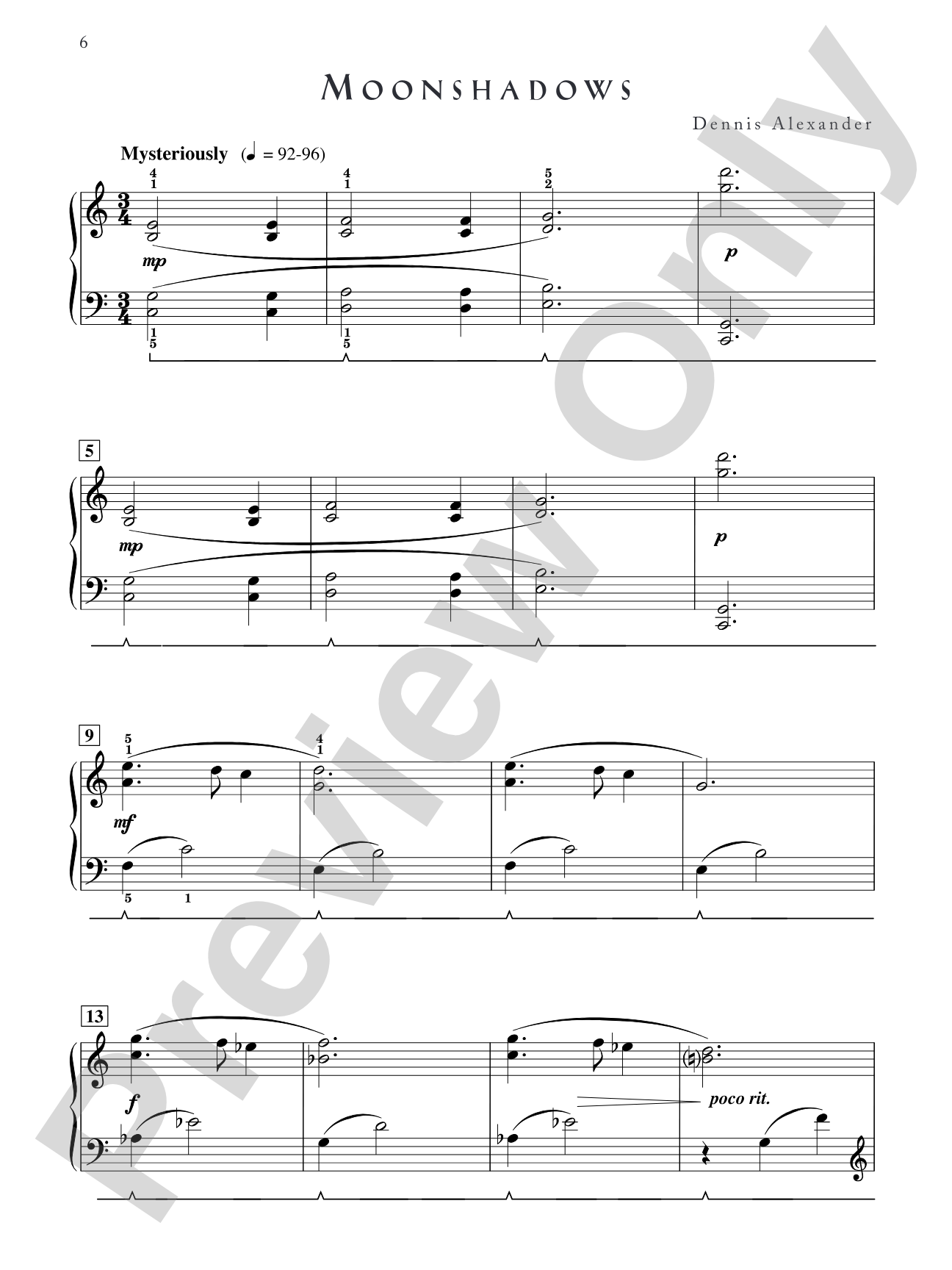

Moonshadows - Piano Solo: Piano Solo
7 Romantic Late Elementary Piano Solos
By Dennis Alexander
Level: Late Elementary
Item: 00-PS-0017477
$4.99
Pickup currently not available
Related Items
Arianna - Piano Solo: Piano Solo |
$4.99
|
View | |
Arioso in C - Piano Solo: Piano Solo |
$4.99
|
View | |
Cello Song - Piano Solo: Piano Solo |
$4.99
|
View | |
Falling Leaves - Piano Solo: Piano Solo |
$4.99
|
View | |
Snowscape - Piano Solo: Piano Solo |
$4.99
|
View | |
Soul Mates - Piano Solo: Piano Solo |
$5.99
|
View | |
Mr. "A" Presents First Lyric Pieces, Book 1: Piano Book |
$5.99
|
View |
Description
This collection is for teacher wanting to prepare students for the Romantic style early in the development of the student. Since no intervals larger than a 6th are used, these are good for small hands. Offers a lot of variety. Late elementary. A Federation Festivals 2024-2028 selection.


Moonshadows - Piano Solo: Piano Solo isn't in MakeMusic Cloud just yet...but it could be. Let us know you'd like to see it, and you'll help shape what comes next. In the meantime, start a free trial and dive into thousands of interactive titles your students can play along with today.
Request This Title
Tell us you want it.
Start Your Free Trial
Explore everything that's ready to play right now.
Sample Audio
No sample audio found.
Sample Video
No sample videos found.
Additional Details
Publisher:
Alfred Music
Page Count:
16
SKU:
00-PS-0017477
More about this title
About the Composer: Dennis Alexander

Dennis Alexander has shaped music education for decades through his prolific output as a composer and pedagogue. After teaching piano pedagogy at the University of Montana for 24 years, he moved to California where he continued faculty work at Cal State Fullerton and Cal State Northridge while maintaining a private studio. Now based in Albuquerque, Alexander remains deeply connected to the field through composition, clinician work at state and national conventions, and touring internationally.
With over 400 publications to his name since 1986, Alexander has built an international reputation as one of the most widely performed composers of educational piano music. His work reflects decades of experience understanding exactly what students need at each level of development. He earned his own training at the University of Kansas and has maintained an active performance life as a soloist, accompanist, and chamber musician throughout his career.
Why we love this
Alexander writes with the late elementary student in mind without condescension, and this collection proves it. The constraint of no intervals larger than a sixth feels intentional rather than limiting, creating compact musical statements that introduce Romantic sensibility without technical overreach. The variety across 16 pages means students encounter different moods and styles within one book, building a broader sense of musical language while staying within comfortable hand positions.
What to expect
These pieces carry the warmth and reflection of Romantic piano writing translated into a student's world. There's an emotional honesty to them, a sense that each piece has something genuine to say rather than serving purely as a technical exercise. The variety ensures students move between different characters and textures, discovering that the Romantic era isn't one mood but many.
Who it's for
Late elementary pianists ready to encounter compositional depth beyond folk melodies and rote exercises. Students whose hands are still small benefit from the absence of wide intervals. Teachers working with Federation Festival repertoire requirements will find a complete, varied solution in one book.
How to get the most out of it
- Attend to the harmonic language beneath the melody. These pieces use chromatic movement and voice leading typical of the Romantic era; listening for these shifts shapes phrasing.
- Observe tempo markings carefully. Alexander typically notates a specific character along with the tempo, and honoring both creates the intended mood.
- Experiment with pedal sparingly. Several pieces benefit from selective pedal use, but trial with your student will reveal which passages need it and which read more clearly without.
- Vary the dynamic landscape. Late elementary students often play evenly; these pieces reward shaping phrases with subtle crescendos and diminuendos.
How to use it
Anchor a studio recital with two or three selections that showcase different sides of the collection, giving students a cohesive program while keeping performance anxiety manageable. Mix these pieces into spring studio lessons when students are preparing for festivals, or use them as supplementary material throughout the year to build Romantic style vocabulary alongside a primary method book.
Skills your students will build
- Romantic period harmonic language and voice leading
- Pedal technique and when to apply it selectively
- Phrasing through dynamic shaping rather than tempo variation
- Hand position management within a sixth interval range
- Sight-reading confidence with varied tempos and character markings