
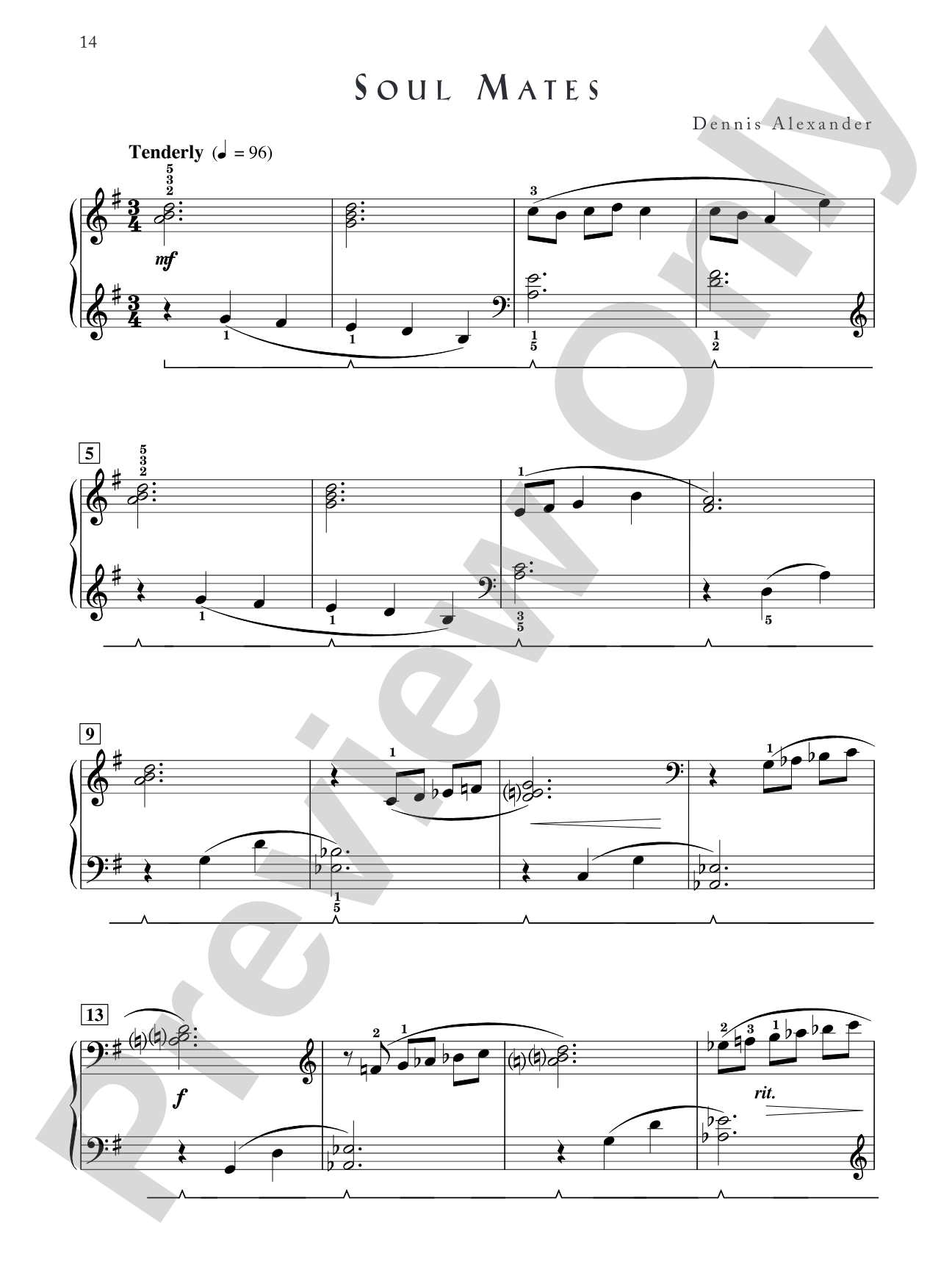

Soul Mates - Piano Solo: Piano Solo
7 Romantic Late Elementary Piano Solos
By Dennis Alexander
Level: Late Elementary
Item: 00-PS-0017479
$5.99
Pickup currently not available
Related Items
Arianna - Piano Solo: Piano Solo |
$4.99
|
View | |
Arioso in C - Piano Solo: Piano Solo |
$4.99
|
View | |
Cello Song - Piano Solo: Piano Solo |
$4.99
|
View | |
Falling Leaves - Piano Solo: Piano Solo |
$4.99
|
View | |
Moonshadows - Piano Solo: Piano Solo |
$4.99
|
View | |
Snowscape - Piano Solo: Piano Solo |
$4.99
|
View | |
Mr. "A" Presents First Lyric Pieces, Book 1: Piano Book |
$5.99
|
View |
Description
This collection is for teacher wanting to prepare students for the Romantic style early in the development of the student. Since no intervals larger than a 6th are used, these are good for small hands. Offers a lot of variety. Late elementary. A Federation Festivals 2024-2028 selection.


Soul Mates - Piano Solo: Piano Solo isn't in MakeMusic Cloud just yet...but it could be. Let us know you'd like to see it, and you'll help shape what comes next. In the meantime, start a free trial and dive into thousands of interactive titles your students can play along with today.
Request This Title
Tell us you want it.
Start Your Free Trial
Explore everything that's ready to play right now.
Sample Audio
No sample audio found.
Sample Video
No sample videos found.
Additional Details
Publisher:
Alfred Music
Page Count:
16
SKU:
00-PS-0017479
More about this title
About the Composer: Dennis Alexander

Dennis Alexander has spent decades shaping how students experience piano, with over 400 published works that demonstrate an intuitive understanding of what intermediate pianists need. After 24 years teaching piano pedagogy at the University of Montana, he moved to California and continued his work with university faculties while building a prolific composing career. Today based in Albuquerque, Alexander remains active as both a composer and touring clinician, having judged national competitions internationally and conducted master classes at MTNA conventions.
Alexander's reputation rests on his ability to write music that sounds like real music while respecting the physical and intellectual limits of developing hands. His work with Alfred Music Publishing since 1986 has made him one of the most widely performed educational composers in America, trusted by teachers who know that his pieces challenge students without frustrating them.
Why we love this
Alexander writes pieces that sound genuinely musical rather than like exercises, which keeps students motivated through the Romantic period transition. The restriction to intervals no larger than a sixth solves a real reach problem for this age without compromising harmonic richness, and the stylistic variety across 16 pages means you get multiple performance options from one book.
What to expect
Lyrical and expressive without being overwrought. These pieces capture the Romantic ear for beautiful melody and harmonic color while keeping the technical demands grounded in what young hands can manage.
Who it's for
Late elementary students whose hands are still small but whose musical minds are ready for genuine Romantic style. Teachers preparing students for festival play who need accessible repertoire that doesn't sound watered down.
How to get the most out of it
- Listen to recordings of Romantic-era pianists before your students tackle these pieces; hearing the style's characteristic rubato and vocal quality will inform their touch choices.
- Encourage students to identify the harmonic progressions that appear across different pieces in the collection; recognizing common patterns accelerates their understanding of Romantic idiom.
- Work on sustain pedal control with each piece, as Alexander's textures will reveal muddy playing immediately while rewarding careful pedal changes.
How to use it
Program individual pieces on recitals to show stylistic range within a single collection, or use the full set as a unit when teaching Romantic repertoire in sequence. The Federation Festivals selection status makes it ideal for students working toward competition performance.
Skills your students will build
- Reading and performing Romantic harmonic progressions (ii-V-I, iv-V-I cadences)
- Managing sustain pedal in pieces with varied textures and harmonic densities
- Interpreting rubato and phrasing appropriate to 19th-century song-like melodies
- Technical facility across the keyboard while respecting hand span limitations
- Understanding the stylistic difference between Baroque, Classical, and Romantic approaches to melody and accompaniment