
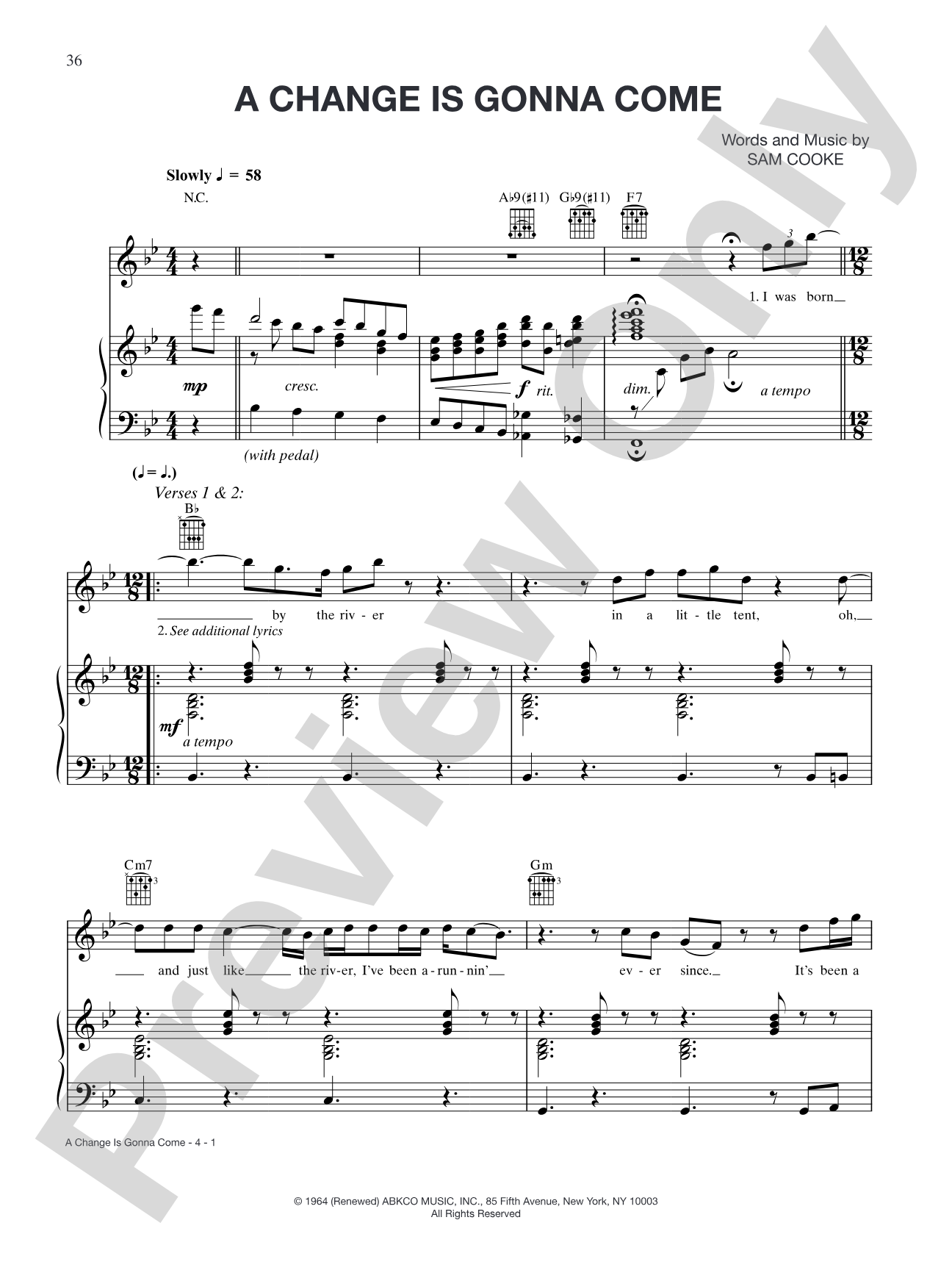

A Change is Gonna Come: Piano/Vocal/Chords
Ten Years of Popular Sheet Music Bestsellers
Item: 00-PS-0010898
$4.99
Pickup currently not available
Related Items
Batman Theme (from "Batman"): Piano/Vocal/Chords |
$4.99
|
View | |
Take Five: Piano/Vocal/Chords |
$4.99
|
View | |
She's a Rainbow: Piano/Vocal/Chords |
$5.99
|
View | |
Monster Mash: Piano/Vocal/Chords |
$5.99
|
View | |
(Your Love Has Lifted Me) Higher and Higher: Piano/Vocal/Chords |
$4.99
|
View | |
The Night They Drove Old Dixie Down: Piano/Vocal/Chords |
$4.99
|
View | |
Save the Last Dance for Me: Piano/Vocal/Chords |
$4.99
|
View | |
You Can't Always Get What You Want: Piano/Vocal/Chords |
$9.99
|
View | |
96 Tears: Piano/Vocal/Chords |
$5.99
|
View | |
Sweet Soul Music: Piano/Vocal/Chords |
$4.99
|
View | |
Aquarius/Let the Sunshine In (from "Hair"): Piano/Vocal/Chords |
$5.99
|
View |
Description
This songbook contains more than 50 of the biggest hits of the '60s. Each song is sure to spark a memory or create a new one for pianists or vocalists of all ages. For practice, performance, or pleasure, play and sing your way through your favorite decade in pop music history! Titles: All Along the Watchtower (Jimi Hendrix) * Aquarius/Let the Sunshine In (5th Dimension) * Ballad of Gilligan's Isle (from Gilligan's Island) * Batman Theme (from Batman) * Blowin' in the Wind (Bob Dylan) * Both Sides Now (Joni Mitchell) * A Change Is Gonna Come (Sam Cooke) * Don't Rain on My Parade (Barbra Streisand) * Dream a Little Dream of Me (The Mamas & The Papas) * Everyday People (Sly & the Family Stone) * For What It's Worth (Buffalo Springfield) * Gimme Some Lovin' (The Spencer Davis Group) * Gloria (Van Morrison) * Higher and Higher (Your Love Keeps Lifting Me) (Jackie Wilson) * Hit the Road Jack (Ray Charles) * Hot Fun in the Summertime (Sly & the Family Stone) * It's My Party (Leslie Gore) * The Jetsons (Main Theme) (from The Jetsons) * Leaving on a Jet Plane (Peter, Paul and Mary) * Like a Rolling Stone (Bob Dylan) * The Lion Sleeps Tonight (The Tokens) * Mack the Knife (Bobby Darin) * Mama Told Me Not to Come (Three Dog Night) * (Meet) The Flintstones (from The Flintstones) * Monster Mash (Bobby Pickett) * Mustang Sally (Wilson Pickett) * Na Na Hey Hey Kiss Him Goodbye (Steam) * The Night They Drove Old Dixie Down (The Band) * One (Three Dog Night) * People (Barbra Streisand) * People Get Ready (Impressions) * Piece of My Heart (Big Brother and the Holding Company) * Pink Panther (Henry Mancini) * Puff the Magic Dragon (Peter, Paul and Mary) * Raindrops Keep Fallin' on My Head (B.J. Thomas) * Save the Last Dance for Me (The Drifters) * She's a Rainbow (The Rolling Stones) * Soul Man (Sam and Dave) * Sound of Silence (Simon and Garfunkel) * Sunny Afternoon (The Kinks) * Sunshine of Your Love (Cream) * Sweet Soul Music (Arthur Conley) * Take Five (Dave Brubeck Quartet) * The Weight (The Band) * Theme from A Summer Place (Percy Faith and His Orchestra) * (What a) Wonderful World (Sam Cooke) * What a Wonderful World (Louis Armstrong) * What'd I Say (Ray Charles) * When a Man Loves a Woman (Percy Sledge) * White Room (Cream) * A Whiter Shade of Pale (Procol Harum) * Wipe Out (The Surfaris) * You Can't Always Get What You Want (The Rolling Stones) * You Don't Have to Say You Love Me (Dusty Springfield).


A Change is Gonna Come: Piano/Vocal/Chords isn't in MakeMusic Cloud just yet...but it could be. Let us know you'd like to see it, and you'll help shape what comes next. In the meantime, start a free trial and dive into thousands of interactive titles your students can play along with today.
Request This Title
Tell us you want it.
Start Your Free Trial
Explore everything that's ready to play right now.
Sample Audio
No sample audio found.
Sample Video
No sample videos found.
Additional Details
Series:
Decade by Decade
Publisher:
Alfred Music
Page Count:
240
SKU:
00-PS-0010898
More about this title
About the Composer: Sam Cooke
Sam Cooke's influence on American popular music runs deeper than most realize. Born in Mississippi and raised in Chicago, he bridged gospel traditions with secular songwriting in ways that shaped soul, R&B, and pop for generations. His compositions became anthems for social consciousness while remaining accessible to mainstream audiences, a balance that few artists have ever achieved.
For music educators, Cooke's work matters because it demonstrates how strong melodic writing and authentic emotional expression can coexist with broad appeal. His songs invite singers of all ages into meaningful material without condescension, and his harmonic language rewards thoughtful interpretation.
Why we love this
This collection captures the sonic and cultural heartbeat of an era when popular music was genuinely diverse, socially conscious, and built on strong melodies that stick with listeners for decades. You get protest songs, TV themes, soul standards, and novelty hits all in one book, which means your students encounter the full range of what '60s songwriting actually was, not a sanitized version. The variety ensures there's something that will resonate with performers of different tastes and technical levels.
What to expect
Stepping into this songbook feels like turning on a jukebox from 1960 to 1969 and discovering that the music still carries the energy and emotion that made it stick around. You'll encounter everything from gospel-inflected soul to psychedelic rock to wistful ballads, all arranged so you can sing or play them with immediate expressiveness and minimal frustration.
Who it's for
Pianists and vocalists (including singer-pianists) who want to perform familiar, substantive pop repertoire from a transformative decade. Whether you're preparing for a recital, running a social gathering, or simply enjoying songs that defined a generation, this book offers accessible arrangements of well-crafted material.
How to get the most out of it
- Attend to the chord symbols carefully; many songs in this collection use straightforward harmonic progressions, but getting the voicing right on piano makes the difference between adequate and authentic.
- Balance melody and accompaniment according to context. When you're singing a lead vocal, keep the piano arrangement supportive rather than ornate; when you're playing solo, you have room to voice chords more richly.
- Use the original recordings as reference material, not as a mandate for tempo or style. You'll find that many of these songs work beautifully at different speeds and with different rhythmic feels.
How to use it
Use this collection as a source of encores, recital fillers, and repertoire for mixed-age performances where generational appeal matters. You might also draw from it for a thematic concert exploring a single decade, or dip into it when you need material that both serious musicians and casual listeners will recognize and enjoy.
Skills your students will build
- Reading piano/vocal scores with chord symbols
- Interpreting chord voicings and realizing figured harmony on keyboard
- Balancing sung melody with keyboard accompaniment
- Understanding song form and phrase structure in popular music
- Stylistic interpretation across multiple genres within a single era