
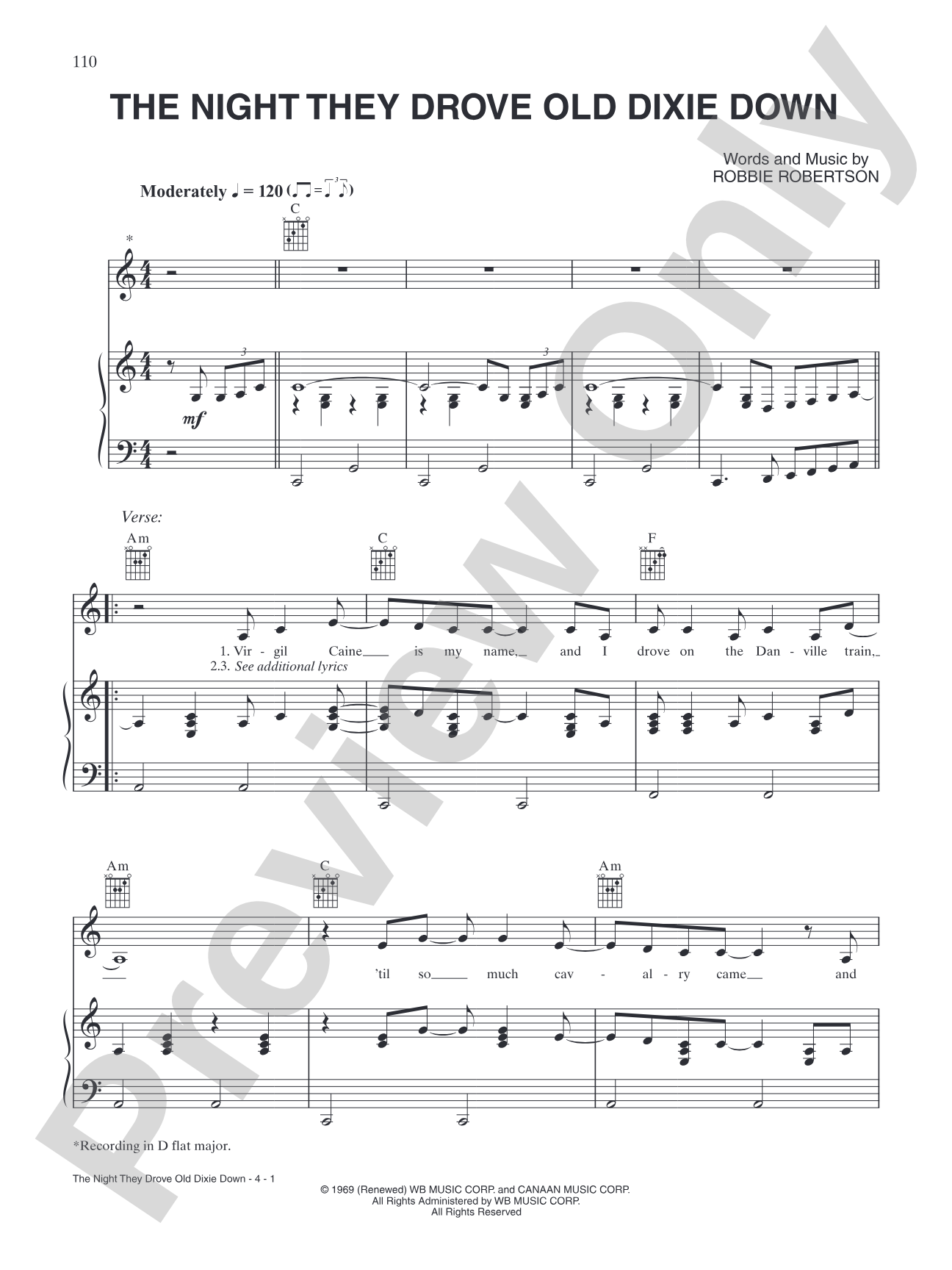

The Night They Drove Old Dixie Down: Piano/Vocal/Chords
Ten Years of Popular Sheet Music Bestsellers
Item: 00-PS-0010851
$4.99
One moment…
Related Items
Batman Theme (from "Batman"): Piano/Vocal/Chords |
$4.99
|
View | |
Take Five: Piano/Vocal/Chords |
$4.99
|
View | |
She's a Rainbow: Piano/Vocal/Chords |
$5.99
|
View | |
Monster Mash: Piano/Vocal/Chords |
$5.99
|
View | |
(Your Love Has Lifted Me) Higher and Higher: Piano/Vocal/Chords |
$4.99
|
View | |
Save the Last Dance for Me: Piano/Vocal/Chords |
$4.99
|
View | |
You Can't Always Get What You Want: Piano/Vocal/Chords |
$9.99
|
View | |
A Change is Gonna Come: Piano/Vocal/Chords |
$4.99
|
View | |
96 Tears: Piano/Vocal/Chords |
$5.99
|
View | |
Sweet Soul Music: Piano/Vocal/Chords |
$4.99
|
View | |
Aquarius/Let the Sunshine In (from "Hair"): Piano/Vocal/Chords |
$5.99
|
View |
Description
This songbook contains more than 50 of the biggest hits of the '60s. Each song is sure to spark a memory or create a new one for pianists or vocalists of all ages. For practice, performance, or pleasure, play and sing your way through your favorite decade in pop music history! Titles: All Along the Watchtower (Jimi Hendrix) * Aquarius/Let the Sunshine In (5th Dimension) * Ballad of Gilligan's Isle (from Gilligan's Island) * Batman Theme (from Batman) * Blowin' in the Wind (Bob Dylan) * Both Sides Now (Joni Mitchell) * A Change Is Gonna Come (Sam Cooke) * Don't Rain on My Parade (Barbra Streisand) * Dream a Little Dream of Me (The Mamas & The Papas) * Everyday People (Sly & the Family Stone) * For What It's Worth (Buffalo Springfield) * Gimme Some Lovin' (The Spencer Davis Group) * Gloria (Van Morrison) * Higher and Higher (Your Love Keeps Lifting Me) (Jackie Wilson) * Hit the Road Jack (Ray Charles) * Hot Fun in the Summertime (Sly & the Family Stone) * It's My Party (Leslie Gore) * The Jetsons (Main Theme) (from The Jetsons) * Leaving on a Jet Plane (Peter, Paul and Mary) * Like a Rolling Stone (Bob Dylan) * The Lion Sleeps Tonight (The Tokens) * Mack the Knife (Bobby Darin) * Mama Told Me Not to Come (Three Dog Night) * (Meet) The Flintstones (from The Flintstones) * Monster Mash (Bobby Pickett) * Mustang Sally (Wilson Pickett) * Na Na Hey Hey Kiss Him Goodbye (Steam) * The Night They Drove Old Dixie Down (The Band) * One (Three Dog Night) * People (Barbra Streisand) * People Get Ready (Impressions) * Piece of My Heart (Big Brother and the Holding Company) * Pink Panther (Henry Mancini) * Puff the Magic Dragon (Peter, Paul and Mary) * Raindrops Keep Fallin' on My Head (B.J. Thomas) * Save the Last Dance for Me (The Drifters) * She's a Rainbow (The Rolling Stones) * Soul Man (Sam and Dave) * Sound of Silence (Simon and Garfunkel) * Sunny Afternoon (The Kinks) * Sunshine of Your Love (Cream) * Sweet Soul Music (Arthur Conley) * Take Five (Dave Brubeck Quartet) * The Weight (The Band) * Theme from A Summer Place (Percy Faith and His Orchestra) * (What a) Wonderful World (Sam Cooke) * What a Wonderful World (Louis Armstrong) * What'd I Say (Ray Charles) * When a Man Loves a Woman (Percy Sledge) * White Room (Cream) * A Whiter Shade of Pale (Procol Harum) * Wipe Out (The Surfaris) * You Can't Always Get What You Want (The Rolling Stones) * You Don't Have to Say You Love Me (Dusty Springfield).


Discover MakeMusic Cloud: thousands of interactive titles your students can play along with today.
Sample Audio
No sample audio found.
Sample Video
No sample videos found.
Additional Details
Series:
Decade by Decade
Publisher:
Alfred Music
Page Count:
240
SKU:
00-PS-0010851
More about this title
About the Composer: Robbie Robertson
Robbie Robertson is best known as the primary songwriter and guitarist for The Band, the influential rock group that emerged from the Canadian music scene in the late 1960s. His compositions blend Americana, folk, and rock traditions with literary storytelling, creating music that has resonated across generations of musicians and listeners.
Why we love this
This collection captures the authentic energy of 1960s popular music through arrangements that work equally well for solo piano practice, vocal rehearsal, or ensemble performance. The variety spans folk, soul, rock, and novelty numbers, giving you genuine flexibility in how you program and teach from a single resource.
What to expect
Opening this book feels like stepping into a cultural moment where rock and roll, soul, and folk were reshaping popular music. The songs carry the optimism, restlessness, and humor of the decade, from the protest anthems and introspective ballads to the infectious novelty numbers and television themes that defined the era's soundtrack.
Who it's for
This collection serves pianists and singers at the early intermediate level and above who want a curated set of genuine 1960s hits ready for recital, casual performance, or personal enjoyment. It's equally valuable for music teachers building repertoire that appeals to students across age ranges and for ensemble musicians seeking material that bridges classical training with popular music fluency.
How to get the most out of it
- Study the chord symbols carefully; this era's harmony often moves quickly between keys, and understanding the progression will anchor your improvisation and accompaniment choices.
- Pay attention to the vocal melody's relationship to the piano part. Many of these songs feature rhythmic interplay between voice and accompaniment that drives the groove; play through several times without singing to lock the feel.
- Consider the era's production style when shaping dynamics and tempo. Songs like 'Monster Mash' and 'Na Na Hey Hey Kiss Him Goodbye' benefit from the playful, slightly tongue-in-cheek delivery of their originals.
- Use the chord voicings as a starting point rather than a limitation. The 1960s allowed room for tasteful reharmonization; experimenting with voice leading can reveal new interpretations of familiar melodies.
How to use it
Weave individual selections throughout a year of recitals to create themed programs around the 1960s or to balance classical repertoire with music students recognize from film, television, and cultural history. This collection also works well for community concerts where mixed audiences respond to familiar melodies, or as a resource for sight-reading practice that keeps students engaged because the material matters to them.
Skills your students will build
- Reading and interpreting chord symbols in various harmonic contexts
- Singing or playing melody with rhythmic precision in styles ranging from ballad to uptempo groove
- Coordinating vocal phrasing with piano accompaniment patterns
- Understanding typical song structures of the 1960s (verse-chorus, bridge, outro)
- Improvising and voicing chords beyond the written notation
- Sight-reading across a wide range of musical styles and song forms