
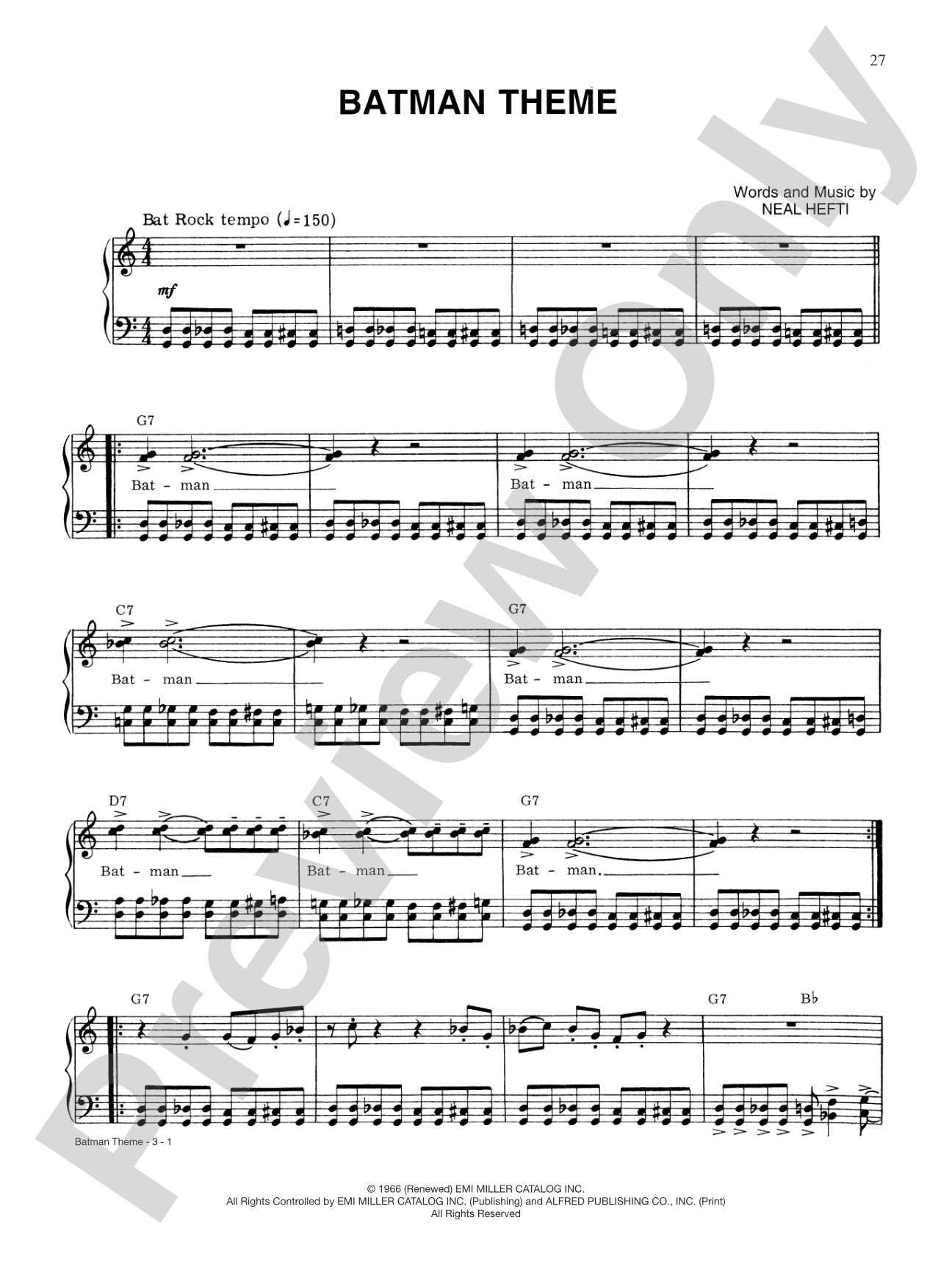

Batman Theme (from "Batman"): Piano/Vocal/Chords
Ten Years of Popular Sheet Music Bestsellers
Item: 00-PS-0010785
$4.99
One moment…
Related Items
Take Five: Piano/Vocal/Chords |
$4.99
|
View | |
She's a Rainbow: Piano/Vocal/Chords |
$5.99
|
View | |
Monster Mash: Piano/Vocal/Chords |
$5.99
|
View | |
(Your Love Has Lifted Me) Higher and Higher: Piano/Vocal/Chords |
$4.99
|
View | |
The Night They Drove Old Dixie Down: Piano/Vocal/Chords |
$4.99
|
View | |
Save the Last Dance for Me: Piano/Vocal/Chords |
$4.99
|
View | |
You Can't Always Get What You Want: Piano/Vocal/Chords |
$9.99
|
View | |
A Change is Gonna Come: Piano/Vocal/Chords |
$4.99
|
View | |
96 Tears: Piano/Vocal/Chords |
$5.99
|
View | |
Sweet Soul Music: Piano/Vocal/Chords |
$4.99
|
View | |
Aquarius/Let the Sunshine In (from "Hair"): Piano/Vocal/Chords |
$5.99
|
View |
Description
This songbook contains more than 50 of the biggest hits of the '60s. Each song is sure to spark a memory or create a new one for pianists or vocalists of all ages. For practice, performance, or pleasure, play and sing your way through your favorite decade in pop music history! Titles: All Along the Watchtower (Jimi Hendrix) * Aquarius/Let the Sunshine In (5th Dimension) * Ballad of Gilligan's Isle (from Gilligan's Island) * Batman Theme (from Batman) * Blowin' in the Wind (Bob Dylan) * Both Sides Now (Joni Mitchell) * A Change Is Gonna Come (Sam Cooke) * Don't Rain on My Parade (Barbra Streisand) * Dream a Little Dream of Me (The Mamas & The Papas) * Everyday People (Sly & the Family Stone) * For What It's Worth (Buffalo Springfield) * Gimme Some Lovin' (The Spencer Davis Group) * Gloria (Van Morrison) * Higher and Higher (Your Love Keeps Lifting Me) (Jackie Wilson) * Hit the Road Jack (Ray Charles) * Hot Fun in the Summertime (Sly & the Family Stone) * It's My Party (Leslie Gore) * The Jetsons (Main Theme) (from The Jetsons) * Leaving on a Jet Plane (Peter, Paul and Mary) * Like a Rolling Stone (Bob Dylan) * The Lion Sleeps Tonight (The Tokens) * Mack the Knife (Bobby Darin) * Mama Told Me Not to Come (Three Dog Night) * (Meet) The Flintstones (from The Flintstones) * Monster Mash (Bobby Pickett) * Mustang Sally (Wilson Pickett) * Na Na Hey Hey Kiss Him Goodbye (Steam) * The Night They Drove Old Dixie Down (The Band) * One (Three Dog Night) * People (Barbra Streisand) * People Get Ready (Impressions) * Piece of My Heart (Big Brother and the Holding Company) * Pink Panther (Henry Mancini) * Puff the Magic Dragon (Peter, Paul and Mary) * Raindrops Keep Fallin' on My Head (B.J. Thomas) * Save the Last Dance for Me (The Drifters) * She's a Rainbow (The Rolling Stones) * Soul Man (Sam and Dave) * Sound of Silence (Simon and Garfunkel) * Sunny Afternoon (The Kinks) * Sunshine of Your Love (Cream) * Sweet Soul Music (Arthur Conley) * Take Five (Dave Brubeck Quartet) * The Weight (The Band) * Theme from A Summer Place (Percy Faith and His Orchestra) * (What a) Wonderful World (Sam Cooke) * What a Wonderful World (Louis Armstrong) * What'd I Say (Ray Charles) * When a Man Loves a Woman (Percy Sledge) * White Room (Cream) * A Whiter Shade of Pale (Procol Harum) * Wipe Out (The Surfaris) * You Can't Always Get What You Want (The Rolling Stones) * You Don't Have to Say You Love Me (Dusty Springfield).


Discover MakeMusic Cloud: thousands of interactive titles your students can play along with today.
Sample Audio
No sample audio found.
Sample Video
No sample videos found.
Additional Details
Series:
Decade by Decade
Publisher:
Alfred Music
Page Count:
240
SKU:
00-PS-0010785
More about this title
About the Composer: Neal Hefti
Neal Hefti (1922–2002) composed and arranged for film and television during Hollywood's golden age. His work defined the sonic identity of 1960s pop culture, creating instantly recognizable themes that became cultural touchstones for generations of viewers.
Hefti's gift for memorable melody and sophisticated orchestration made him a sought-after composer for both dramatic moments and comedic underscore. His Batman theme, in particular, became synonymous with the campy energy of the 1960s television series and remains one of the most recognizable television themes ever written.
Why we love this
This collection captures the Batman theme alongside 50 other defining moments from 1960s popular music, giving pianists and singers access to material that generations recognize instantly. The arrangement provides full chord symbols and vocal melody, making it equally valuable for solo practice, duet performance, or informal ensemble singing. Programming a piece like the Batman theme creates immediate audience connection and reminds students that popular music deserves the same musical engagement as classical repertoire.
What to expect
The Batman theme pulses with the infectious energy and theatrical swagger of 1960s television. The driving rhythm and bold, simple melody create an immediate sense of adventure and fun, even for musicians encountering it for the first time.
Who it's for
This arrangement works for pianists and singers preparing solos or duets for recitals, informal performances, or classroom showcases. It's equally suited to adult students reconnecting with music they love and younger musicians building confidence through recognizable material.
How to get the most out of it
- Anchor the iconic four-note motive with rhythmic precision and slight emphasis; this is what listeners expect, and clarity here makes everything else land.
- Balance the vocal line prominently against the piano accompaniment, especially during the main theme statement, so the melodic hook cuts through.
- Vary dynamics between verses and the main theme to prevent monotony over a piece this repetitive in structure.
- Treat chord symbols as a starting point rather than gospel; experiment with voicings that match the energy level you want to convey, from straightforward and clean to thicker and more orchestral.
How to use it
Slot this into a pop standards concert or a "Music from Television" themed recital to create tonal contrast with classical selections. Its instantly recognizable melody makes it an excellent choice for engaging younger audience members or for a lighthearted finale.
Skills your students will build
- Reading chord symbols and voicing changes in real time
- Balancing melody and accompaniment as a pianist-vocalist team
- Interpreting repetitive musical material with expressive variation
- Adapting popular music arrangements to performance context and ensemble size