
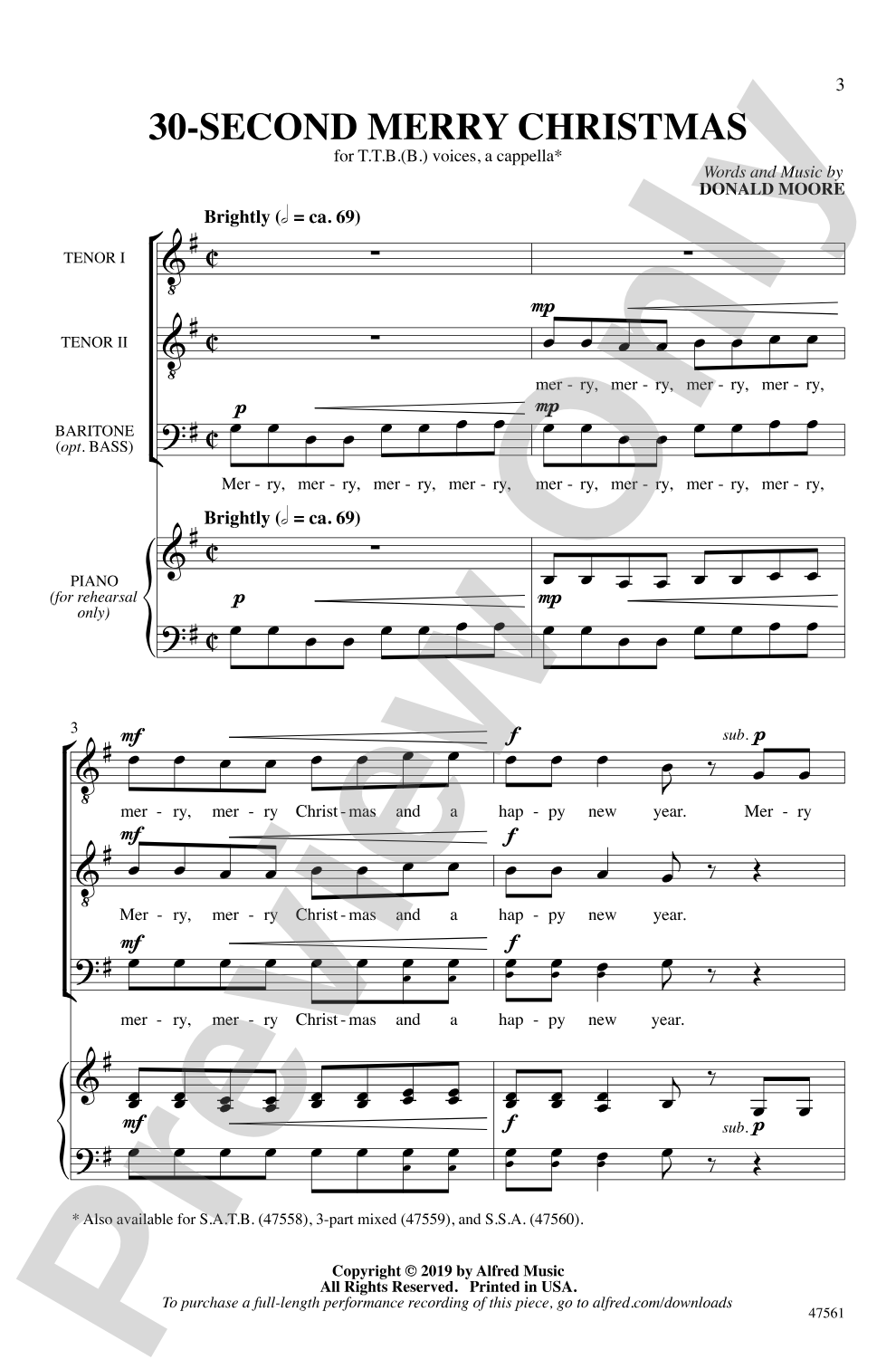

30-Second Merry Christmas: TTB(B), a cappella Choral Octavo
Words and music by Donald Moore
Item: 00-PO-0005932

$2.05
Minimum order quantity: 20 copies
Pickup currently not available
Related Items
30-Second Merry Christmas: SATB, a cappella Choral Octavo |
$2.05
|
View | |
30-Second Merry Christmas: 3-Part Mixed, a cappella Choral Octavo |
$2.05
|
View | |
30-Second Merry Christmas: SSA, a cappella Choral Octavo |
$2.05
|
View | |
30-Second Merry Christmas: SATB, a cappella Choral Octavo |
$2.05
|
View | |
30-Second Merry Christmas: 3-Part Mixed, a cappella Choral Octavo |
$2.05
|
View | |
30-Second Merry Christmas: SSA, a cappella Choral Octavo |
$2.05
|
View | |
30-Second Merry Christmas: TTB(B), a cappella Choral Octavo |
$2.05
|
View |
Description
Wish your audience a “Merry Christmas and a Happy New Year” in just a half a minute. This madrigal-style a cappella novelty is equally easy to learn and enjoyable to sing. Plus, it's a great choice for any seasonal performance: Christmas concerts, community events, madrigal feasts, door-to-door caroling, singing telegrams---you name it! Fun, flexible, and festive in all voicings.


Don't just read it, hear it, play along with it, and watch your students grow with it. In MakeMusic Cloud, 30-Second Merry Christmas: TTB(B), a cappella Choral Octavo comes alive with professional accompaniment, adjustable tempo, and built-in practice tools that turn solo practice into real progress.
Open in the Player
Jump straight in and assign it today.
Start Your Free Trial
Open this title and explore the full library in minutes.
Sample Audio
1
Audio File
--:--
0:00
0:00
Sample Video
No sample videos found.
Additional Details
Series:
Alfred Choral Designs
Publisher:
Alfred Music
Page Count:
8
SKU:
00-PO-0005932
More about this title
About the Composer: Donald Moore

Donald Moore earned his Bachelor of Music in organ performance and Master of Arts in Teaching from Kent State University. He currently serves as Organist-Choirmaster at Pilgrim United Church of Christ in Cuyahoga Falls, Ohio, and has established himself as a prolific voice in American choral music with over 500 published compositions across sacred, secular, educational, and popular genres.
Moore's work appears regularly at state contests, festivals, and music conventions nationwide. The American Choral Directors Association recognized him among 400 elite composers of historical significance in American choral music. He is a seventeen-time recipient of the ASCAP Composers Standard Award and publishes through Alfred Music Publishing, Hal Leonard, Heritage Music Press, and other major houses.
Why we love this
Thirty seconds of pure holiday charm without the rehearsal burden. Moore crafts genuine musical wit here—the madrigal style keeps singers engaged with independent lines rather than block harmony, and the flexible voicing means you can perform it with whoever shows up, whether that's three voices or four. It's the rare novelty that works equally well at a formal holiday concert, a community caroling event, or a madrigal feast.
What to expect
Festive and clever. The madrigal idiom gives this novelty a touch of sophistication and playfulness that elevates it beyond simple caroling while keeping the mood light and fun. It moves with holiday warmth and a knowing wink to the audience.
Who it's for
Choirs at every level, from high school through community and church ensembles, will find this approachable and rewarding. It works equally well for singers who read music fluently and those still building confidence, since the madrigal style and short form make it learnable quickly without feeling simplified.
How to get the most out of it
- Balance the individual melodic lines by having singers listen across parts rather than locking into their own line; the madrigal texture only works when all voices are present and moving together.
- Keep the tempo brisk and the text clear; these thirty seconds disappear if the piece sags, so maintain forward motion and articulate the holiday greeting crisply.
- Use the flexibility in voicing to your advantage by assigning parts based on your available singers rather than forcing a standard SATB lineup into an unfamiliar arrangement.
How to use it
Tuck this into the closing moments of a Christmas concert as a bridge between your main repertoire and the final carol; audiences love the brevity and humor when they're expecting something more substantial. It also shines as a standalone moment at holiday community events, madrigal dinners, or any performance where you need something festive, brief, and memorable that won't require weeks of rehearsal.
Skills your students will build
- Independent singing of individual melodic lines within madrigal texture
- Unaccompanied ensemble balance and intonation
- Reading music across multiple voicing options (TB, TTB, TBB, TTBB)
- Diction clarity and holiday text projection in a cappella setting