
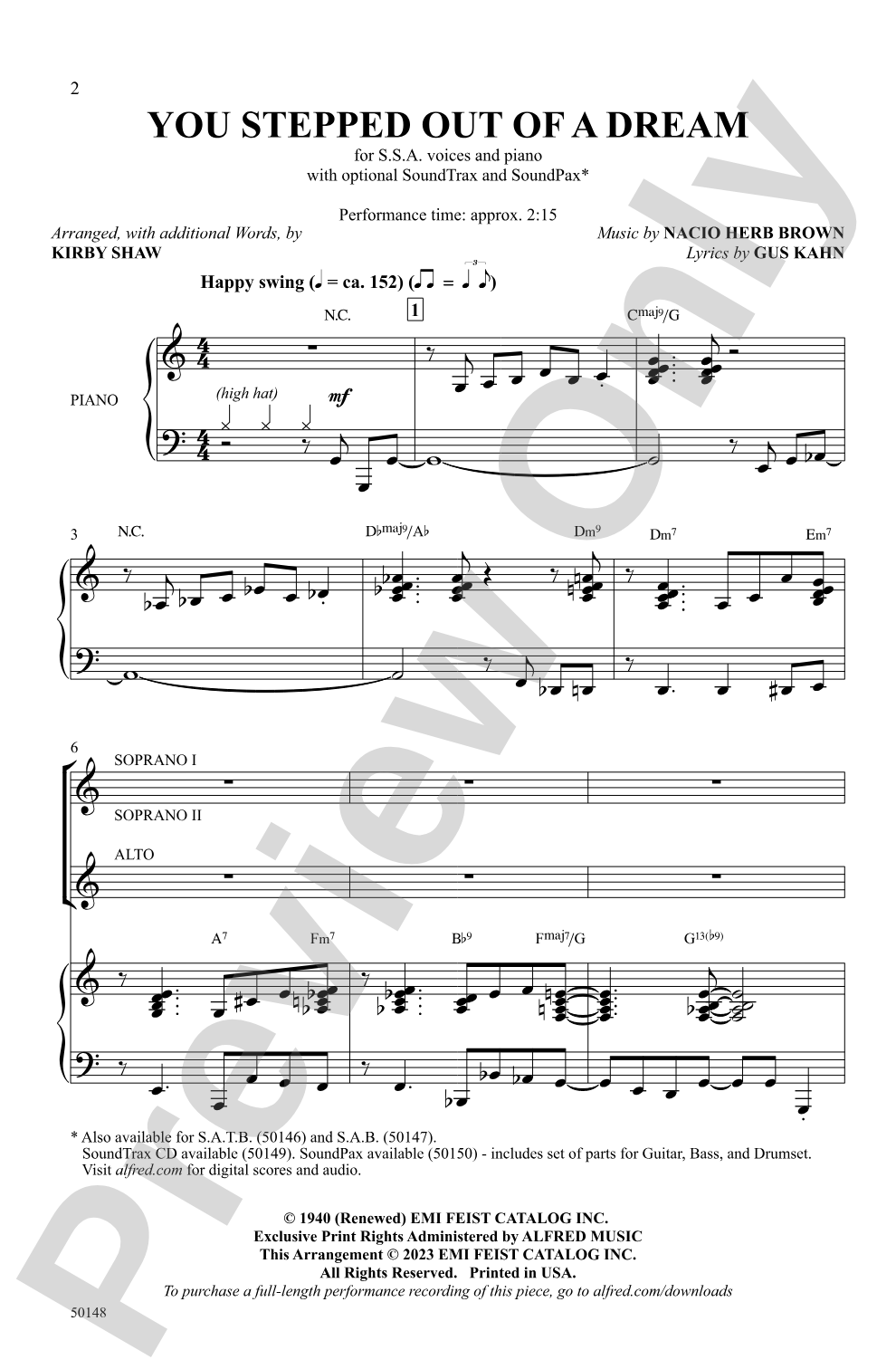
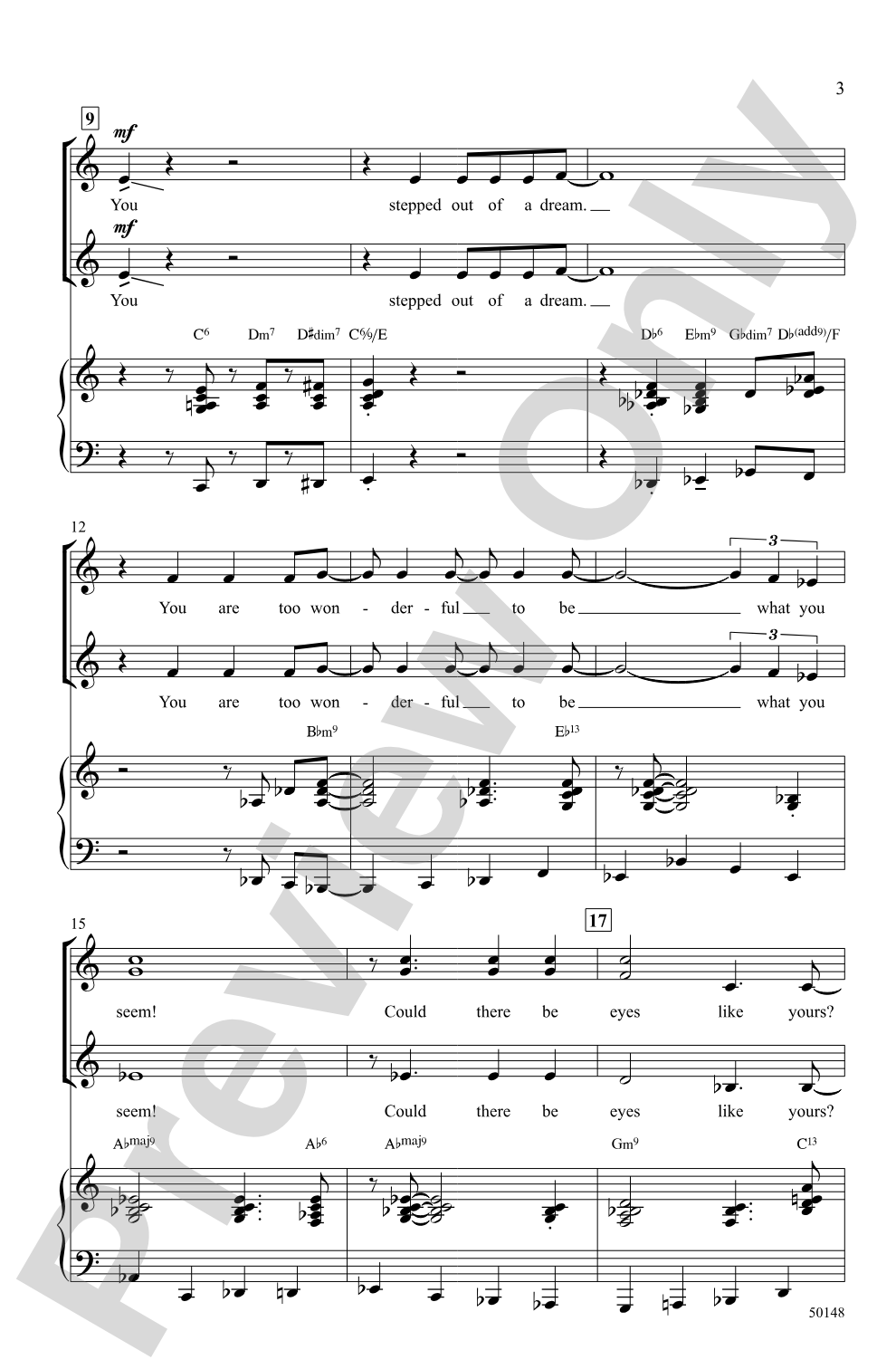

You Stepped Out of a Dream: SSA Choral Octavo
Music by Nacio Herb Brown, lyrics by Gus Kahn / arr. with additional words, by Kirby Shaw
Item: 00-PO-0007024
$2.10
Minimum order quantity: 20 copies
One moment…
Related Items
You Stepped Out of a Dream: SoundTrax Digital Audio Download |
$29.98
|
View | |
You Stepped Out of a Dream: SATB Choral Octavo |
$2.10
|
View | |
You Stepped Out of a Dream: SAB Choral Octavo |
$2.10
|
View | |
You Stepped Out of a Dream: Choral SoundPax |
$15.00
|
View | |
You Stepped Out of a Dream: SATB Choral Octavo |
$2.10
|
View | |
You Stepped Out of a Dream: SAB Choral Octavo |
$2.10
|
View | |
You Stepped Out of a Dream: SSA Choral Octavo |
$2.10
|
View | |
You Stepped Out of a Dream: Choral Octavo SoundTrax CD |
$29.99
|
View | |
You Stepped Out of a Dream: Choral SoundPax |
$15.00
|
View |
Description
A Great American Songbook standard famously recorded by Nat King Cole. With tight stylistic sonorities, a lively swing feel, and Kirby's signature scat singing, this arrangement is a dream come true for vocal jazz groups. An optional SoundPax includes parts for guitar, bass, and drums.


You Stepped Out of a Dream: SSA Choral Octavo isn't in MakeMusic Cloud just yet...but it could be. Let us know you'd like to see it, and you'll help shape what comes next. In the meantime, start a free trial and dive into thousands of interactive titles your students can play along with today.
Request This Title
Tell us you want it.
Start Your Free Trial
Explore everything that's ready to play right now.
Sample Audio
1
Audio File
--:--
0:00
0:00
Sample Video
Additional Details
Series:
Alfred Pop Choral Series
Publisher:
Alfred Music
Page Count:
12
SKU:
00-PO-0007024
More about this title
About the Composer: Nacio Herb Brown
Nacio Herb Brown composed some of the most enduring standards of the 1930s and 1940s, writing songs that became synonymous with Hollywood's Golden Age. His collaborations with lyricist Arthur Freed produced iconic tunes that have remained central to jazz and popular music repertoire for nearly a century.
Brown's gift for melody and his understanding of what makes a song singable made his work ideal for adaptation across genres. Educators and directors return to his compositions because they sit naturally in the voice, swing with elegance, and carry the warmth that defines the Great American Songbook.
Why we love this
Kirby Shaw's arrangement captures the essence of what made Cole's recording legendary while tailoring it specifically for treble voices. The writing stays true to the swing idiom without overwhelming younger or less experienced singers; the optional instrumental parts (SoundPax) give your ensemble the full combo sound without requiring a pianist to carry the rhythm section.
What to expect
A sophisticated night out wrapped in warmth and humor. The scat singing and swing rhythms create energy and playfulness, while the harmonic language keeps things elegant and polished. Singing this feels like stepping into a 1950s jazz club, but with the comfort of a beloved standard that audiences recognize immediately.
Who it's for
Choral directors working with SSA or SSAA groups who want to teach swing style and vocal jazz techniques in an approachable, joyful context. This arrangement works for high school jazz choirs, college treble ensembles, and community groups looking to program something familiar yet musically substantial.
How to get the most out of it
- Nail the rhythmic precision in the scat passage. The swing feel depends entirely on locked ensemble attacks; mark those entrances in rehearsal and drill them separately from the melodic line.
- Balance the lead voice against the harmonic backgrounds. The scat singing needs clarity to land its humor and style, so ensure your soloists aren't buried under block voicing.
- If using the SoundPax parts, run at least one full rehearsal with the recorded accompaniment or live instruments before performing. The groove shifts dramatically with that rhythm section underneath.
- Shape the phrasing around Cole's recordings. Listen to his interpretation together as an ensemble; understanding his approach to rubato and timing will unlock the swing feel your arrangement requires.
How to use it
Program this as a standalone feature that showcases your group's ability to swing and interpret jazz idiom, or pair it with other Great American Songbook standards to build a cohesive set. It works equally well as a concert opener that establishes style and energy or as a closer that leaves audiences smiling.
Skills your students will build
- Swing rhythm and jazz phrasing
- Scat singing articulation and precision
- Blend and balance in small-section harmony
- Listening to and interpreting recorded vocal models
- Coordination with instrumental accompaniment