
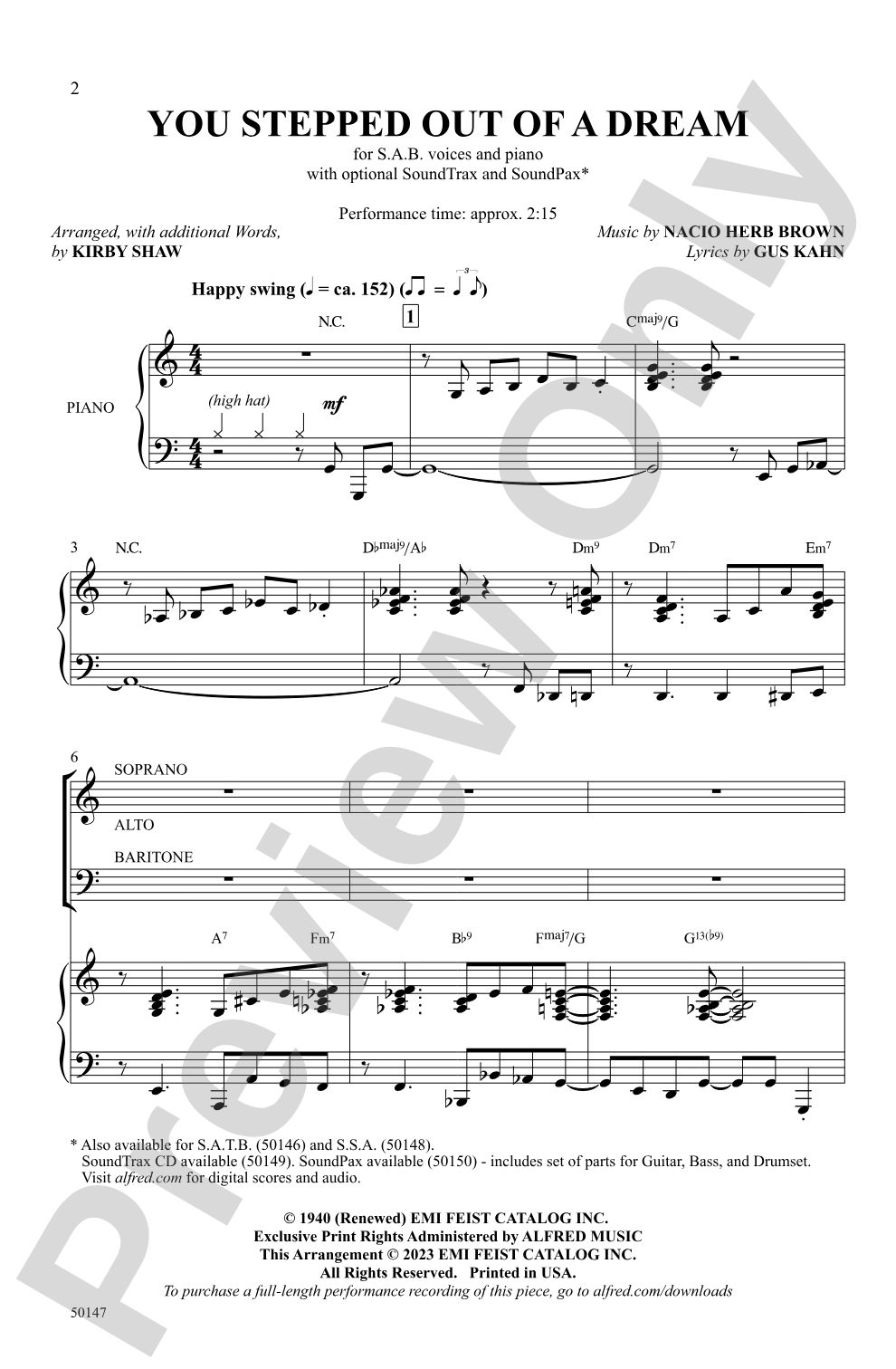
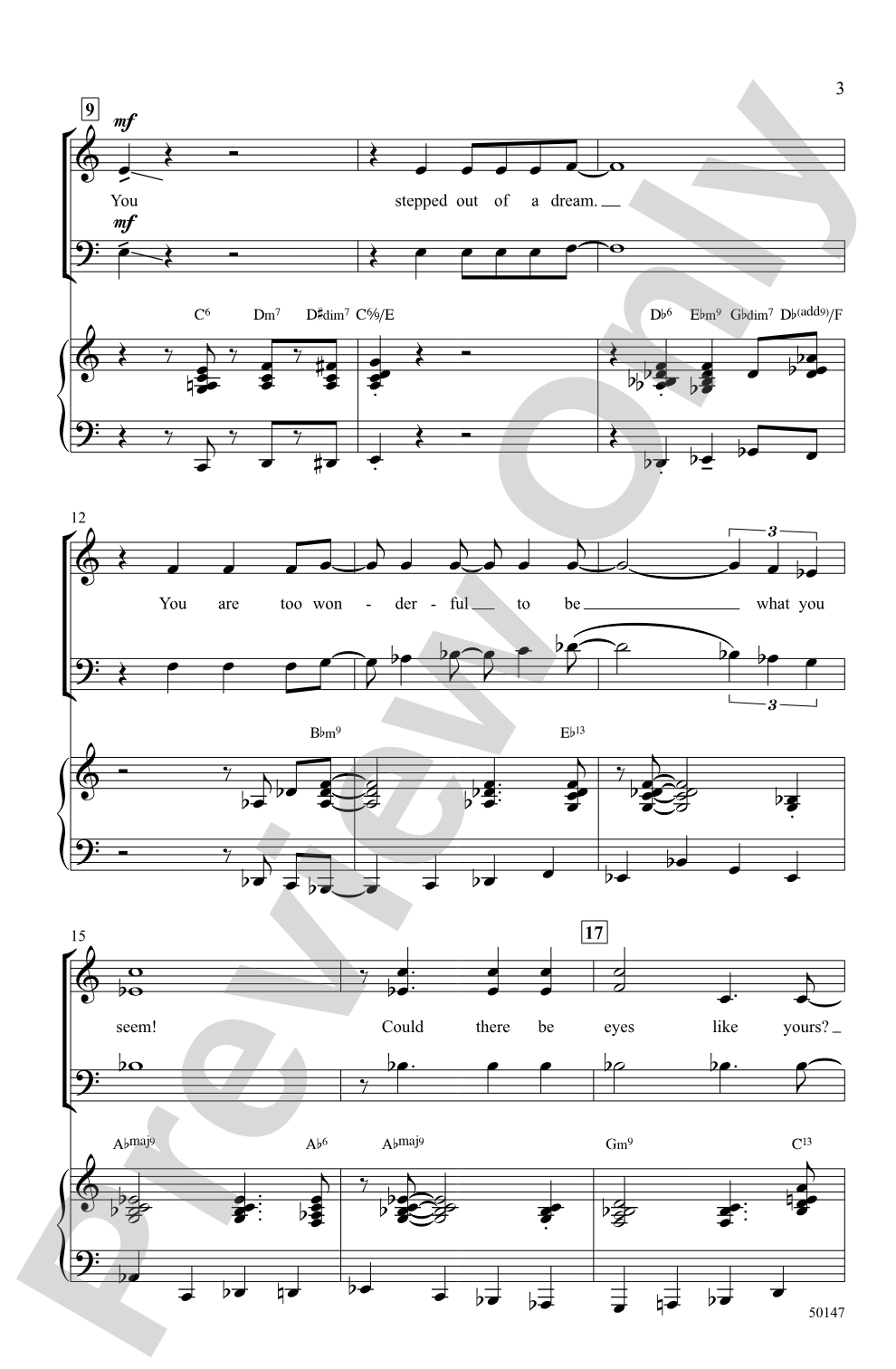

You Stepped Out of a Dream: SAB Choral Octavo
Music by Nacio Herb Brown, lyrics by Gus Kahn / arr. with additional words, by Kirby Shaw
Item: 00-PO-0007023
$2.10
Minimum order quantity: 20 copies
One moment…
Related Items
You Stepped Out of a Dream: SoundTrax Digital Audio Download |
$29.98
|
View | |
You Stepped Out of a Dream: SATB Choral Octavo |
$2.10
|
View | |
You Stepped Out of a Dream: SSA Choral Octavo |
$2.10
|
View | |
You Stepped Out of a Dream: Choral SoundPax |
$15.00
|
View | |
You Stepped Out of a Dream: SATB Choral Octavo |
$2.10
|
View | |
You Stepped Out of a Dream: SAB Choral Octavo |
$2.10
|
View | |
You Stepped Out of a Dream: SSA Choral Octavo |
$2.10
|
View | |
You Stepped Out of a Dream: Choral Octavo SoundTrax CD |
$29.99
|
View | |
You Stepped Out of a Dream: Choral SoundPax |
$15.00
|
View |
Description
A Great American Songbook standard famously recorded by Nat King Cole. With tight stylistic sonorities, a lively swing feel, and Kirby's signature scat singing, this arrangement is a dream come true for vocal jazz groups. An optional SoundPax includes parts for guitar, bass, and drums.


You Stepped Out of a Dream: SAB Choral Octavo isn't in MakeMusic Cloud just yet...but it could be. Let us know you'd like to see it, and you'll help shape what comes next. In the meantime, start a free trial and dive into thousands of interactive titles your students can play along with today.
Request This Title
Tell us you want it.
Start Your Free Trial
Explore everything that's ready to play right now.
Sample Audio
1
Audio File
--:--
0:00
0:00
Sample Video
Additional Details
Series:
Alfred Pop Choral Series
Publisher:
Alfred Music
Page Count:
12
SKU:
00-PO-0007023
More about this title
About the Composer: Nacio Herb Brown
Nacio Herb Brown (1896-1964) shaped the sound of American musical theater and film during Hollywood's Golden Age. His gift for crafting memorable melodies made him one of the most prolific composers of the 1920s and 1930s, with songs that have endured as standards in the Great American Songbook.
Brown's work defined an era of accessible, singable compositions that moved easily from stage to screen. His collaborations with lyricist Arthur Freed produced some of the most recorded songs in American music, making his catalog essential repertoire for singers across all genres and levels.
Why we love this
Kirby Shaw's arrangement captures the sophisticated swing and vocal sophistication that made Nat King Cole's recording iconic, while keeping the voicing accessible for developing SAB ensembles. The scat singing element adds personality and style without requiring advanced technical prowess, and the optional instrumental parts let you move beyond a cappella if your program allows.
What to expect
Bright, sophisticated, and genuinely fun. The piece radiates the elegance of the Great American Songbook while the scat singing and swing rhythm keep things conversational and immediate. It feels like stepping into a mid-century jazz club where good humor and musical craft coexist.
Who it's for
SAB groups looking for material that teaches jazz sensibility and contemporary phrasing without sacrificing musicality. This arrangement works well for groups with at least one year of basic ensemble experience and a willingness to explore styles beyond classical choral traditions.
How to get the most out of it
- Shape the swing eighth notes with light, forward phrasing; avoid clipping them short or letting them drag. The groove depends on rhythmic precision paired with a relaxed feel.
- Approach the scat sections with playful confidence rather than technical perfection. Clarity and musicality matter more than flawless execution of every syllable.
- If you add the optional guitar, bass, and drums, use rehearsals to lock the harmonic and rhythmic foundation before layering in the vocals. Ensemble cohesion improves dramatically once the rhythm section establishes the pocket.
- Balance the three parts so no single line dominates; this arrangement thrives when all three voices blend into a unified sonority rather than standing out individually.
How to use it
Program this as a palate cleanser in a concert that balances classical and contemporary repertoire, or use it as an anchor piece in a Great American Songbook-themed concert. Its recognizable melody and accessible style make it effective for community audiences and student recruitment.
Skills your students will build
- Swing rhythm and eighth-note articulation in jazz style
- Scat singing and rhythmic improvisation within a notated framework
- Part balance and blend in three-part mixed voicing
- Stylistic interpretation of popular standards
- Ensemble coordination with optional instrumental accompaniment