
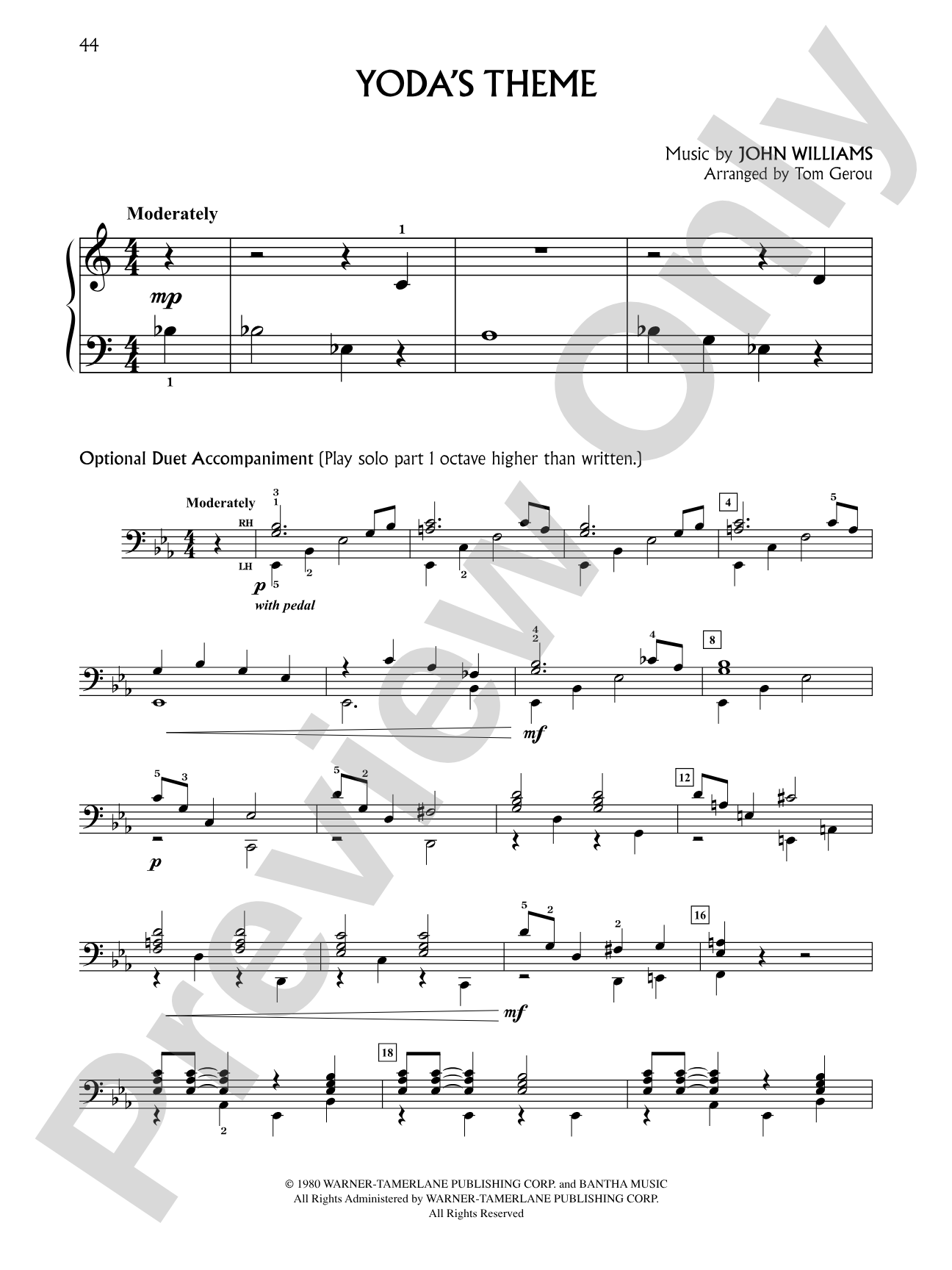

Yoda's Theme (from "Star Wars Episode V: The Empire Strikes Back"): Five Finger Piano
Arranged by Tom Gerou
Level: Elementary
Item: 00-PS-0012759
$4.99
One moment…
Related Items
Cantina Band (from "Star Wars Episode IV: A New Hope"): Five Finger Piano |
$4.99
|
View | |
Cantina Band (from "Star Wars Episode IV: A New Hope"): Big Note Piano |
$4.99
|
View | |
Princess Leia's Theme (from "Star Wars"): Big Note Piano |
$4.99
|
View | |
Princess Leia's Theme (from "Star Wars"): Five Finger Piano |
$4.99
|
View | |
The Throne Room (from "Star Wars"): Five Finger Piano |
$4.99
|
View | |
The Throne Room (from "Star Wars"): Big Note Piano |
$4.99
|
View | |
Yoda's Theme (from "Star Wars Episode V: The Empire Strikes Back"): Big Note Piano |
$4.99
|
View | |
May the Force Be With You (from "Star Wars Episode V: The Empire Strikes Back"): Big Note Piano |
$4.99
|
View | |
May the Force Be With You (from "Star Wars Episode V: The Empire Strikes Back"): Five Finger Piano |
$4.99
|
View | |
Imperial March ("Darth Vader's Theme") (from "Star Wars Episode V: The Empire Strikes Back"): Big Note Piano |
$4.99
|
View | |
Imperial March ("Darth Vader's Theme") (from "Star Wars Episode V: The Empire Strikes Back"): Five Finger Piano |
$4.99
|
View | |
Jawa Sandcrawler (from "Star Wars Episode IV: A New Hope"): Five Finger Piano |
$4.99
|
View | |
Jawa Sandcrawler (from "Star Wars Episode IV: A New Hope"): Big Note Piano |
$4.99
|
View | |
Binary Sunset (from "Star Wars Episode IV: A New Hope"): Big Note Piano |
$4.99
|
View | |
Binary Sunset (from "Star Wars Episode IV: A New Hope"): Five Finger Piano |
$4.99
|
View | |
Star Wars Main Theme (from "Star Wars"): Five Finger Piano |
$4.99
|
View | |
Star Wars Main theme (from "Star Wars"): Big Note Piano |
$4.99
|
View |
Description
The entire Star Wars saga is encompassed in this piano sheet music collection! Set amid stunning imagery from the films, these piano arrangements bring the magic of Star Wars to life as they masterfully invoke the grand romanticism of John Williams's epic, award-winning scores. Included are the most definitive and memorable pieces from each of the six Star Wars episodes arranged by Tom Gerou. These arrangements are set in traditional five-finger style, with the melody split between the hands. For performance ease, student parts have no key signatures, dotted quarter notes, triplets, or 16th notes. Optional duet accompaniments are also provided for a fuller, richer musical experience.
Titles: 20th Century Fox Fanfare * Across the Stars * Anakin's Theme * Battle of the Heroes * Binary Sunset * Cantina Band * Duel of the Fates * The Imperial March * Jawa Sandcrawler * Luke and Leia * May the Force Be with You * Princess Leia's Theme * Star Wars (Main Title) * The Throne Room * Yoda's Theme.


Titles: 20th Century Fox Fanfare * Across the Stars * Anakin's Theme * Battle of the Heroes * Binary Sunset * Cantina Band * Duel of the Fates * The Imperial March * Jawa Sandcrawler * Luke and Leia * May the Force Be with You * Princess Leia's Theme * Star Wars (Main Title) * The Throne Room * Yoda's Theme.
Yoda's Theme (from "Star Wars Episode V: The Empire Strikes Back"): Five Finger Piano isn't in MakeMusic Cloud just yet...but it could be. Let us know you'd like to see it, and you'll help shape what comes next. In the meantime, start a free trial and dive into thousands of interactive titles your students can play along with today.
Request This Title
Tell us you want it.
Start Your Free Trial
Explore everything that's ready to play right now.
Sample Audio
No sample audio found.
Sample Video
No sample videos found.
Additional Details
Series:
5 Finger
Publisher:
Alfred Music
Page Count:
52
SKU:
00-PS-0012759
More about this title
About the Composer: John Williams
John Williams stands as one of the most celebrated film composers of all time, with a career spanning over six decades. His orchestral scores for the Star Wars saga, Indiana Jones films, Jaws, E.T., and countless others have defined the sound of modern cinema and earned him five Academy Awards, four Golden Globes, and 52 Grammy nominations. Williams studied composition at UCLA and at Indiana University, where he later served on the faculty for many years. His mastery of Romantic-era orchestration and gift for unforgettable melodic themes have made his work standard repertoire in concert halls and classrooms worldwide.
For music educators, Williams's compositions represent a rare achievement: they capture the imagination of young musicians while demonstrating sophisticated harmonic language and structural clarity. His themes teach students how melody, orchestration, and emotional storytelling work together, making his music invaluable for building musicianship and engagement in ensemble and solo contexts.
Why we love this
This collection taps into the genuine excitement students feel about Star Wars while delivering legitimate musical substance. Five-finger arrangements stripped of key signatures and complex rhythms mean beginners can access Williams's iconic melodies immediately, but the optional duet parts elevate the experience for mixed-ability groups or allow you to enrich the sound in performance. The pairing of recognizable material with smart pedagogical design makes this a tool that builds confidence and musicianship without compromise.
What to expect
These arrangements bring the grandeur and emotion of Williams's original scores into the student's hands. Yoda's Theme unfolds with gentle wisdom and mystery; the Imperial March commands with dark, striding authority; the Main Title soars with heroic optimism. Even in simplified form, the melodies retain their power to transport and inspire.
Who it's for
Early-elementary piano students (ages 6-10) who are ready to play beyond method book progressions and want music that feels significant. Teachers seeking repertoire that motivates young pianists through familiar, beloved material while reinforcing fundamental five-finger patterns. Mixed ability studio classes where duets create ensemble experience for students at different stages.
How to get the most out of it
- Shape each phrase with the dynamics and articulation marked in the score, even within the simplified note patterns. Williams's themes depend on expressive phrasing to feel complete.
- If using the duet accompaniment, rehearse the student and accompanist parts separately first, then layer them together once both are secure. This prevents the student from losing focus on their own line.
- Let rubato and breath guide your tempo rather than metronomic rigidity. Five-finger arrangements don't need to sound mechanical; Williams's melodies sing best when you allow small natural variations in timing.
- Record yourself playing through a piece without stopping, even if you make mistakes. Hearing the full melodic arc builds ownership and reveals where phrasing needs attention.
How to use it
Feature one or two pieces in a student recital themed around film music or adventure, allowing parents and siblings to recognize the tunes immediately. Use shorter selections as sight-reading warm-ups for group lessons or studio classes; the familiar melodies make errors less discouraging and build quick success. Consider pairing a duet arrangement with a young student's solo in a group performance for an ensemble moment that builds community without requiring instrumental coordination.
Skills your students will build
- Reading melody in both treble clef hands without relying on key signatures
- Legato and staccato articulation within five-finger hand positions
- Phrase shaping and expressive interpretation of recognizable themes
- Accompaniment listening and rhythmic coordination (when playing optional duet parts)
- Sight-reading of rhythmic patterns without 16th notes or complex meters
- Hand independence across both staves within a limited range