
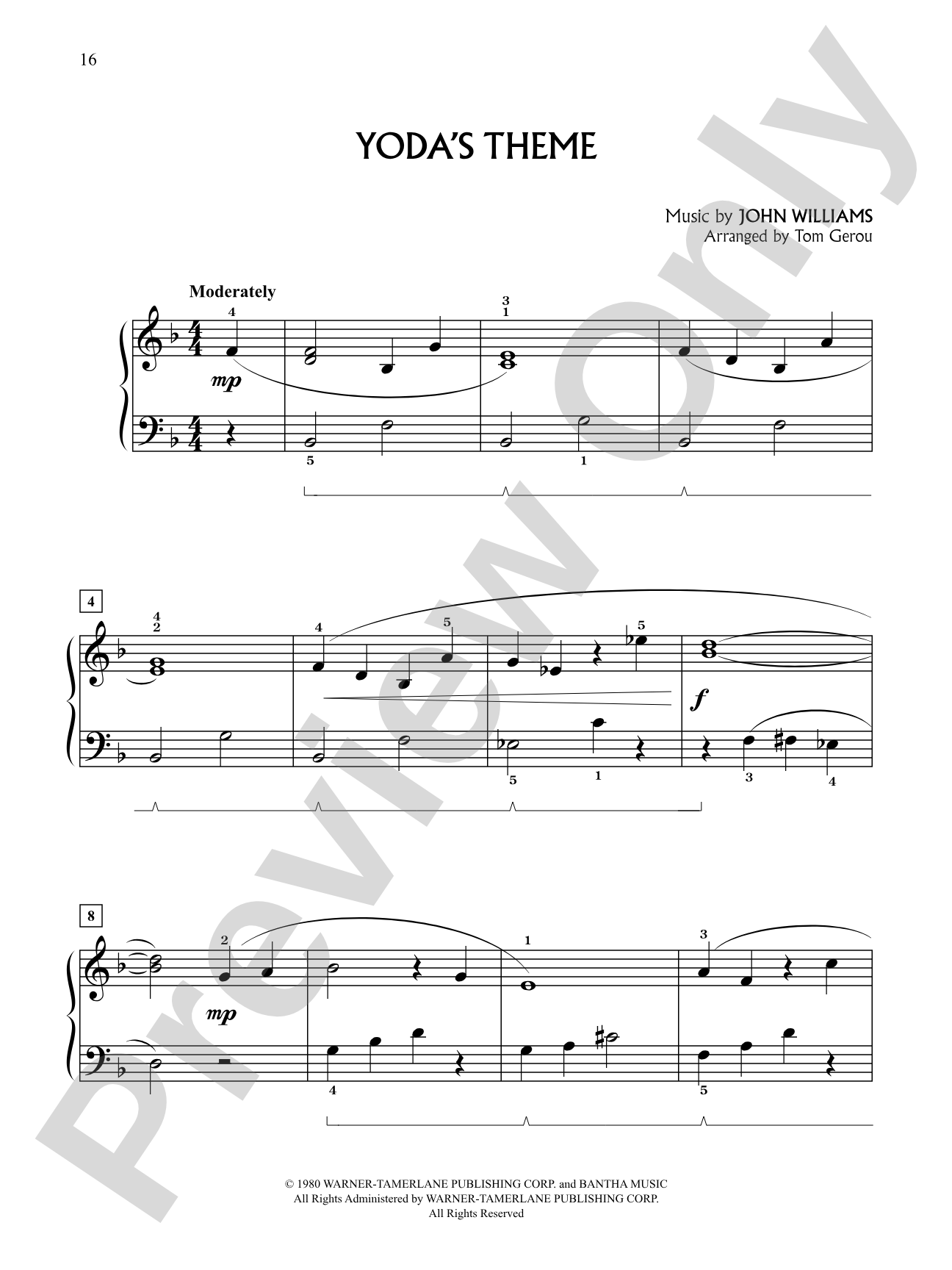

Yoda's Theme (from "Star Wars Episode V: The Empire Strikes Back"): Big Note Piano
Arranged by Tom Gerou
Level: Big Note
Item: 00-PS-0012758
$4.99
One moment…
Related Items
Cantina Band (from "Star Wars Episode IV: A New Hope"): Five Finger Piano |
$4.99
|
View | |
Cantina Band (from "Star Wars Episode IV: A New Hope"): Big Note Piano |
$4.99
|
View | |
Princess Leia's Theme (from "Star Wars"): Big Note Piano |
$4.99
|
View | |
Princess Leia's Theme (from "Star Wars"): Five Finger Piano |
$4.99
|
View | |
The Throne Room (from "Star Wars"): Five Finger Piano |
$4.99
|
View | |
The Throne Room (from "Star Wars"): Big Note Piano |
$4.99
|
View | |
Yoda's Theme (from "Star Wars Episode V: The Empire Strikes Back"): Five Finger Piano |
$4.99
|
View | |
May the Force Be With You (from "Star Wars Episode V: The Empire Strikes Back"): Big Note Piano |
$4.99
|
View | |
May the Force Be With You (from "Star Wars Episode V: The Empire Strikes Back"): Five Finger Piano |
$4.99
|
View | |
Imperial March ("Darth Vader's Theme") (from "Star Wars Episode V: The Empire Strikes Back"): Big Note Piano |
$4.99
|
View | |
Imperial March ("Darth Vader's Theme") (from "Star Wars Episode V: The Empire Strikes Back"): Five Finger Piano |
$4.99
|
View | |
Jawa Sandcrawler (from "Star Wars Episode IV: A New Hope"): Five Finger Piano |
$4.99
|
View | |
Jawa Sandcrawler (from "Star Wars Episode IV: A New Hope"): Big Note Piano |
$4.99
|
View | |
Binary Sunset (from "Star Wars Episode IV: A New Hope"): Big Note Piano |
$4.99
|
View | |
Binary Sunset (from "Star Wars Episode IV: A New Hope"): Five Finger Piano |
$4.99
|
View | |
Star Wars Main Theme (from "Star Wars"): Five Finger Piano |
$4.99
|
View | |
Star Wars Main theme (from "Star Wars"): Big Note Piano |
$4.99
|
View |
Description
The entire Star Wars saga is encompassed in this piano sheet music collection! Set amid stunning imagery from the films, these piano arrangements bring the magic of Star Wars to life as they masterfully invoke the grand romanticism of John Williams's epic, award-winning scores. Included are the most definitive and memorable pieces from each of the six Star Wars episodes arranged for Big Note piano by Tom Gerou.
Titles: 20th Century Fox Fanfare * Across the Stars * Anakin's Theme * Battle of the Heroes * Binary Sunset * Cantina Band * Duel of the Fates * The Imperial March * Jawa Sandcrawler * Luke and Leia * May the Force Be with You * Princess Leia's Theme * Star Wars (Main Title) * The Throne Room * Yoda's Theme.


Titles: 20th Century Fox Fanfare * Across the Stars * Anakin's Theme * Battle of the Heroes * Binary Sunset * Cantina Band * Duel of the Fates * The Imperial March * Jawa Sandcrawler * Luke and Leia * May the Force Be with You * Princess Leia's Theme * Star Wars (Main Title) * The Throne Room * Yoda's Theme.
Yoda's Theme (from "Star Wars Episode V: The Empire Strikes Back"): Big Note Piano isn't in MakeMusic Cloud just yet...but it could be. Let us know you'd like to see it, and you'll help shape what comes next. In the meantime, start a free trial and dive into thousands of interactive titles your students can play along with today.
Request This Title
Tell us you want it.
Start Your Free Trial
Explore everything that's ready to play right now.
Sample Audio
No sample audio found.
Sample Video
No sample videos found.
Additional Details
Publisher:
Alfred Music
Page Count:
48
SKU:
00-PS-0012758
More about this title
About the Composer: John Williams
John Williams stands as one of the most celebrated film composers in cinema history, with a career spanning more than six decades and an unmatched ability to craft instantly recognizable themes. His work across the Star Wars saga, Indiana Jones films, Jaws, E.T., and Harry Potter demonstrates a mastery of orchestral writing rooted in the great romantic composers, yet utterly his own. Williams has won five Academy Awards, four Golden Globes, and 52 Grammy Awards, making him a cornerstone of music education repertoire worldwide.
For music students and educators, Williams's scores offer a direct path into understanding how melody, harmony, and orchestration work together to create emotional impact and narrative meaning. His themes are constructed with pedagogical clarity: memorable, singable, and built on harmonic principles that reveal themselves at every level of study. Through Williams's music, students encounter sophisticated compositional technique without pretension.
Why we love this
This collection captures what makes Williams's Star Wars themes so enduring: crystal-clear melodic lines paired with accessible harmonic progressions that reward careful listening and repeat playing. Young pianists encounter genuinely great music here, not simplified versions of it, and the Big Note format removes the technical barrier without diluting the compositional integrity. Programming these pieces gives students immediate access to film music that has shaped popular culture while building their understanding of leitmotif, key relationships, and thematic development.
What to expect
These pieces breathe with the grandeur of John Williams's orchestrations even in simplified form. Playing them evokes the epic scope of the films—the mystery of Yoda's Theme, the heroic swagger of the Main Title, the ominous darkness of the Imperial March. Each arrangement preserves the emotional core that made these themes unforgettable, wrapping it in piano writing that feels full-voiced and satisfying.
Who it's for
This collection suits young pianists (typically ages 8-13) who are at the Big Note level and want to play recognizable, culturally meaningful music without years of technique-building first. It's ideal for students who connect emotionally to Star Wars and need motivation to practice consistently. Teachers also use these arrangements as rewards, recital pieces, or as entry points to studying film music composition.
How to get the most out of it
- Identify the main melodic contour in each hand before worrying about tempo. These themes were designed to sing, so let the shape of the line guide your phrasing even at a moderate pace.
- Pay attention to dynamic markings as essential storytelling tools. A crescendo into a key moment or a sudden drop in volume transforms how listeners experience the theme.
- Practice the left hand independently to secure harmonic progressions and voice leading. Many pieces use alberti patterns or sustained chords that need consistency to support the melody above.
- Record yourself playing and listen back without judgment. Hearing how the arrangement actually sounds often reveals moments where you're rushing, dragging, or losing the melodic line.
How to use it
Feature individual pieces as recital solos that appeal to younger performers and their families, or group several themes together for a thematic concert highlighting film music and its compositional craft. These arrangements work especially well as a bridge between beginner and intermediate repertoire, offering students a sense of accomplishment while introducing them to the language of leitmotif and romantic-era harmony.
Skills your students will build
- Reading ledger lines and navigating wider staff intervals
- Sustaining melodic phrasing across hand position changes
- Balancing melody and accompaniment when playing multiple voices
- Understanding harmonic function and key relationships in simple progressions
- Responding to dynamic markings and tempo indications for musical expression
- Left-hand independence and evenness in repeated rhythmic patterns