
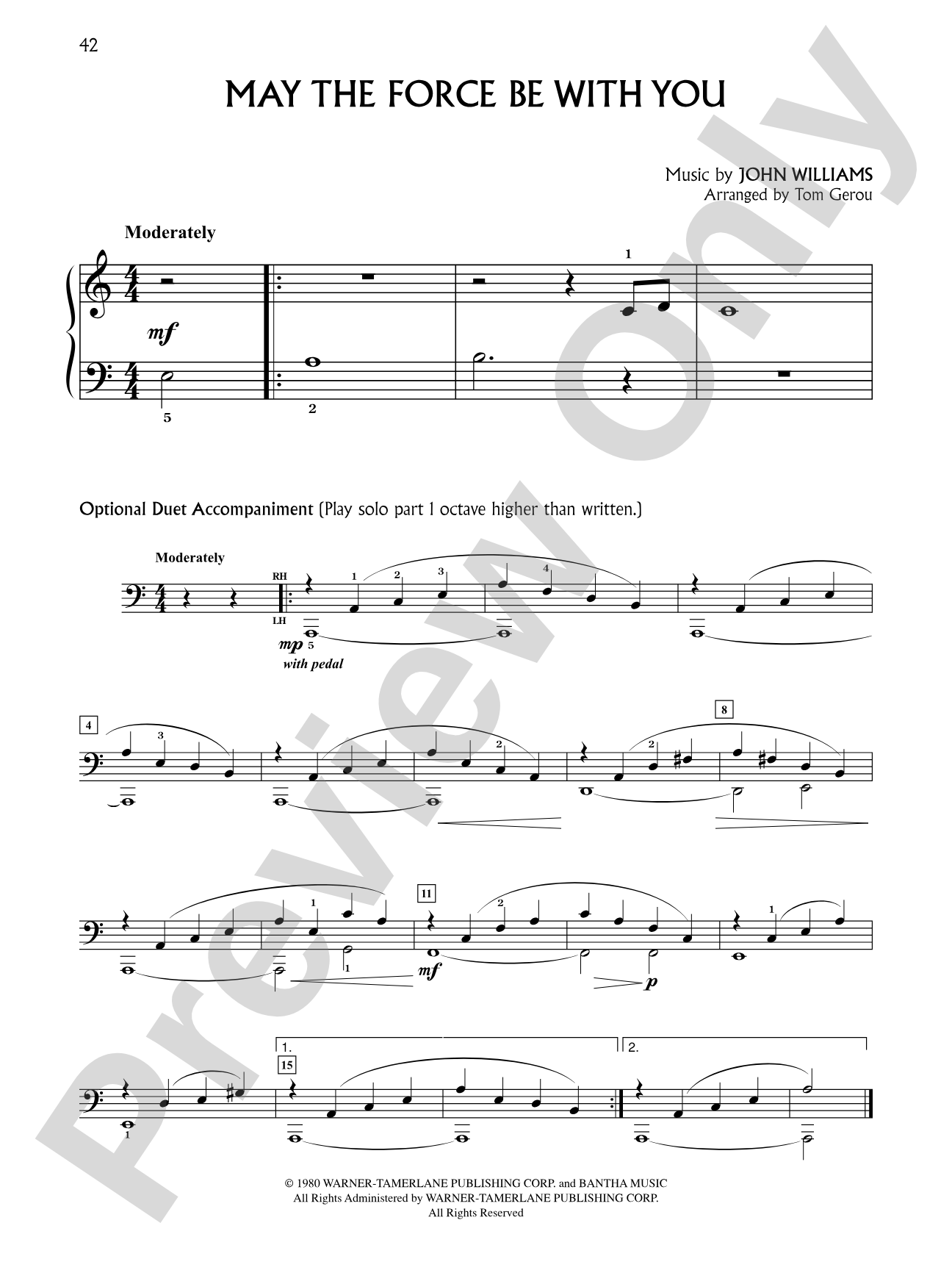

May the Force Be With You (from "Star Wars Episode V: The Empire Strikes Back"): Five Finger Piano
Arranged by Tom Gerou
Level: Elementary
Item: 00-PS-0012762
$4.99
One moment…
Related Items
Cantina Band (from "Star Wars Episode IV: A New Hope"): Five Finger Piano |
$4.99
|
View | |
Cantina Band (from "Star Wars Episode IV: A New Hope"): Big Note Piano |
$4.99
|
View | |
Princess Leia's Theme (from "Star Wars"): Big Note Piano |
$4.99
|
View | |
Princess Leia's Theme (from "Star Wars"): Five Finger Piano |
$4.99
|
View | |
The Throne Room (from "Star Wars"): Five Finger Piano |
$4.99
|
View | |
The Throne Room (from "Star Wars"): Big Note Piano |
$4.99
|
View | |
Yoda's Theme (from "Star Wars Episode V: The Empire Strikes Back"): Big Note Piano |
$4.99
|
View | |
Yoda's Theme (from "Star Wars Episode V: The Empire Strikes Back"): Five Finger Piano |
$4.99
|
View | |
May the Force Be With You (from "Star Wars Episode V: The Empire Strikes Back"): Big Note Piano |
$4.99
|
View | |
Imperial March ("Darth Vader's Theme") (from "Star Wars Episode V: The Empire Strikes Back"): Big Note Piano |
$4.99
|
View | |
Imperial March ("Darth Vader's Theme") (from "Star Wars Episode V: The Empire Strikes Back"): Five Finger Piano |
$4.99
|
View | |
Jawa Sandcrawler (from "Star Wars Episode IV: A New Hope"): Five Finger Piano |
$4.99
|
View | |
Jawa Sandcrawler (from "Star Wars Episode IV: A New Hope"): Big Note Piano |
$4.99
|
View | |
Binary Sunset (from "Star Wars Episode IV: A New Hope"): Big Note Piano |
$4.99
|
View | |
Binary Sunset (from "Star Wars Episode IV: A New Hope"): Five Finger Piano |
$4.99
|
View | |
Star Wars Main Theme (from "Star Wars"): Five Finger Piano |
$4.99
|
View | |
Star Wars Main theme (from "Star Wars"): Big Note Piano |
$4.99
|
View |
Description
The entire Star Wars saga is encompassed in this piano sheet music collection! Set amid stunning imagery from the films, these piano arrangements bring the magic of Star Wars to life as they masterfully invoke the grand romanticism of John Williams's epic, award-winning scores. Included are the most definitive and memorable pieces from each of the six Star Wars episodes arranged by Tom Gerou. These arrangements are set in traditional five-finger style, with the melody split between the hands. For performance ease, student parts have no key signatures, dotted quarter notes, triplets, or 16th notes. Optional duet accompaniments are also provided for a fuller, richer musical experience.
Titles: 20th Century Fox Fanfare * Across the Stars * Anakin's Theme * Battle of the Heroes * Binary Sunset * Cantina Band * Duel of the Fates * The Imperial March * Jawa Sandcrawler * Luke and Leia * May the Force Be with You * Princess Leia's Theme * Star Wars (Main Title) * The Throne Room * Yoda's Theme.


Titles: 20th Century Fox Fanfare * Across the Stars * Anakin's Theme * Battle of the Heroes * Binary Sunset * Cantina Band * Duel of the Fates * The Imperial March * Jawa Sandcrawler * Luke and Leia * May the Force Be with You * Princess Leia's Theme * Star Wars (Main Title) * The Throne Room * Yoda's Theme.
May the Force Be With You (from "Star Wars Episode V: The Empire Strikes Back"): Five Finger Piano isn't in MakeMusic Cloud just yet...but it could be. Let us know you'd like to see it, and you'll help shape what comes next. In the meantime, start a free trial and dive into thousands of interactive titles your students can play along with today.
Request This Title
Tell us you want it.
Start Your Free Trial
Explore everything that's ready to play right now.
Sample Audio
No sample audio found.
Sample Video
No sample videos found.
Additional Details
Series:
5 Finger
Publisher:
Alfred Music
Page Count:
52
SKU:
00-PS-0012762
More about this title
About the Composer: John Williams
John Williams stands among the most celebrated film composers of all time, with a career spanning over six decades and an unmatched ability to create themes that define entire cinematic universes. His Star Wars scores revolutionized film music by restoring symphonic grandeur and memorable melodic writing to cinema, earning him five Academy Award nominations across the saga and cementing these themes as part of popular culture.
In music education, Williams's work serves a vital purpose: his melodies are instantly recognizable, harmonically sophisticated, and structured in ways that reward careful listening. Teachers and students encounter his themes as gateways to understanding orchestration, leitmotif technique, and the relationship between music and emotion in storytelling.
Why we love this
These arrangements capture the iconic sweep and drama of Williams's original orchestrations while meeting elementary pianists where they are. The five-finger format removes technical barriers without sacrificing the emotional impact of themes like "The Imperial March" or "Binary Sunset," allowing young players to experience genuine musical storytelling rather than simplified exercises.
What to expect
Playing these pieces feels like stepping into the Star Wars universe yourself. Each theme carries its own character: the majestic and noble Main Title, the sinister creep of the Imperial March, the tender poignancy of themes tied to Luke's journey. The melodies are soaring and memorable; your hands move through recognizable patterns that feel satisfying and complete.
Who it's for
Elementary pianists ready to experience music beyond traditional method books, particularly those excited by film music and pop culture. This collection works for students in roughly grades 2-4 who have basic five-finger patterns and hand position secured and want repertoire that feels genuinely musical rather than purely instructional.
How to get the most out of it
- Allow rubato in the melody lines, especially in slower pieces like "Binary Sunset." These themes invite slight timing flexibility that mirrors the film's emotional pacing and sounds more mature than metronomic accuracy.
- When performing the optional duet accompaniments, the accompanist should provide a steady foundation that lets the melody shine; resist the urge to balance equally with the upper line.
- Listen to John Williams's original orchestral recordings before learning each piece. Knowing the intended orchestration (strings, brass, woodwinds) helps pianists shape phrase contours and articulation choices authentically.
- Pay attention to dynamics marked in the score. These arrangements use dynamic contrast deliberately to create the cinematic drama that makes Star Wars music so compelling.
How to use it
Offer these as a recital program built around a Star Wars theme, either as individual pieces scattered throughout a concert or as a thematic set that tells a story. They also work beautifully as supplementary repertoire during units on film music appreciation or as incentive material for students who need engaging contemporary music alongside classical studies.
Skills your students will build
- Melodic phrasing and shaping across longer lines without relying on technical difficulty
- Hand independence and coordination in five-finger positions
- Dynamic control and expressive playing through intentional use of soft and loud
- Sight-reading simple notation without key signatures or complex rhythmic figures
- Musical interpretation and emotional expression in performance