
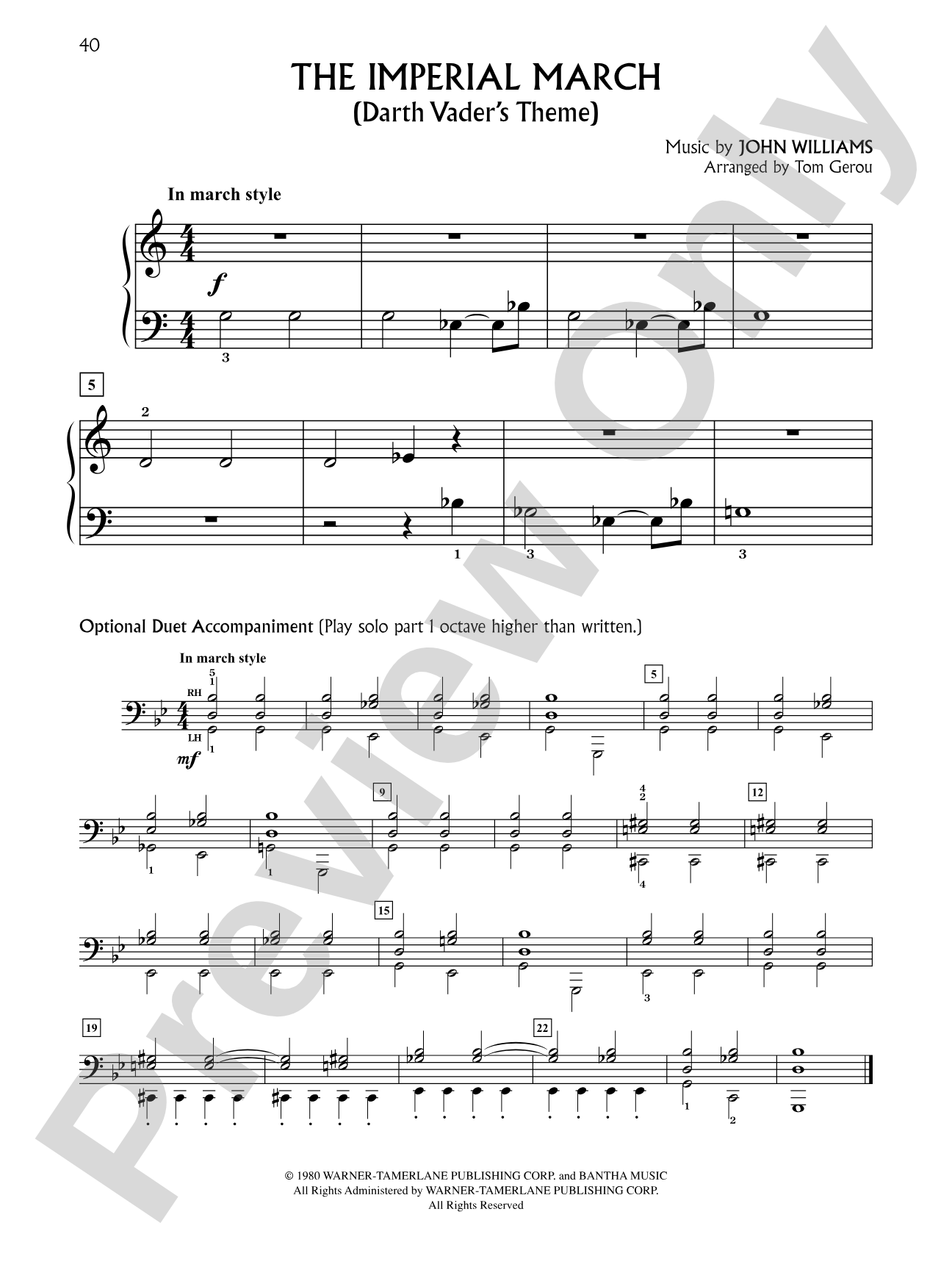

Imperial March ("Darth Vader's Theme") (from "Star Wars Episode V: The Empire Strikes Back"): Five Finger Piano
Arranged by Tom Gerou
Level: Elementary
Item: 00-PS-0012765
$4.99
One moment…
Related Items
Cantina Band (from "Star Wars Episode IV: A New Hope"): Five Finger Piano |
$4.99
|
View | |
Cantina Band (from "Star Wars Episode IV: A New Hope"): Big Note Piano |
$4.99
|
View | |
Princess Leia's Theme (from "Star Wars"): Big Note Piano |
$4.99
|
View | |
Princess Leia's Theme (from "Star Wars"): Five Finger Piano |
$4.99
|
View | |
The Throne Room (from "Star Wars"): Five Finger Piano |
$4.99
|
View | |
The Throne Room (from "Star Wars"): Big Note Piano |
$4.99
|
View | |
Yoda's Theme (from "Star Wars Episode V: The Empire Strikes Back"): Big Note Piano |
$4.99
|
View | |
Yoda's Theme (from "Star Wars Episode V: The Empire Strikes Back"): Five Finger Piano |
$4.99
|
View | |
May the Force Be With You (from "Star Wars Episode V: The Empire Strikes Back"): Big Note Piano |
$4.99
|
View | |
May the Force Be With You (from "Star Wars Episode V: The Empire Strikes Back"): Five Finger Piano |
$4.99
|
View | |
Imperial March ("Darth Vader's Theme") (from "Star Wars Episode V: The Empire Strikes Back"): Big Note Piano |
$4.99
|
View | |
Jawa Sandcrawler (from "Star Wars Episode IV: A New Hope"): Five Finger Piano |
$4.99
|
View | |
Jawa Sandcrawler (from "Star Wars Episode IV: A New Hope"): Big Note Piano |
$4.99
|
View | |
Binary Sunset (from "Star Wars Episode IV: A New Hope"): Big Note Piano |
$4.99
|
View | |
Binary Sunset (from "Star Wars Episode IV: A New Hope"): Five Finger Piano |
$4.99
|
View | |
Star Wars Main Theme (from "Star Wars"): Five Finger Piano |
$4.99
|
View | |
Star Wars Main theme (from "Star Wars"): Big Note Piano |
$4.99
|
View |
Description
The entire Star Wars saga is encompassed in this piano sheet music collection! Set amid stunning imagery from the films, these piano arrangements bring the magic of Star Wars to life as they masterfully invoke the grand romanticism of John Williams's epic, award-winning scores. Included are the most definitive and memorable pieces from each of the six Star Wars episodes arranged by Tom Gerou. These arrangements are set in traditional five-finger style, with the melody split between the hands. For performance ease, student parts have no key signatures, dotted quarter notes, triplets, or 16th notes. Optional duet accompaniments are also provided for a fuller, richer musical experience.
Titles: 20th Century Fox Fanfare * Across the Stars * Anakin's Theme * Battle of the Heroes * Binary Sunset * Cantina Band * Duel of the Fates * The Imperial March * Jawa Sandcrawler * Luke and Leia * May the Force Be with You * Princess Leia's Theme * Star Wars (Main Title) * The Throne Room * Yoda's Theme.


Titles: 20th Century Fox Fanfare * Across the Stars * Anakin's Theme * Battle of the Heroes * Binary Sunset * Cantina Band * Duel of the Fates * The Imperial March * Jawa Sandcrawler * Luke and Leia * May the Force Be with You * Princess Leia's Theme * Star Wars (Main Title) * The Throne Room * Yoda's Theme.
Imperial March ("Darth Vader's Theme") (from "Star Wars Episode V: The Empire Strikes Back"): Five Finger Piano isn't in MakeMusic Cloud just yet...but it could be. Let us know you'd like to see it, and you'll help shape what comes next. In the meantime, start a free trial and dive into thousands of interactive titles your students can play along with today.
Request This Title
Tell us you want it.
Start Your Free Trial
Explore everything that's ready to play right now.
Sample Audio
No sample audio found.
Sample Video
No sample videos found.
Additional Details
Series:
5 Finger
Publisher:
Alfred Music
Page Count:
52
SKU:
00-PS-0012765
More about this title
About the Composer: John Williams
John Williams has composed the scores for some of cinema's most iconic franchises, from Star Wars to Indiana Jones to Harry Potter. His mastery of orchestral writing and ability to craft instantly recognizable themes has made him one of the most performed film composers in the world. In the classroom and practice studio, his melodies serve as gateways to music literacy because they are inherently musical, memorable, and emotionally resonant.
Williams's compositional approach draws from the great Romantic tradition, blending classical forms with modern film storytelling. His themes reward careful listening and repeated study, making them invaluable tools for teaching phrasing, harmonic structure, and the relationship between melody and accompaniment.
Why we love this
These five-finger arrangements give early elementary pianists access to music they know and love without oversimplifying the emotional content. The melodies remain unmistakably Williams, and students feel genuine accomplishment when they recognize what they've learned to play. Duet accompaniments turn solo practice into a shared musical experience, which deepens engagement and gives struggling readers a reason to keep going.
What to expect
Playing these pieces captures the grandeur and emotion of the Star Wars universe in miniature. Even simplified, melodies like the Imperial March carry dramatic weight, while lighter themes like Cantina Band sparkle with character. The five-finger format keeps the focus on clean melody and steady rhythm, letting the music itself do the heavy lifting.
Who it's for
Beginning pianists (typically grades 1-3) who are ready to move beyond single-hand playing and explore the five-finger position across both hands. Students who respond to familiar, engaging music will stay motivated through the technical challenges of hand shifts and coordination. Parents and teachers looking for material that bridges early method books and more complex repertoire will find these arrangements perfect for keeping practice sessions rewarding.
How to get the most out of it
- Maintain steady tempo throughout, even when the melody jumps between hands. The five-finger layout makes hand position shifts easier if you stay rhythmically grounded.
- Listen to the original John Williams recording before you begin. Knowing the orchestral color helps you shape dynamics and phrasing with intention, even at this beginner level.
- If using the optional duet accompaniment, rehearse with a partner or teacher playing the lower part first. The accompaniment supports the melody and makes timing clearer.
- Practice the hand transitions slowly. Mark where the melody passes to the other hand so the shift feels intentional rather than accidental.
How to use it
These arrangements work beautifully in a casual student recital, film music concert, or even as a bridging experience between a spring solo festival and summer break. They also fit naturally into a curriculum that celebrates popular music and film, showing young musicians that quality composition appears everywhere. A duet performance with a teacher or advanced student transforms a solo piece into a more sophisticated performance moment.
Skills your students will build
- Playing melody across both hands with accurate hand position shifts
- Reading treble clef without key signatures
- Maintaining steady tempo during hand transitions
- Interpreting simple dynamics and phrasing cues
- Coordinating melody and accompaniment when performing with a duet partner
- Recognizing and memorizing iconic melodic themes