
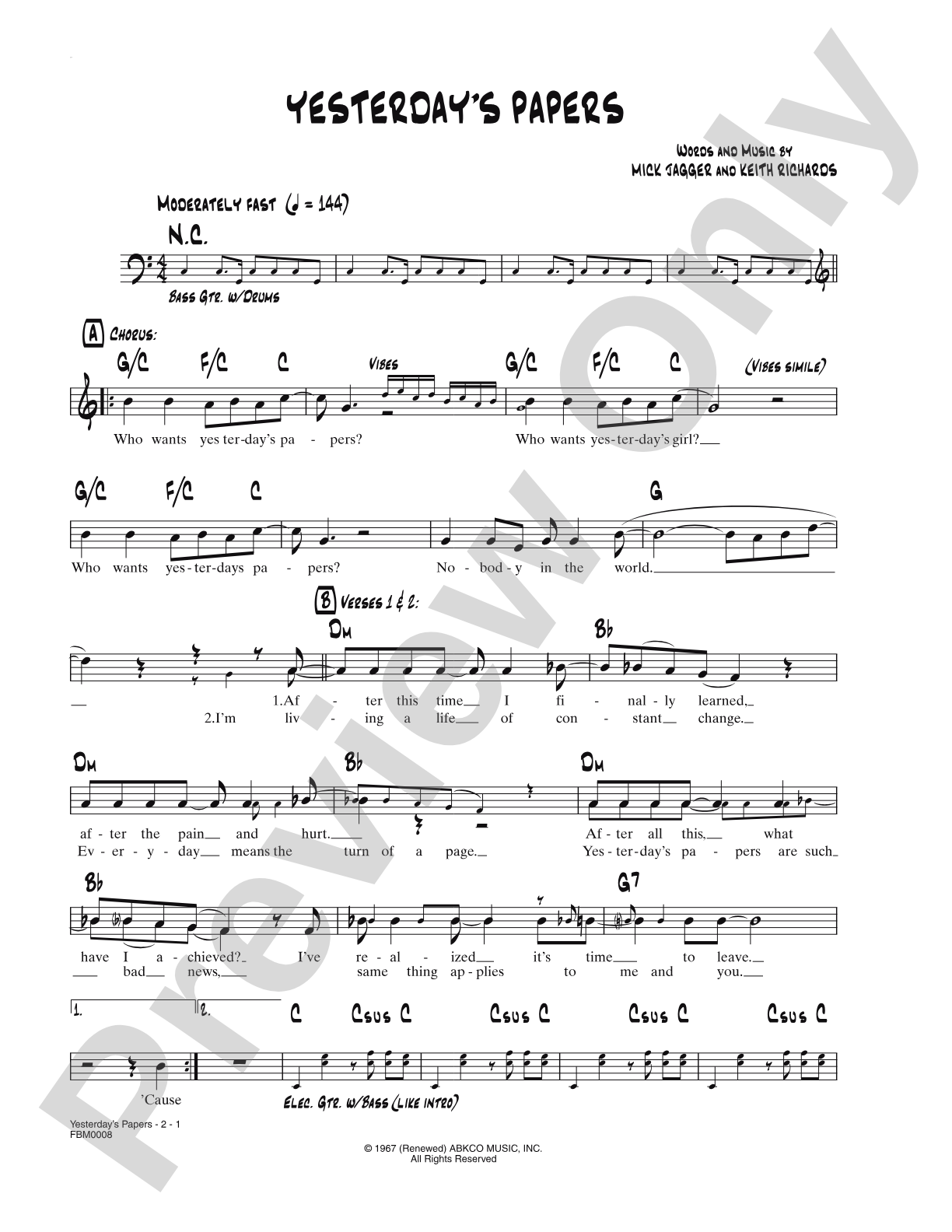

Yesterday's Papers: Lead Sheet
The Rolling Stones
Item: 00-PS-0012293
$4.99
Pickup currently not available
Related Items
(Get Your Kicks On) Route 66: Lead Sheet |
$4.99
|
View | |
Time is on My Side: Lead Sheet |
$4.99
|
View | |
You Better Move On: Lead Sheet |
$4.99
|
View | |
I'm Movin' On: Lead Sheet |
$4.99
|
View | |
Mercy, Mercy: Lead Sheet |
$4.99
|
View | |
If You Need Me: Lead Sheet |
$4.99
|
View | |
Fortune Teller: Lead Sheet |
$4.99
|
View | |
19th Nervous Breakdown: Lead Sheet |
$4.99
|
View | |
2000 Light Years From Home: Lead Sheet |
$4.99
|
View | |
2000 Man: Lead Sheet |
$4.99
|
View | |
2120 South Michigan Avenue: Lead Sheet |
$4.99
|
View | |
All Sold Out: Lead Sheet |
$4.99
|
View | |
All Down the Line: Lead Sheet |
$4.99
|
View | |
As Tears Go By: Lead Sheet |
$4.99
|
View | |
Backstreet Girl: Lead Sheet |
$4.99
|
View | |
Bitch: Lead Sheet |
$4.99
|
View | |
Brown Sugar: Lead Sheet |
$4.99
|
View | |
Blue Turns to Grey: Lead Sheet |
$4.99
|
View | |
Citadel: Lead Sheet |
$4.99
|
View | |
Can't You Hear Me Knocking: Lead Sheet |
$4.99
|
View | |
Child of the Moon: Lead Sheet |
$4.99
|
View | |
Connection: Lead Sheet |
$4.99
|
View | |
Complicated: Lead Sheet |
$4.99
|
View | |
Congratulations: Lead Sheet |
$4.99
|
View | |
Country Honk: Lead Sheet |
$4.99
|
View | |
Dead Flowers: Lead Sheet |
$4.99
|
View | |
Cool, Calm and Collected: Lead Sheet |
$4.99
|
View | |
Dandelion: Lead Sheet |
$4.99
|
View | |
Dear Doctor: Lead Sheet |
$4.99
|
View | |
Don't Lie to Me: Lead Sheet |
$4.99
|
View | |
Doncha Bother Me: Lead Sheet |
$4.99
|
View | |
Downtown Suzie: Lead Sheet |
$4.99
|
View | |
Empty Heart: Lead Sheet |
$4.99
|
View | |
Each and Every Day of the Year: Lead Sheet |
$4.99
|
View | |
Factory Girl: Lead Sheet |
$4.99
|
View | |
Family: Lead Sheet |
$4.99
|
View | |
Gimme Shelter: Lead Sheet |
$4.99
|
View | |
Good Times, Bad Times: Lead Sheet |
$4.99
|
View | |
Flight 505: Lead Sheet |
$4.99
|
View | |
Get Off of My Cloud: Lead Sheet |
$4.99
|
View | |
Goin' Home: Lead Sheet |
$4.99
|
View | |
Gomper: Lead Sheet |
$4.99
|
View | |
Good Times: Lead Sheet |
$4.99
|
View | |
Grown Up Wrong: Lead Sheet |
$4.99
|
View | |
Gotta Get Away: Lead Sheet |
$4.99
|
View | |
Have You Seen Your Mother, Baby, Standing in the Shadow?: Lead Sheet |
$4.99
|
View | |
Heart of Stone: Lead Sheet |
$4.99
|
View | |
Honky Tonk Women: Lead Sheet |
$4.99
|
View | |
High and Dry: Lead Sheet |
$4.99
|
View | |
I Am Waiting: Lead Sheet |
$4.99
|
View |
Description
The Rolling Stones Fake Book includes 167 classic Stones songs recorded between 1963 and 1971 -- from early blues covers (Chuck Berry and Buddy Holly songs) to the psychedelia of Their Satanic Majesties Request. All songs are in complete, professional-style lead sheets with fundamental instrumental riffs and figures included. There is also a special guitar TAB section, featuring the pivotal guitar riffs and solos from 29 of their most legendary songs, an introductory essay, a full-color ABKCO years discography (with album art), and 40 pages of classic early sheet music covers reproduced in full color. The comb binding creates a lay-flat book that is perfect for study and performance. The ultimate Rolling Stones songbook!


Yesterday's Papers: Lead Sheet isn't in MakeMusic Cloud just yet...but it could be. Let us know you'd like to see it, and you'll help shape what comes next. In the meantime, start a free trial and dive into thousands of interactive titles your students can play along with today.
Request This Title
Tell us you want it.
Start Your Free Trial
Explore everything that's ready to play right now.
Sample Audio
No sample audio found.
Sample Video
No sample videos found.
Additional Details
Series:
Just Real Books Series
Publisher:
Alfred Music
Page Count:
432
SKU:
00-PS-0012293
More about this title
About the Composer: Mick Jagger
Mick Jagger stands as one of rock music's most distinctive songwriters and performers, known for his ability to blend blues traditions with contemporary songwriting and his unmatched stage presence. As the primary lyricist and vocalist of The Rolling Stones, Jagger shaped the band's sound across their most creatively fertile decade, co-writing with Keith Richards to produce songs that ranged from faithful blues interpretations to innovative studio compositions that pushed rock into new territory.
Why we love this
This collection captures The Rolling Stones at their most inventive, presenting lead sheets alongside the actual guitar riffs and solos that defined each track. Guitar students get direct access to the instrumental DNA of these songs; studying how the guitar riffs function within the arrangement teaches harmonic and rhythmic thinking that transcends rock music. The mix of blues fundamentals and studio sophistication makes this an honest teaching resource for understanding how great songwriting actually works.
What to expect
Raw, inventive, and endlessly adaptable. These songs move between the grit of early electric blues and the experimental studio textures that defined the late 1960s, capturing a band that refused to settle into a single style. Whether it's a straightforward 12-bar blues or a psychedelic studio construct, each arrangement carries the restless energy that made The Rolling Stones matter.
Who it's for
Guitar students and musicians seeking practical access to foundational rock repertoire, and instructors building curricula around song analysis and ensemble interpretation. This resource works for intermediate players who read lead sheets fluently and want to understand how iconic riffs and vocal melodies interact within professional arrangements.
How to get the most out of it
- Study the included guitar TAB transcriptions for the 29 featured songs before attempting the lead sheets; understanding the signature riff gives you the rhythmic and harmonic context the written melody requires.
- Pay attention to the fundamental instrumental figures notated within each lead sheet; these aren't ornamental but structural, showing you how the band locks the song together.
- Use the early Stones arrangements as a window into blues form and phrasing; the early covers reveal how professional musicians interpret standards within their own voice.
- Reference the full-color discography to hear the original recordings while you work; the studio sound and production choices inform how a lead sheet should actually breathe in performance.
How to use it
Select individual tracks for jazz ensemble or contemporary music classes where students explore how rock songwriting engages with blues form and harmonic language. The comprehensive TAB section makes this valuable for guitar technique curricula focusing on riff-based composition and arrangement, while the historical discography supports musicology units examining rock's development between 1963 and 1971.
Skills your students will build
- Reading and interpreting lead sheets with instrumental figures
- Analyzing how guitar riffs function harmonically and rhythmically within song structures
- Understanding blues form, phrasing, and call-and-response in modern contexts
- Transcribing and performing iconic guitar solos from lead sheet notation
- Exploring how studio production choices shape arrangement and interpretation