
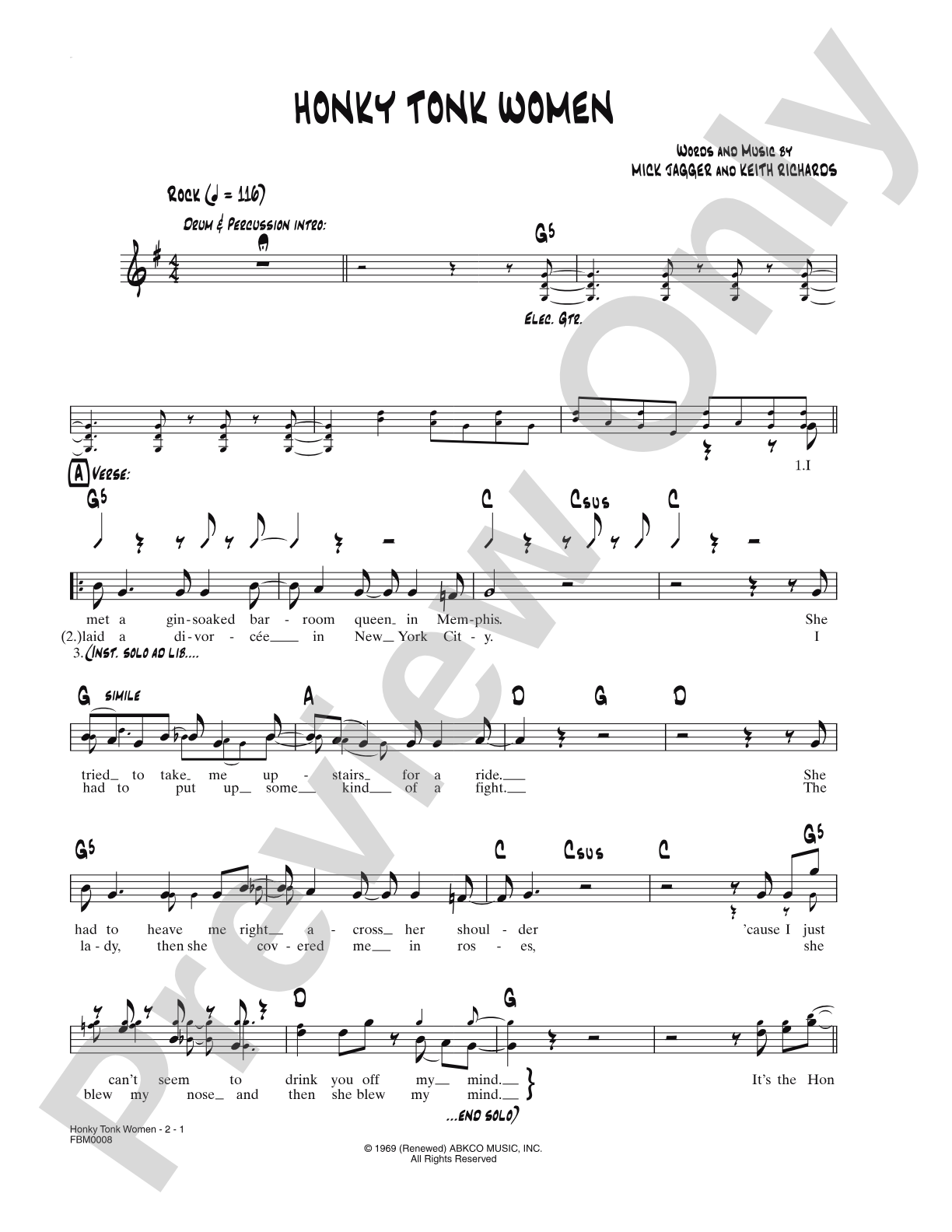

Honky Tonk Women: Lead Sheet
The Rolling Stones
Item: 00-PS-0012217
$4.99
Pickup currently not available
Related Items
(Get Your Kicks On) Route 66: Lead Sheet |
$4.99
|
View | |
Time is on My Side: Lead Sheet |
$4.99
|
View | |
You Better Move On: Lead Sheet |
$4.99
|
View | |
I'm Movin' On: Lead Sheet |
$4.99
|
View | |
Mercy, Mercy: Lead Sheet |
$4.99
|
View | |
If You Need Me: Lead Sheet |
$4.99
|
View | |
Fortune Teller: Lead Sheet |
$4.99
|
View | |
19th Nervous Breakdown: Lead Sheet |
$4.99
|
View | |
2000 Light Years From Home: Lead Sheet |
$4.99
|
View | |
2000 Man: Lead Sheet |
$4.99
|
View | |
2120 South Michigan Avenue: Lead Sheet |
$4.99
|
View | |
All Sold Out: Lead Sheet |
$4.99
|
View | |
All Down the Line: Lead Sheet |
$4.99
|
View | |
As Tears Go By: Lead Sheet |
$4.99
|
View | |
Backstreet Girl: Lead Sheet |
$4.99
|
View | |
Bitch: Lead Sheet |
$4.99
|
View | |
Brown Sugar: Lead Sheet |
$4.99
|
View | |
Blue Turns to Grey: Lead Sheet |
$4.99
|
View | |
Citadel: Lead Sheet |
$4.99
|
View | |
Can't You Hear Me Knocking: Lead Sheet |
$4.99
|
View | |
Child of the Moon: Lead Sheet |
$4.99
|
View | |
Connection: Lead Sheet |
$4.99
|
View | |
Complicated: Lead Sheet |
$4.99
|
View | |
Congratulations: Lead Sheet |
$4.99
|
View | |
Country Honk: Lead Sheet |
$4.99
|
View | |
Dead Flowers: Lead Sheet |
$4.99
|
View | |
Cool, Calm and Collected: Lead Sheet |
$4.99
|
View | |
Dandelion: Lead Sheet |
$4.99
|
View | |
Dear Doctor: Lead Sheet |
$4.99
|
View | |
Don't Lie to Me: Lead Sheet |
$4.99
|
View | |
Doncha Bother Me: Lead Sheet |
$4.99
|
View | |
Downtown Suzie: Lead Sheet |
$4.99
|
View | |
Empty Heart: Lead Sheet |
$4.99
|
View | |
Each and Every Day of the Year: Lead Sheet |
$4.99
|
View | |
Factory Girl: Lead Sheet |
$4.99
|
View | |
Family: Lead Sheet |
$4.99
|
View | |
Gimme Shelter: Lead Sheet |
$4.99
|
View | |
Good Times, Bad Times: Lead Sheet |
$4.99
|
View | |
Flight 505: Lead Sheet |
$4.99
|
View | |
Get Off of My Cloud: Lead Sheet |
$4.99
|
View | |
Goin' Home: Lead Sheet |
$4.99
|
View | |
Gomper: Lead Sheet |
$4.99
|
View | |
Good Times: Lead Sheet |
$4.99
|
View | |
Grown Up Wrong: Lead Sheet |
$4.99
|
View | |
Gotta Get Away: Lead Sheet |
$4.99
|
View | |
Have You Seen Your Mother, Baby, Standing in the Shadow?: Lead Sheet |
$4.99
|
View | |
Heart of Stone: Lead Sheet |
$4.99
|
View | |
High and Dry: Lead Sheet |
$4.99
|
View | |
I Am Waiting: Lead Sheet |
$4.99
|
View | |
I Got the Blues: Lead Sheet |
$4.99
|
View |
Description
The Rolling Stones Fake Book includes 167 classic Stones songs recorded between 1963 and 1971 -- from early blues covers (Chuck Berry and Buddy Holly songs) to the psychedelia of Their Satanic Majesties Request. All songs are in complete, professional-style lead sheets with fundamental instrumental riffs and figures included. There is also a special guitar TAB section, featuring the pivotal guitar riffs and solos from 29 of their most legendary songs, an introductory essay, a full-color ABKCO years discography (with album art), and 40 pages of classic early sheet music covers reproduced in full color. The comb binding creates a lay-flat book that is perfect for study and performance. The ultimate Rolling Stones songbook!


Honky Tonk Women: Lead Sheet isn't in MakeMusic Cloud just yet...but it could be. Let us know you'd like to see it, and you'll help shape what comes next. In the meantime, start a free trial and dive into thousands of interactive titles your students can play along with today.
Request This Title
Tell us you want it.
Start Your Free Trial
Explore everything that's ready to play right now.
Sample Audio
No sample audio found.
Sample Video
No sample videos found.
Additional Details
Series:
Just Real Books Series
Publisher:
Alfred Music
Page Count:
432
SKU:
00-PS-0012217
More about this title
About the Composer: Mick Jagger
Mick Jagger co-wrote "Honky Tonk Women" with Keith Richards, establishing himself as a songwriter capable of crafting memorable melodies and incisive lyrics that defined the Rolling Stones' sound. As the band's lead vocalist and primary lyricist throughout their most creatively fertile period, Jagger demonstrated an instinct for rhythm, phrasing, and narrative that elevated rock and roll songwriting beyond its blues and Chuck Berry foundations.
Jagger's work during the 1960s and early 1970s reflects deep engagement with American blues traditions, country music, and evolving psychedelic and hard rock aesthetics. His songwriting partnership with Richards produced some of rock's most enduring compositions, and his approach to melody and lyrical storytelling continues to inform how guitarists and bandleaders interpret classic rock material.
Why we love this
This lead sheet captures one of rock's most immediately recognizable riffs in readable form, making it accessible for guitarists learning from notation rather than ear alone. The inclusion of fundamental instrumental figures means players can understand the song's architecture beyond just the vocal melody, seeing how the guitar riff, bass movement, and chord changes interlock. For ensemble directors building rock repertoire or guitarists developing lead sheet reading skills, this single entry from a larger songbook offers a tangible entry point into classic rock interpretation.
What to expect
Swagger and swagger alone. The riff owns the space it occupies, propelled by a relentless shuffle groove that sits somewhere between blues stomp and arena rock bombast. There's a lightness beneath the heaviness, a country twang mixed with raw electric energy, and a vocal melody that sits perfectly in the pocket of that iconic figure.
Who it's for
Guitarists working through classic rock standards who want access to professional lead sheets with embedded riff notation rather than relying solely on tab or transcription by ear. Band directors and music teachers building repertoire that spans blues, rock, and popular music traditions will find this useful for classroom study and ensemble performance. Solo performers and practice-focused players benefit from seeing how melody, harmony, and instrumental figures coexist on a single page.
How to get the most out of it
- Lock the rhythmic feel of the signature riff to the kick drum and bass line; the groove lives in that pocket, not in rushing the sixteenth-note figures.
- Study the original recording to absorb the tone and articulation of the opening riff, then translate those phrasing choices into your lead sheet reading.
- Balance the vocal melody's prominence with the riff's character; both compete for attention, so decide whether you're accompanying or trading roles.
- Use the chord changes as anchors for improvisation if extending the form, rather than wandering outside the blues-based harmonic structure.
How to use it
Program this as a bridge piece between a blues or early rock unit and contemporary popular music, showing how the Stones synthesized American roots styles into their own voice. It works equally well as a solo feature for a guitarist in a pop or rock ensemble, or as a teaching example for how instrumental riffs can carry equal weight to vocal melody. For a mixed ensemble, use the lead sheet to identify the core groove and have different sections lock onto different elements of the arrangement.
Skills your students will build
- Reading lead sheets with embedded instrumental figures and riffs
- Understanding blues-based chord progressions and their variations
- Balancing rhythmic pocket with melodic phrasing
- Interpreting guitar-specific notation within standard notation context