
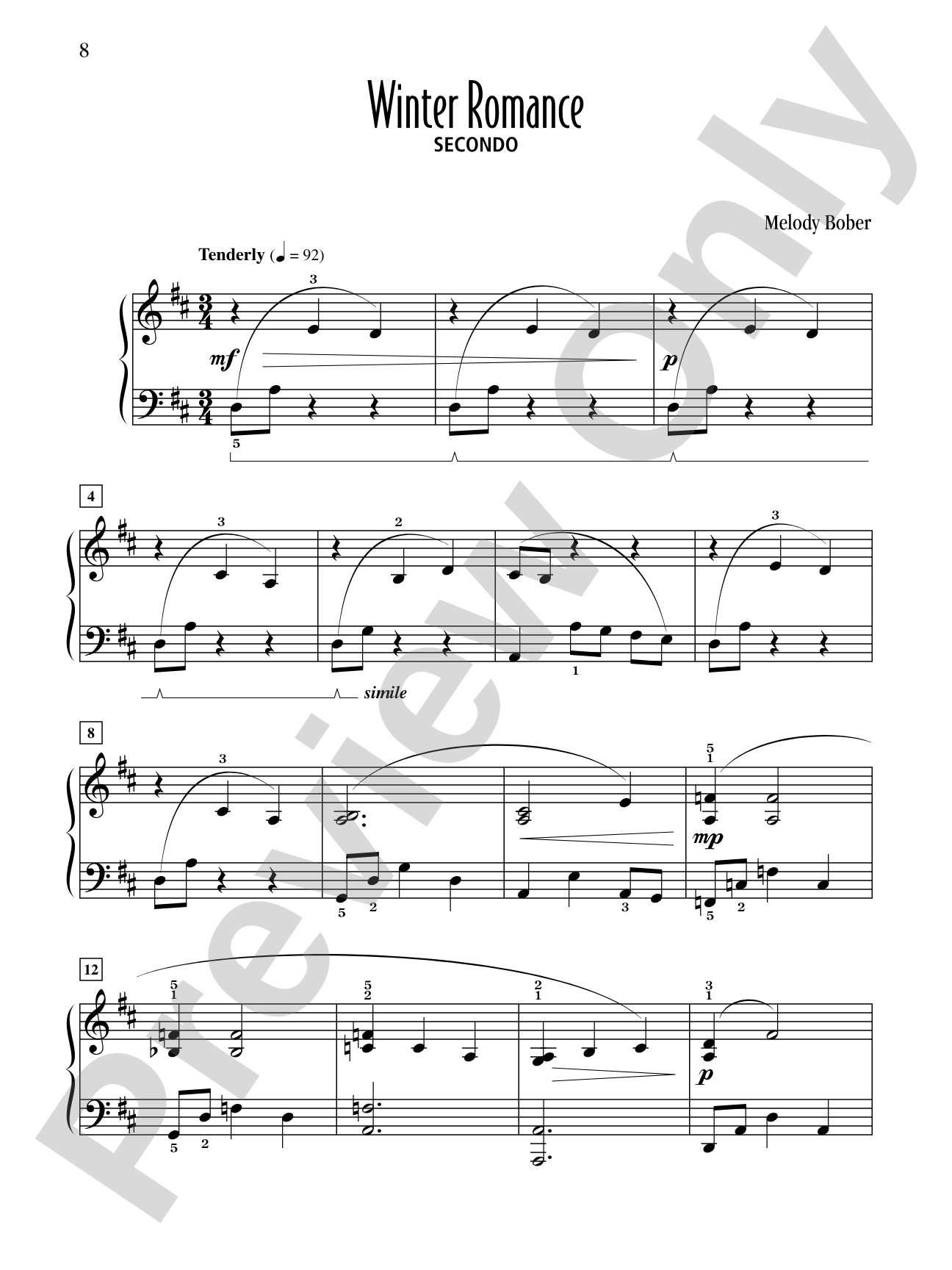
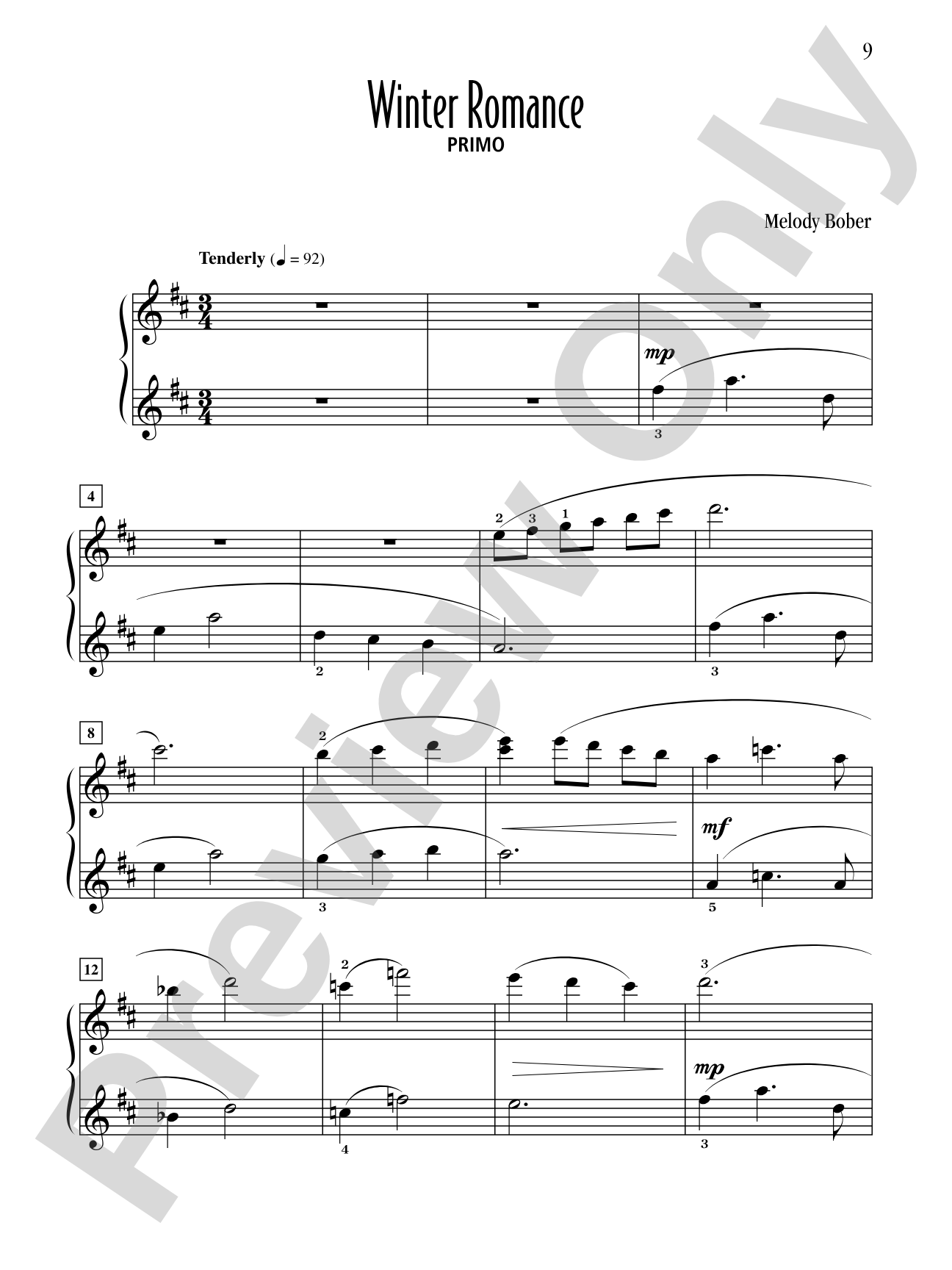

Winter Romance - Piano Duet (1 Piano, 4 Hands): Piano Duet (1 Piano, 4 Hands)
By Melody Bober
Level: Late Intermediate
Item: 00-PS-0017491
$7.99
Pickup currently not available
Related Items
Autumn Ballade - Piano Duet (1 Piano, 4 Hands): Piano Duet (1 Piano, 4 Hands) |
$5.99
|
View | |
Spring Jazz - Piano Duet (1 Piano, 4 Hands): Piano Duet (1 Piano, 4 Hands) |
$5.99
|
View | |
Summer Latin - Piano Duet (1 Piano, 4 Hands): Piano Duet (1 Piano, 4 Hands) |
$5.99
|
View | |
Suite in Season: Piano Book |
$9.99
|
View | |
Suite in Season: Piano Duet Suite (1 Piano, 4 Hands) Book |
$7.99
|
View |
Description
The Music Teachers National Association commissioned Melody Bober to write a collaborative composition for piano and two instruments, suitable for high school performers. Suite in Season for Piano, Flute and Bassoon (#39120) was premiered at the 2012 conference in New York City. Written in four movements, each movement represents a season and has a corresponding style that fits the mood. Shortly after finishing the trio, Melody arranged the suite for piano duet to allow other students to experience the variety of musical styles and genres used in the piece. A Federation Festivals 2024-2028 selection.


Discover MakeMusic Cloud: thousands of interactive titles your students can play along with today.
Sample Audio
No sample audio found.
Sample Video
No sample videos found.
Additional Details
Series:
Duet Recital Suite Series
Publisher:
Alfred Music
Page Count:
28
SKU:
00-PS-0017491
More about this title
About the Composer: Melody Bober

Melody Bober's dual expertise in music education and performance informs everything she writes. Her academic foundation includes a bachelor's degree in music education from the University of Illinois and a Master of Arts in piano performance from Minnesota State University, Moorhead, where she studied under respected teachers including Joel Shapiro and Andrew Froelich.
With two decades of public school teaching and university-level instruction behind her, Bober brings classroom experience to her compositional voice. She remains active as a church pianist, accompanist, and director while maintaining a thriving private studio and serving as a sought-after clinician at piano conferences and workshops across North America. Her work centers on creating pieces that deepen students' musical understanding and genuine engagement with the art form.
Why we love this
Bober's seasonal framework gives you natural programming flexibility while keeping both hands equally engaged throughout the piece. The arrangement from the original trio preserves the distinctive character work that makes Suite in Season memorable, but the piano duet format opens it to far more students than the instrumentation of the original allows. Selecting a Federation Festivals repertoire list ensures this piece meets established standards for musicianship and craft.
What to expect
Each movement inhabits its own world: spring blooms with renewal, summer radiates warmth, autumn carries reflective depth, and winter settles into intimate stillness. The piece moves fluidly between styles, honoring the natural arc of a year while maintaining engaging, idiomatic writing for the keyboard throughout.
Who it's for
Late intermediate pianists ready to experience the musical breadth of a four-movement suite without the complexity of learning a new instrument. Duet partners preparing for festivals, recitals, or simply wanting collaborative repertoire that challenges both players equally. Piano students who benefit from learning different stylistic approaches within a single work.
How to get the most out of it
- Balance the primo and secondo parts carefully in the first season; each hand should articulate its own melodic line without one overwhelming the other.
- Coordinate pedal changes between both players to maintain the impressionistic textures Bober creates, especially in transitions between movements.
- Let the stylistic shifts define your tempo relationships across seasons; resist the urge to play everything at a uniform tempo despite the 28-page length.
- Mark shared rhythmic anchor points in rehearsal so both players lock together during the more active passages without losing the rubato in lyrical sections.
How to use it
Open a recital with Spring to set an energetic tone, or close one with Winter for a reflective ending. The four-movement structure works beautifully as a complete program on a student recital or as part of a thematic concert exploring seasons in music. Consider pairing it with other seasonal works from your repertoire library to reinforce that programming concept.
Skills your students will build
- Reading two independent melodic lines and maintaining separate voicing as primo and secondo
- Coordinating pedal and tempo with another musician in real time
- Interpreting stylistic variety across a single multi-movement work
- Balancing texture and sonority in impressionistic and lyrical writing
- Managing longer solo repertoire with consistent focus and musicality