
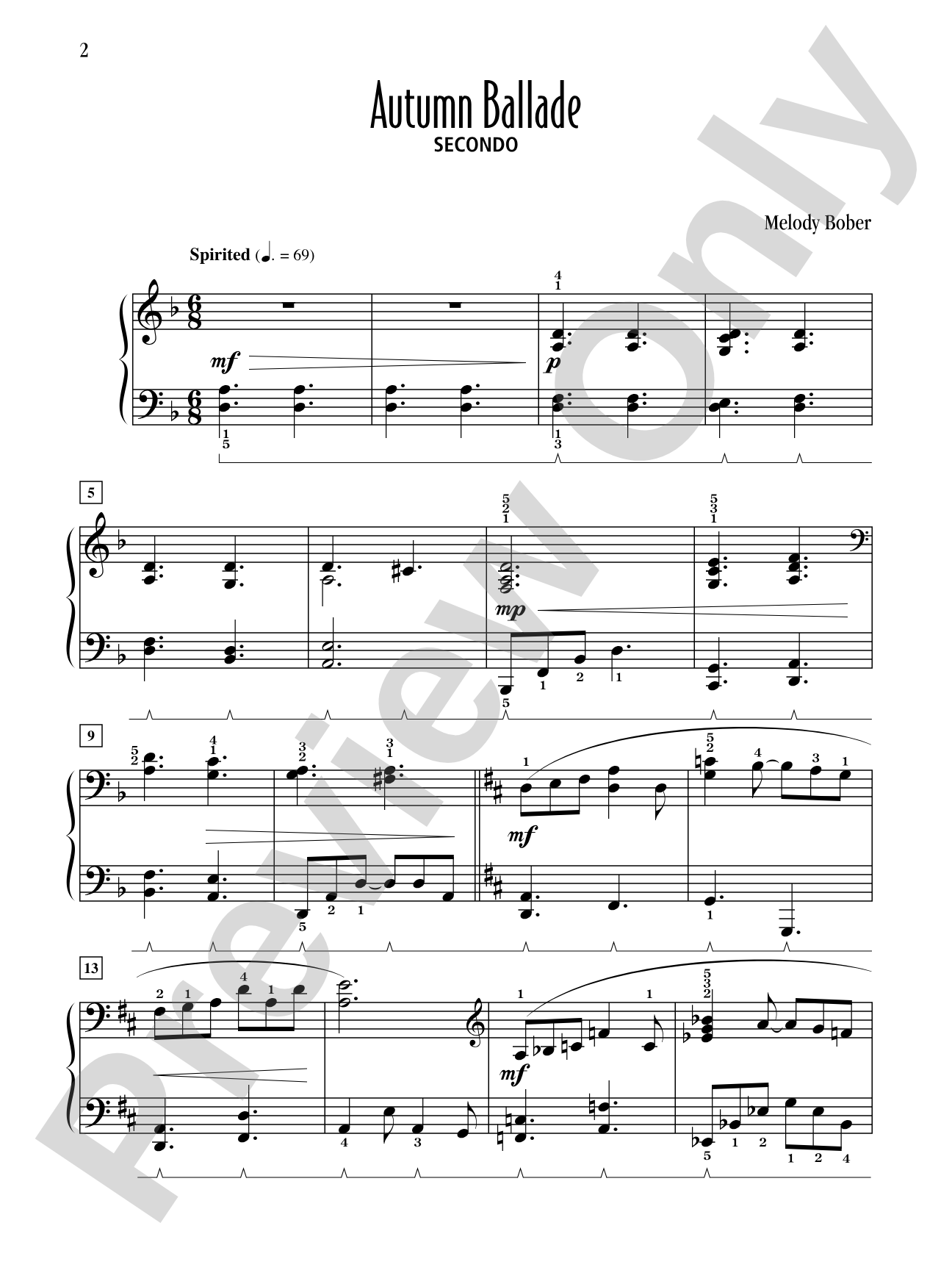
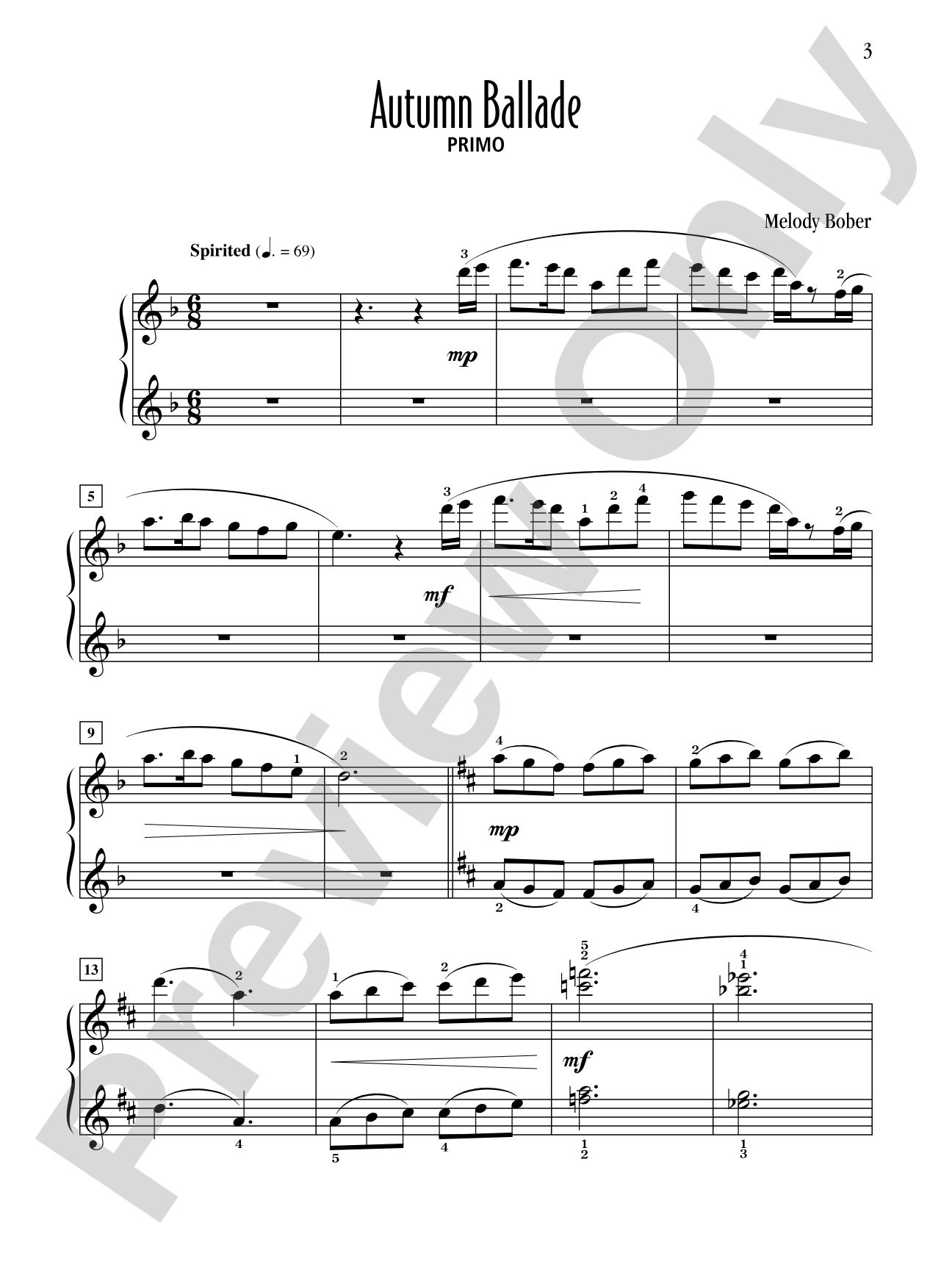

Autumn Ballade - Piano Duet (1 Piano, 4 Hands): Piano Duet (1 Piano, 4 Hands)
By Melody Bober
Level: Late Intermediate
Item: 00-PS-0017488
$5.99
Pickup currently not available
Related Items
Spring Jazz - Piano Duet (1 Piano, 4 Hands): Piano Duet (1 Piano, 4 Hands) |
$5.99
|
View | |
Summer Latin - Piano Duet (1 Piano, 4 Hands): Piano Duet (1 Piano, 4 Hands) |
$5.99
|
View | |
Winter Romance - Piano Duet (1 Piano, 4 Hands): Piano Duet (1 Piano, 4 Hands) |
$7.99
|
View | |
Suite in Season: Piano Book |
$9.99
|
View | |
Suite in Season: Piano Duet Suite (1 Piano, 4 Hands) Book |
$7.99
|
View |
Description
The Music Teachers National Association commissioned Melody Bober to write a collaborative composition for piano and two instruments, suitable for high school performers. Suite in Season for Piano, Flute and Bassoon (#39120) was premiered at the 2012 conference in New York City. Written in four movements, each movement represents a season and has a corresponding style that fits the mood. Shortly after finishing the trio, Melody arranged the suite for piano duet to allow other students to experience the variety of musical styles and genres used in the piece. A Federation Festivals 2024-2028 selection.


Discover MakeMusic Cloud: thousands of interactive titles your students can play along with today.
Sample Audio
No sample audio found.
Sample Video
No sample videos found.
Additional Details
Series:
Duet Recital Suite Series
Publisher:
Alfred Music
Page Count:
28
SKU:
00-PS-0017488
More about this title
About the Composer: Melody Bober

Melody Bober studied music education at the University of Illinois and earned a master's degree in piano performance from Minnesota State University, Moorhead. Her training under pianists Joel Shapiro and Andrew Froelich, combined with her studies in music education and jazz, shaped her distinctive compositional voice.
With two decades in public school music and additional university teaching experience, Bober has built a reputation as both a clinician and innovator. She actively performs as a church pianist and accompanist, and her work appears regularly on piano teacher convention programs across North America. Her compositions consistently balance accessibility with artistic substance, reflecting her deep understanding of what motivates student musicians.
Why we love this
Bober's seasonal suite showcases four distinct musical languages within a single work, exposing duet partners to style exploration that typically requires separate pieces. The arrangement preserves the original trio's character while creating a practical vehicle for student pianists who might not have flute and bassoon partners available. Both players stay genuinely engaged throughout; this isn't a primo-heavy duet where the second player just fills harmony.
What to expect
Each movement inhabits its own emotional landscape, from delicate and introspective to rhythmically spirited. The writing feels conversational rather than decorative; both hands at both pianos are necessary, never arbitrary. Moving between seasons creates natural narrative shape, as if you're watching a year unfold under your fingertips.
Who it's for
High school pianists working toward festival performances or recital partnerships. The late intermediate level welcomes students with solid technique but still-developing stylistic range. Duet pairs benefit especially from the variety; playing through four distinct movements builds interpretive flexibility without requiring four separate repertoire pieces.
How to get the most out of it
- Study the movement titles and seasonal associations before you play. Knowing whether you're evoking spring's awakening or autumn's reflection shapes your tone choices and phrase direction.
- Balance the hand distribution carefully at tempo changes. Mark your part clearly about who leads during transitions between movements so neither player second-guesses.
- Record yourselves early in the learning process. Duet partners often hear balance and rhythmic alignment issues best when they listen back rather than while playing.
How to use it
Consider opening a duet recital with the spring movement to establish energy, then closing with autumn's reflective tone. Alternatively, program all four movements on a student showcase concert to demonstrate range within a single work. The suite also works well in festival competition circuits where variety of style is valued.
Skills your students will build
- Stylistic contrast and modal color shifts (spring vs. autumn character)
- Balanced ensemble playing and listening across four hands
- Tempo and meter negotiation between equal partners
- Interpretive independence within a collaborative framework