
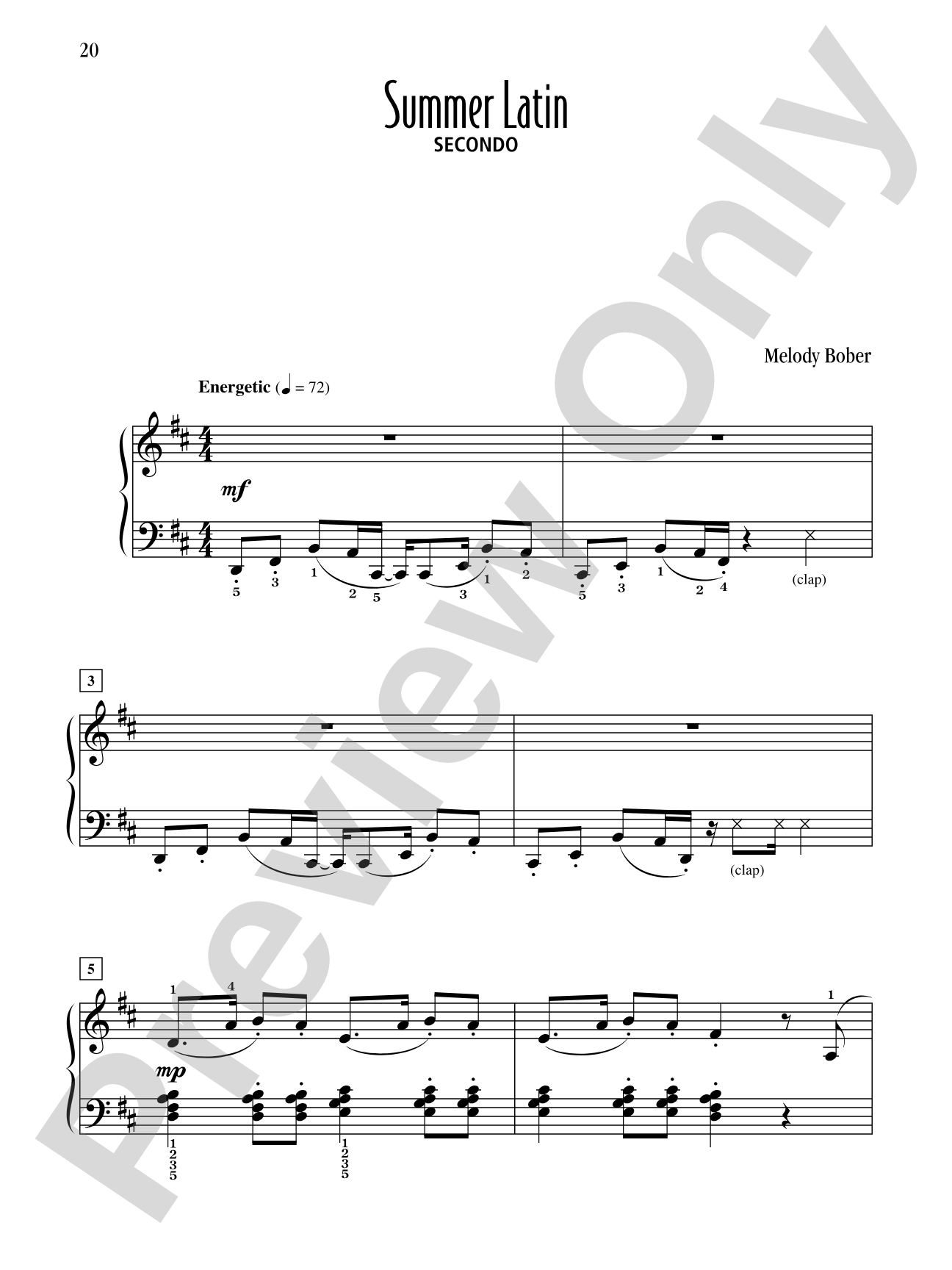
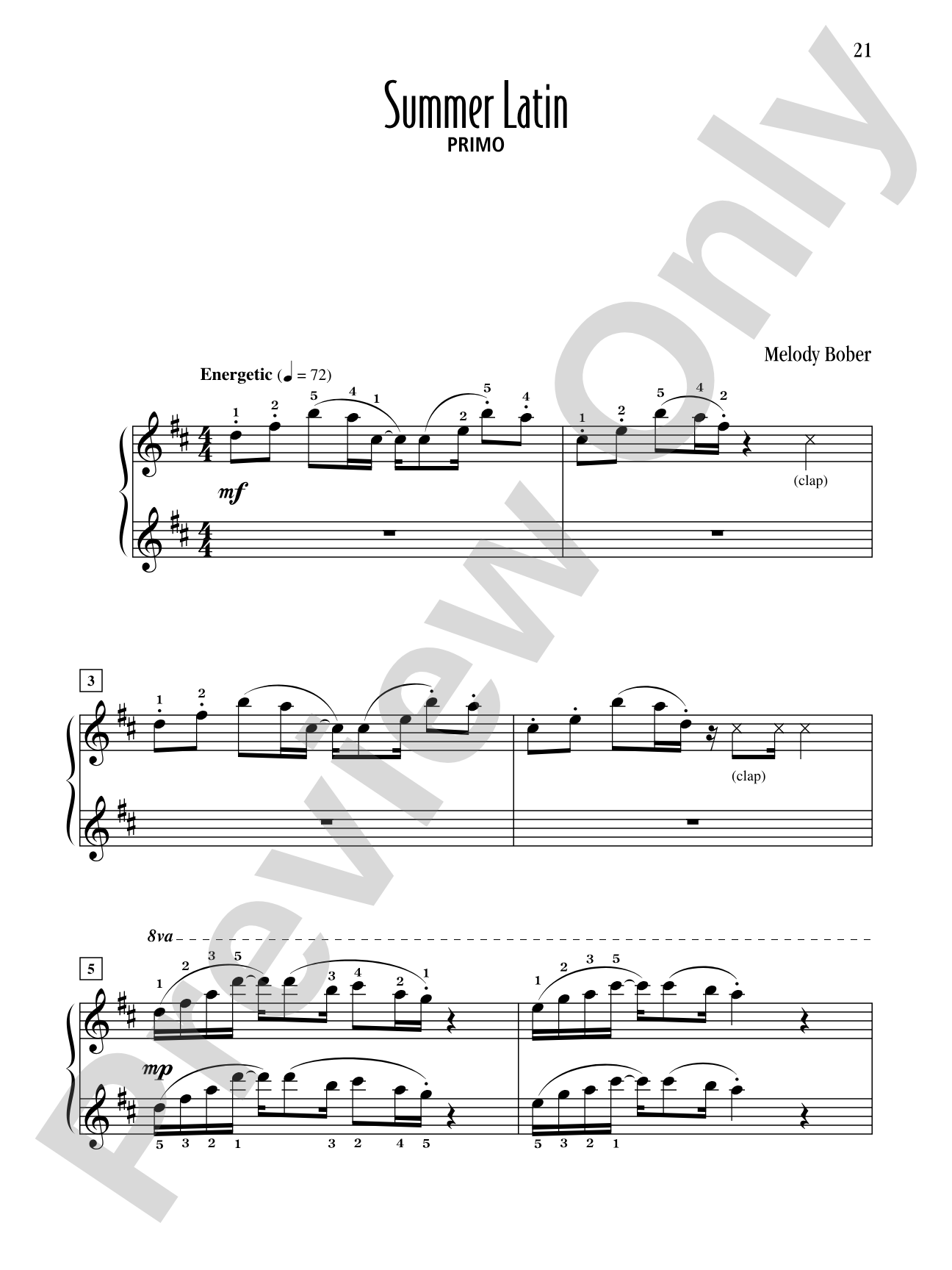

Summer Latin - Piano Duet (1 Piano, 4 Hands): Piano Duet (1 Piano, 4 Hands)
By Melody Bober
Level: Late Intermediate
Item: 00-PS-0017490
$5.99
Pickup currently not available
Related Items
Autumn Ballade - Piano Duet (1 Piano, 4 Hands): Piano Duet (1 Piano, 4 Hands) |
$5.99
|
View | |
Spring Jazz - Piano Duet (1 Piano, 4 Hands): Piano Duet (1 Piano, 4 Hands) |
$5.99
|
View | |
Winter Romance - Piano Duet (1 Piano, 4 Hands): Piano Duet (1 Piano, 4 Hands) |
$7.99
|
View | |
Suite in Season: Piano Book |
$9.99
|
View | |
Suite in Season: Piano Duet Suite (1 Piano, 4 Hands) Book |
$7.99
|
View |
Description
The Music Teachers National Association commissioned Melody Bober to write a collaborative composition for piano and two instruments, suitable for high school performers. Suite in Season for Piano, Flute and Bassoon (#39120) was premiered at the 2012 conference in New York City. Written in four movements, each movement represents a season and has a corresponding style that fits the mood. Shortly after finishing the trio, Melody arranged the suite for piano duet to allow other students to experience the variety of musical styles and genres used in the piece. A Federation Festivals 2024-2028 selection.


Discover MakeMusic Cloud: thousands of interactive titles your students can play along with today.
Sample Audio
No sample audio found.
Sample Video
No sample videos found.
Additional Details
Series:
Duet Recital Suite Series
Publisher:
Alfred Music
Page Count:
28
SKU:
00-PS-0017490
More about this title
About the Composer: Melody Bober

Melody Bober composes with her students at the center of every decision. She holds degrees in music education from the University of Illinois and in piano performance from Minnesota State University, Moorhead, where she studied with respected mentors including Joel Shapiro, Mary Hoffman, and Tony Caramia. Her work spans two decades in public school music education, university instruction, and private studio teaching, complemented by active service as a church pianist and music director.
Demanded regularly as a clinician and presenter at music teacher conferences throughout North America, Bober has developed a gift for writing pieces that motivate students while expanding their musical vocabulary. Her compositions reflect her deep understanding of how students learn and what drives them to engage more fully with music.
Why we love this
This arrangement opens the door to multi-style exploration for a much larger roster of students. Rather than limiting ensemble experience to the original trio, the piano duet format lets any two pianists encounter the same sophisticated variety of musical languages Bober built into her commissioned work, making a MTNA-premiered piece accessible to festival participants and concert programmers everywhere.
What to expect
A musical calendar unfolds across 28 pages, each movement capturing a season's distinctive mood through style and orchestration. You move from one climate to another, discovering how the same instrument pair can sound intimate, energetic, introspective, and celebratory across the suite's arc.
Who it's for
High school pianists seeking duet repertoire that combines technical engagement with musical variety. Student pairs preparing for festival performance or collaborative recital, or pianists who want the ensemble experience of the original trio without needing flute and bassoon partners.
How to get the most out of it
- Balance the inner parts carefully in movements with thicker textures; the secondo player should voice harmonic layers so the primo melody reads clearly without drowning out supporting lines.
- Lean into the stylistic shifts between seasons. Each movement breathes differently, so resist the urge to maintain one interpretive approach across all four; let the character of each season reshape your tempo choices and touch.
- Use the stylistic contrasts as rehearsal checkpoints. Once you've nailed the technical passages, spend time on transitions between movements to clarify how the music marks the passage from one season to the next.
How to use it
Feature this as a duet recital centerpiece, or program individual movements alongside solo repertoire by other composers to create a thematic concert around seasons or style contrasts. It works equally well as a festival entry or as part of a student showcase where collaborative repertoire takes center stage.
Skills your students will build
- Balancing melodic and harmonic roles in duet settings
- Interpreting multiple musical styles and corresponding touch/tempo requirements
- Coordination and ensemble listening between primo and secondo players
- Phrase shaping within programmatic contexts (seasonal imagery)
- Sight-reading variety across contrasting musical textures