
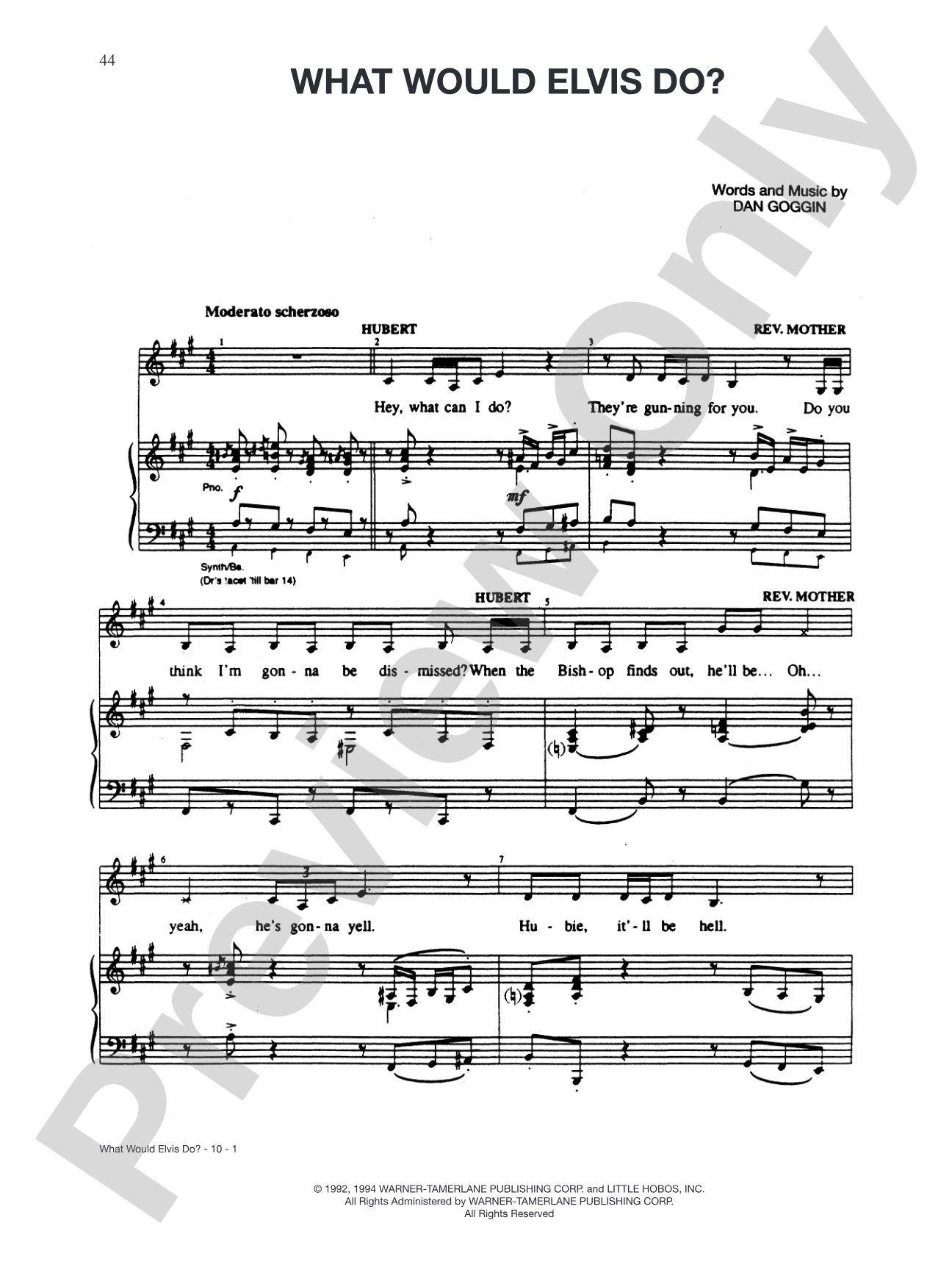
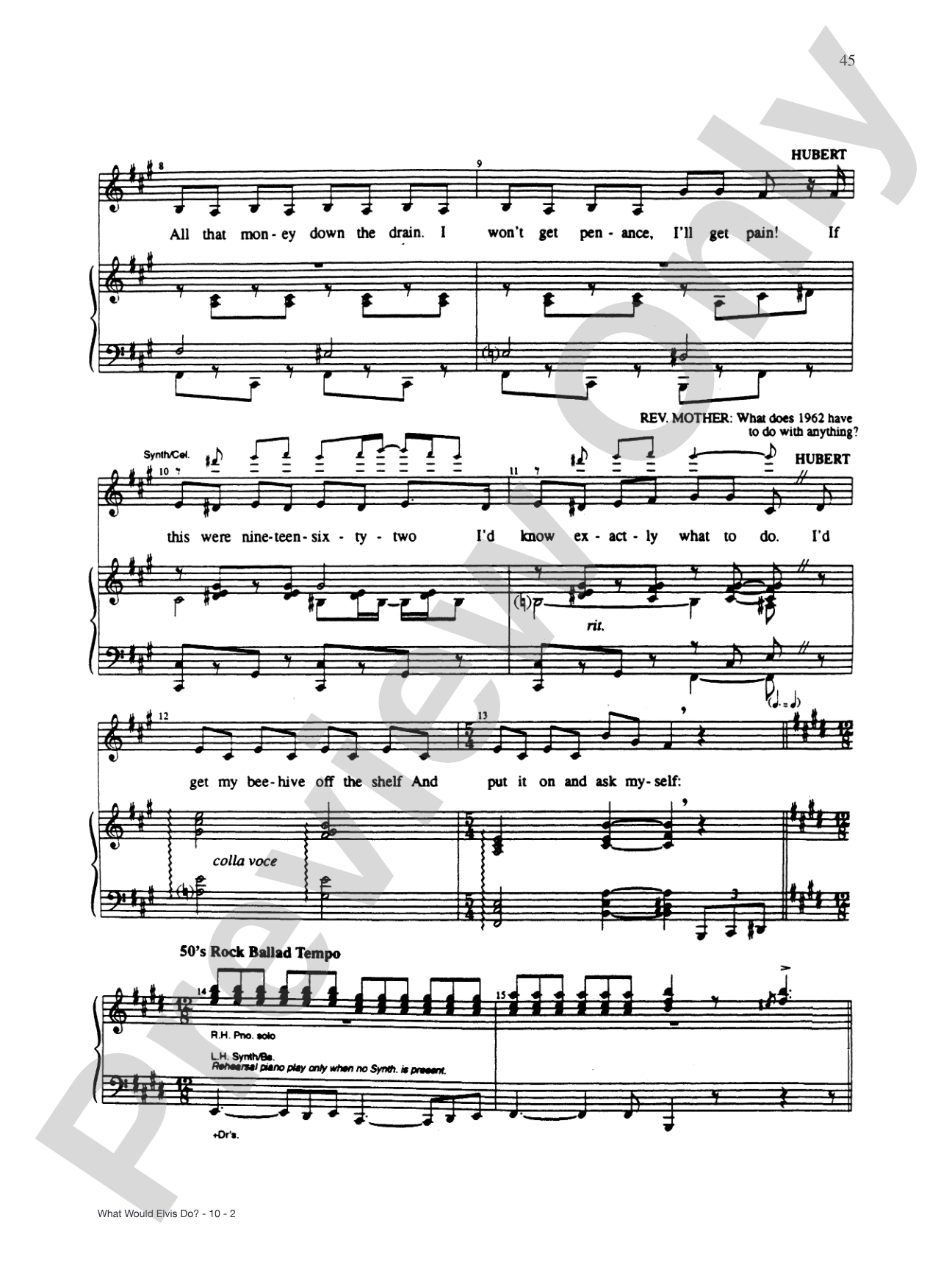

What Would Elvis Do? (from Nunsense II): Piano/Vocal/Chords
Highlights from 6 Classic Nunsense Musicals
Music and lyrics by Dan Goggin
Item: 00-PS-0016098
$9.99
One moment…
Related Items
Nunsense Is Habit-Forming (from Nunsense): Piano/Vocal/Chords |
$5.99
|
View | |
Growing Up Catholic (from Nunsense): Piano/Vocal/Chords |
$4.99
|
View | |
I Just Want to Be a Star (from Nunsense): Piano/Vocal/Chords |
$5.99
|
View | |
I Could’ve Gone to Nashville (from Nunsense): Piano/Vocal/Chords |
$5.99
|
View | |
Holier Than Thou (from Nunsense): Piano/Vocal/Chords |
$5.99
|
View | |
I Am Here to Stay (from Nunsense II): Piano/Vocal/Chords |
$5.99
|
View | |
No One Cared Like You (from Nunsense II): Piano/Vocal/Chords |
$5.99
|
View | |
Play a Country Enut (from Sister Amnesia's Country Western Nunsense Jamboree): Piano/Vocal/Chords |
$5.99
|
View | |
Every Day of the Week Is a Saturday (from Sister Amnesia's Country Western Nunsense Jamboree): Piano/Vocal/Chords |
$5.99
|
View | |
The Delta Queen (from Sister Amnesia's Country Western Nunsense Jamboree): Piano/Vocal/Chords |
$5.99
|
View | |
All I Want for Christmas (from Nuncrackers): Piano/Vocal/Chords |
$5.99
|
View | |
The Christmas Box (from Nuncrackers): Piano/Vocal/Chords |
$5.99
|
View | |
Santa Ain’t Comin’ to Our House (from Nuncrackers): Piano/Vocal/Chords |
$5.99
|
View | |
A Love Like This (from Meshuggah-Nuns): Piano/Vocal/Chords |
$5.99
|
View | |
I’ll Find a Song to Sing (from Meshuggah-Nuns): Piano/Vocal/Chords |
$5.99
|
View | |
Say It in Yiddish (from Meshuggah-Nuns): Piano/Vocal/Chords |
$5.99
|
View | |
If I Were a Catholic (from Meshuggah-Nuns): Piano/Vocal/Chords |
$4.99
|
View | |
My Fat Is My Fortune (from Meshuggah-Nuns): Piano/Vocal/Chords |
$5.99
|
View | |
Life Is a Game of Chance (from Nunsensations): Piano/Vocal/Chords |
$5.99
|
View | |
A Long, Long Way (from Nunsensations): Piano/Vocal/Chords |
$5.99
|
View | |
I Left Him There (from Nunsensations): Piano/Vocal/Chords |
$4.99
|
View | |
Double or Nothin’ (from Nunsensations): Piano/Vocal/Chords |
$4.99
|
View |
Description
Commemorate the 25th anniversary of Nunsense with Nunsense: The 25th Nunniversary Songbook, arranged for Piano/Vocal/Chords.
Titles: A Long, Long Way * A Love Like This * All I Want for Christmas * The Christmas Box * The Delta Queen * Double or Nothin' * Every Day of the Week Is a Saturday * Growing Up Catholic * Holier Than Thou * I Am Here to Stay * I Could've Gone to Nashville * I Just Want to Be a Star * I Left Him There * I'll Find a Song to Sing * If I Were a Catholic * Life Is a Game of Chance * My Fat Is My Fortune * No One Cared Like You * Nunsense Is Habit-Forming * Play a Country Enut * Santa Ain't Comin' to Our House * Say It in Yiddish * What Would Elvis Do?.


Titles: A Long, Long Way * A Love Like This * All I Want for Christmas * The Christmas Box * The Delta Queen * Double or Nothin' * Every Day of the Week Is a Saturday * Growing Up Catholic * Holier Than Thou * I Am Here to Stay * I Could've Gone to Nashville * I Just Want to Be a Star * I Left Him There * I'll Find a Song to Sing * If I Were a Catholic * Life Is a Game of Chance * My Fat Is My Fortune * No One Cared Like You * Nunsense Is Habit-Forming * Play a Country Enut * Santa Ain't Comin' to Our House * Say It in Yiddish * What Would Elvis Do?.
What Would Elvis Do? (from Nunsense II): Piano/Vocal/Chords isn't in MakeMusic Cloud just yet...but it could be. Let us know you'd like to see it, and you'll help shape what comes next. In the meantime, start a free trial and dive into thousands of interactive titles your students can play along with today.
Request This Title
Tell us you want it.
Start Your Free Trial
Explore everything that's ready to play right now.
Sample Audio
No sample audio found.
Sample Video
No sample videos found.
Additional Details
Publisher:
Alfred Music
Page Count:
168
SKU:
00-PS-0016098
More about this title
About the Composer: Dan Goggin
Dan Goggin is the composer and lyricist behind Nunsense, the longest-running off-Broadway musical in history. His gift for irreverent humor paired with genuine melodic charm created a phenomenon that has entertained audiences for decades through countless productions, revivals, and adaptations across stages worldwide.
Goggin's work demonstrates how comedy and musicality reinforce each other. His songs balance witty, character-driven lyrics with accessible melodies that singers and pianists genuinely enjoy learning and performing. For music educators, his catalog offers an exceptional resource for teaching contemporary musical theater repertoire that engages both performers and audiences.
Why we love this
This songbook captures the anarchic joy that made Nunsense a cultural touchstone. Goggin's songs are deceptively well-crafted; beneath the comedic premise lies solid musicianship that rewards careful preparation and pays off brilliantly in performance.
What to expect
Irreverent, playful, and genuinely affectionate. This music bounces along with theatrical energy while maintaining enough melodic substance to satisfy singers who care about craft. The piano writing is accessible without being simplistic, leaving room for personality and interpretation.
Who it's for
Singers preparing audition material or performance roles from Nunsense productions; pianists accompanying community theater, school, or professional productions; voice students seeking contemporary musical theater repertoire that combines humor with solid vocal writing.
How to get the most out of it
- Study the lyrical intent behind each comedic moment. The humor lands hardest when singers commit fully to character and emotional truth, not when they wink at the audience.
- Balance the vocal line against the piano accompaniment by listening carefully to how Goggin uses the keyboard to support rather than compete with the melody.
- Mark your breath points and phrasing in pencil before rehearsals begin; the song structures sometimes follow theatrical timing rather than traditional musical phrase lengths.
- Lean into the rhythmic specificity of the accompaniment patterns, particularly in uptempo numbers where the piano groove drives the overall energy.
How to use it
Program individual songs as comedy relief or character moments within a larger concert of musical theater selections. This piece works particularly well in audition showcases for musical theater programs, or as a solo feature within a cabaret or revue setting.
Skills your students will build
- Balancing comedic delivery with musical phrasing in a theatrical context
- Reading and interpreting chord symbols for creative piano voicing
- Sustaining character consistency through song performance
- Handling rhythmic variation between vocal line and accompaniment patterns