
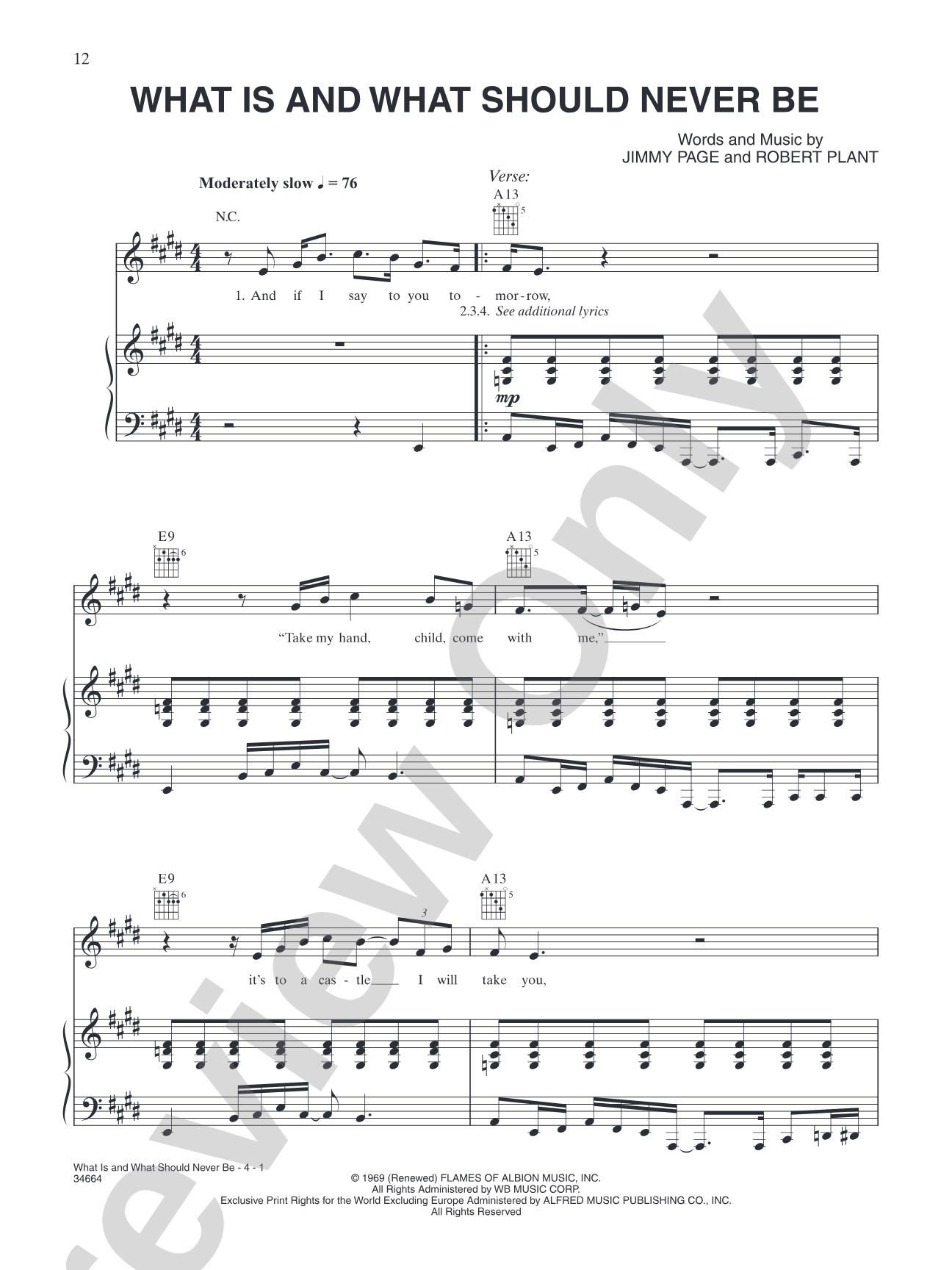

What Is and What Should Never Be: Piano/Vocal/Chords
Led Zeppelin
Item: 00-XS-0000093
$4.99
Pickup currently not available
Related Items
Heartbreaker: Authentic Guitar TAB |
$9.99
|
View | |
Living Loving Maid (She's Just a Woman): Authentic Guitar TAB |
$5.99
|
View | |
Moby Dick: Authentic Guitar TAB |
$4.99
|
View | |
Ramble On: Authentic Guitar TAB |
$9.99
|
View | |
Thank You: Authentic Guitar TAB |
$5.99
|
View | |
What Is and What Should Never Be: Authentic Guitar TAB |
$4.99
|
View | |
Whole Lotta Love: Authentic Guitar TAB |
$5.99
|
View | |
Whole Lotta Love: Piano/Vocal/Chords |
$4.99
|
View | |
Living Loving Maid: Piano/Vocal/Chords |
$4.99
|
View | |
Moby Dick: Piano/Vocal/Chords |
$4.99
|
View | |
Led Zeppelin: II Platinum Album Edition: Authentic Guitar TAB Book |
$24.99
|
View | |
Led Zeppelin: II Platinum Album Edition: Drum Transcriptions Book |
$19.99
|
View | |
Led Zeppelin: II Platinum Album Edition: Piano/Vocal/Chords Book |
$19.99
|
View | |
Led Zeppelin: II Platinum Album Edition: Authentic Bass TAB Book |
$16.99
|
View |
Description
Matching piano/vocal/guitar songbook to Led Zeppelin's second album, featuring detailed arrangements that capture all the nuances, including the intense bass lines of John Paul Jones and keyboard renditions of the essential guitar parts. Keyboardists, you're in for some fun: grab that pitch-bender and play the entire "Heartbreaker" guitar solo note-for-note. Guitar World magazine editor Brad Tolinski provides an insightful historical foreword, and Robert Plant has officially certified the accuracy of the lyrics. Titles: Whole Lotta Love * What Is and What Should Never Be * The Lemon Song * Thank You * Heartbreaker * Living Loving Maid (She's Just a Woman) * Ramble On * Moby Dick * Bring It on Home.


What Is and What Should Never Be: Piano/Vocal/Chords isn't in MakeMusic Cloud just yet...but it could be. Let us know you'd like to see it, and you'll help shape what comes next. In the meantime, start a free trial and dive into thousands of interactive titles your students can play along with today.
Request This Title
Tell us you want it.
Start Your Free Trial
Explore everything that's ready to play right now.
Sample Audio
No sample audio found.
Sample Video
No sample videos found.
Additional Details
Series:
Alfred's Platinum Album Editions
Publisher:
Alfred Music
Page Count:
60
SKU:
00-XS-0000093
More about this title
About the Composer: Jimmy Page
Jimmy Page built Led Zeppelin's signature sound through innovative studio techniques, layered guitar textures, and a deep knowledge of blues tradition that he transformed into something entirely new. As both guitarist and primary architect of the band's arrangements, Page created some of rock music's most enduring riffs and compositional frameworks, influencing generations of musicians across genres.
Why we love this
This songbook captures Led Zeppelin II in a way that demands serious musicianship from pianists and singers. The keyboard arrangements of Page's iconic guitar parts, combined with John Paul Jones's thunderous bass lines rendered in readable notation, give your ensemble access to arrangements that respect the original while unlocking these classics for multi-instrumental performance. Having Robert Plant's official certification of lyric accuracy means you're working from the source.
What to expect
Raw power wrapped in intricate detail. These arrangements respect the swagger and intensity of the original performances while translating electric guitar heroics and bass fundamentals into piano and keyboard language that feels equally commanding. You'll hear the weight of the rhythm section and the architectural precision of Page's compositional choices come into sharp focus.
Who it's for
Pianists and keyboardists who want to perform Led Zeppelin material with full harmonic and melodic accuracy, as well as singers seeking authentic arrangements of these classics with professional-quality accompaniment. Intermediate to advanced musicians will find the transcriptions both playable and musically substantial.
How to get the most out of it
- Treat the pitch-bender as an essential expressive tool in 'Heartbreaker,' especially when executing the guitar solo voicings on keyboard; practice the note-for-note transcription slowly before adding the bend articulation.
- Lock the bass line and keyboard foundation first in 'Whole Lotta Love' and 'Ramble On' to establish the groove that these songs demand; the vocal melody will sit much more naturally once the rhythmic foundation is locked.
- Study the dynamic range indicated in the arranged passages; these songs live and die on the contrast between the driving sections and the more sparse, atmospheric moments.
- Coordinate any piano/keyboard doubling with the vocalist so the texture either thickens intentionally or steps back to support rather than compete with the melody.
How to use it
Feature a pianist and vocalist in a recital celebrating rock songwriting, or use individual songs as dramatic concert programming pieces that showcase your ensemble's ability to honor classic rock arrangements seriously. The historical foreword by Brad Tolinski adds educational value if you're programming music history or genre study into a concert context.
Skills your students will build
- Reading complex piano accompaniment patterns with integrated bass lines
- Executing pitch-bend and expressive techniques on keyboard to capture stylistic nuance
- Coordinating vocal melody with keyboard arrangement to balance support and transparency
- Interpreting dynamic and articulation markings in transcribed rock arrangements
- Understanding how electric guitar voicings and techniques translate to keyboard texture