

Watu Wote (All the People---Swahili): 2-Part/SSA Choral Octavo
(All the People -- Swahili)
Music by Sally K. Albrecht and Jay Althouse
Item: 00-PO-0002230
$2.95
Minimum order quantity: 20 copies
Pickup currently not available
Related Items
Watu Wote: SoundTrax Digital Audio Download |
$27.99
|
View | |
Watu Wote (All the People -- Swahili): SATB Choral Octavo |
$2.95
|
View | |
Watu Wote: 3-Part Mixed Choral Octavo |
$2.20
|
View | |
Watu Wote: SATB Choral Octavo |
$2.95
|
View | |
Watu Wote: 3-Part Mixed Choral Octavo |
$2.20
|
View | |
Watu Wote: 2-Part/SSA Choral Octavo |
$2.95
|
View | |
Watu Wote: Choral Octavo SoundTrax CD |
$27.99
|
View |
Description
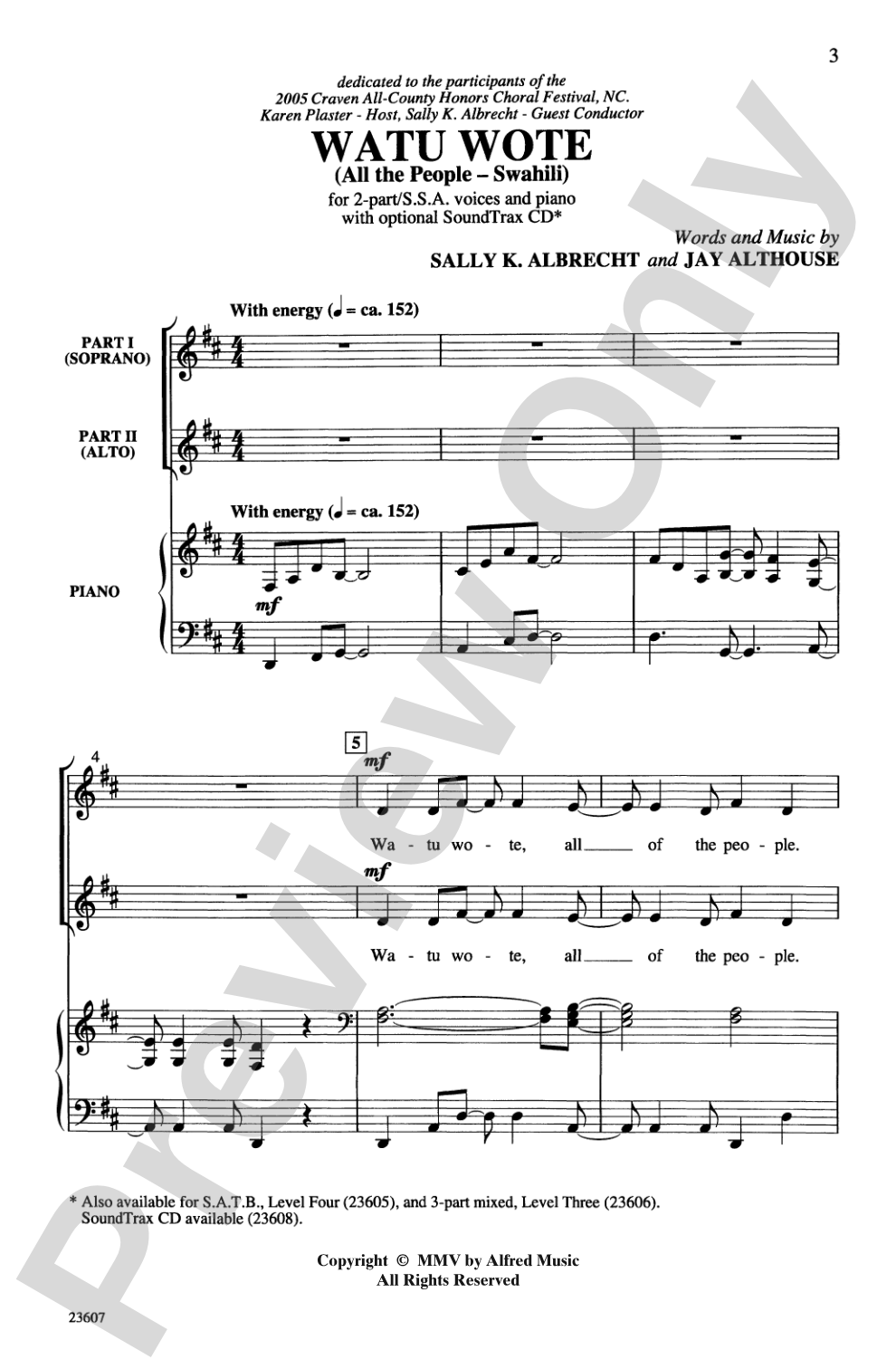
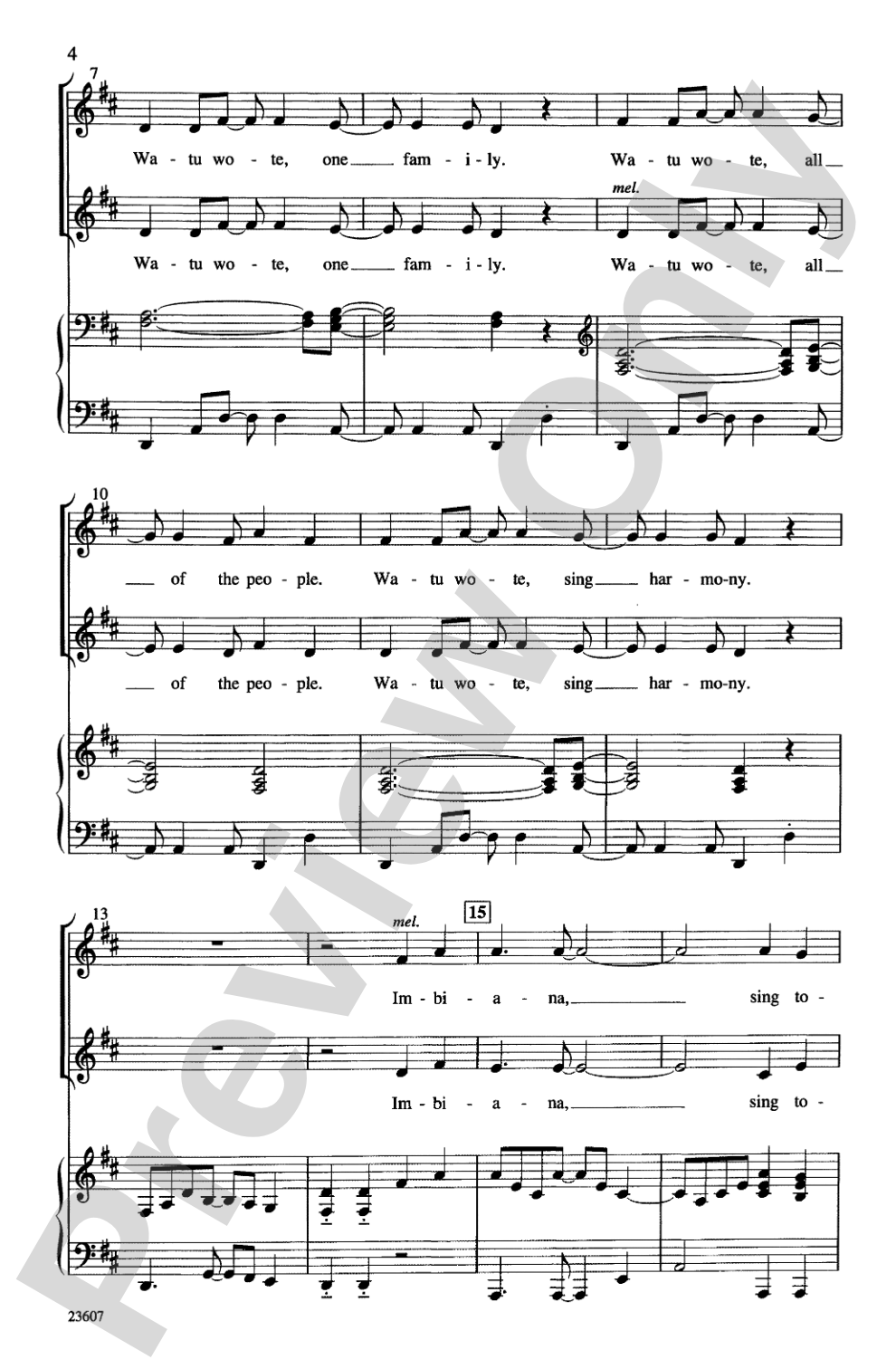
Sally and Jay are known for their excellent multicultural compositions and this new one continues the tradition in a whole new way. "All the people sing in harmony" loosely translates the message of this African influenced chorus sung on alternating Swahili and English words. Upbeat and up-to-date. Add Sally's choreography from the DVD #23853 or VHS #23855, and use the energized CD for added effect.


Watu Wote (All the People---Swahili): 2-Part/SSA Choral Octavo isn't in MakeMusic Cloud just yet...but it could be. Let us know you'd like to see it, and you'll help shape what comes next. In the meantime, start a free trial and dive into thousands of interactive titles your students can play along with today.
Request This Title
Tell us you want it.
Start Your Free Trial
Explore everything that's ready to play right now.
Sample Audio
1
Audio File
--:--
0:00
0:00
Sample Video
No sample videos found.
Additional Details
Series:
Alfred Archive Edition: Alfred Choral Designs
Publisher:
Alfred Music
Page Count:
16
SKU:
00-PO-0002230
More about this title
About the Composer: Sally K. Albrecht
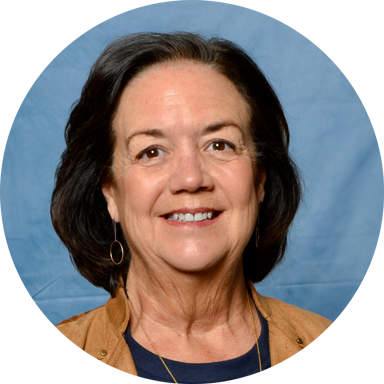
Sally K. Albrecht has established herself as one of the most prolific and recognized voices in multicultural choral music. A conductor, clinician, and ASCAP award recipient since 1987, she has placed over 600 choral works in print alongside 75 larger musicals and songbooks. Her career spans decades of service directing honor choirs at major venues including Lincoln Center, Carnegie Hall, and The Kennedy Center, and she spent more than thirty years shaping choral publications as Director of School Choral, Vocal, and Elementary Publications for leading educational music publishers, including Alfred Music.
Albrecht holds degrees from Rollins College (B.A. in Music and Theater, 1976), the University of Miami (M.A. in Drama, 1977; M.M. in Accompanying, 1979), and has taught at Oakland University, Jersey City State College, and Meredith College. Recognized for her distinctive integration of movement and staging into choral learning, she has served as Chair of the Board of Trustees for the Omicron Delta Kappa National Leadership Honor Society and received their Pillar of Leadership award. In 2021, both the University of Miami Frost School of Music and Rollins College honored her with Distinguished Alumna Awards. She lives in Wake Forest, North Carolina, with her husband Jay Althouse, a composer and arranger in his own right.
Why we love this
Albrecht and Althouse craft a piece that balances genuine multicultural authenticity with accessibility for young singers. The alternation between Swahili and English text creates natural phrasing opportunities while reinforcing the song's message of unity, and the upbeat energy makes this engaging enough to hold students' attention through rehearsal and performance.
What to expect
Watu Wote radiates warmth and forward motion. The blending of Swahili and English creates a conversation that feels both fresh and grounded, while the harmonic language keeps things modern without losing accessibility. This is music that invites movement, celebrates community, and leaves singers and audiences energized.
Who it's for
This piece works beautifully for middle and high school choirs, particularly those looking to expand their multicultural repertoire with something musically engaging rather than token. It suits ensembles of mixed voice ranges (SSA voicing allows flexibility) and appeals to singers who respond to contemporary energy and meaningful cultural content.
How to get the most out of it
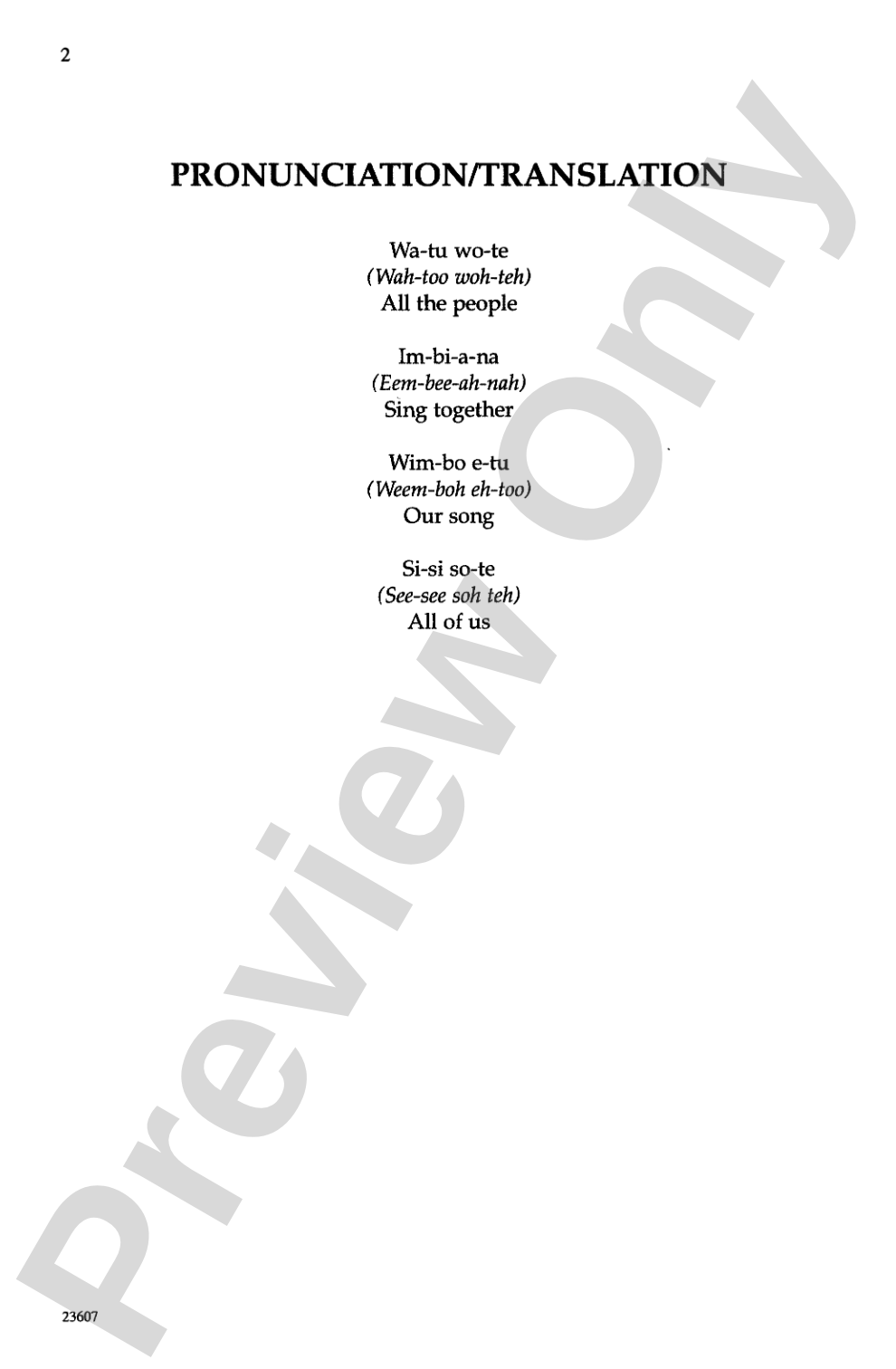
- Honor the Swahili pronunciation by working through the phonetic guide carefully during early rehearsals; clarity in the non-English text strengthens the song's cultural integrity and student engagement.
- Layer in the choreography progressively rather than all at once; give singers time to secure the music before adding movement, then integrate staging gradually so both elements feel natural together.
- Use the recorded accompaniment during rehearsals to lock the rhythmic energy, particularly in sections where the two parts move independently.
- Pay attention to the harmonic balance between the two parts, especially where they diverge; the arrangement's effectiveness depends on both lines being equally present and clear.
How to use it
Program this as a concert opener or second piece to establish an uplifting tone, or use it in a set exploring world cultures and languages. The optional choreography makes it equally effective as a concert feature or a community engagement tool; the recorded accompaniment also works well for assembly performances or school cultural events where rehearsal time is limited.
Skills your students will build
- Singing in a non-English language with accurate pronunciation and clear articulation
- Reading and performing two independent choral lines in 2-Part/SSA voicing
- Integrating movement and staging with singing while maintaining musical focus
- Understanding call-and-response and alternating phrase structures common in African musical traditions