
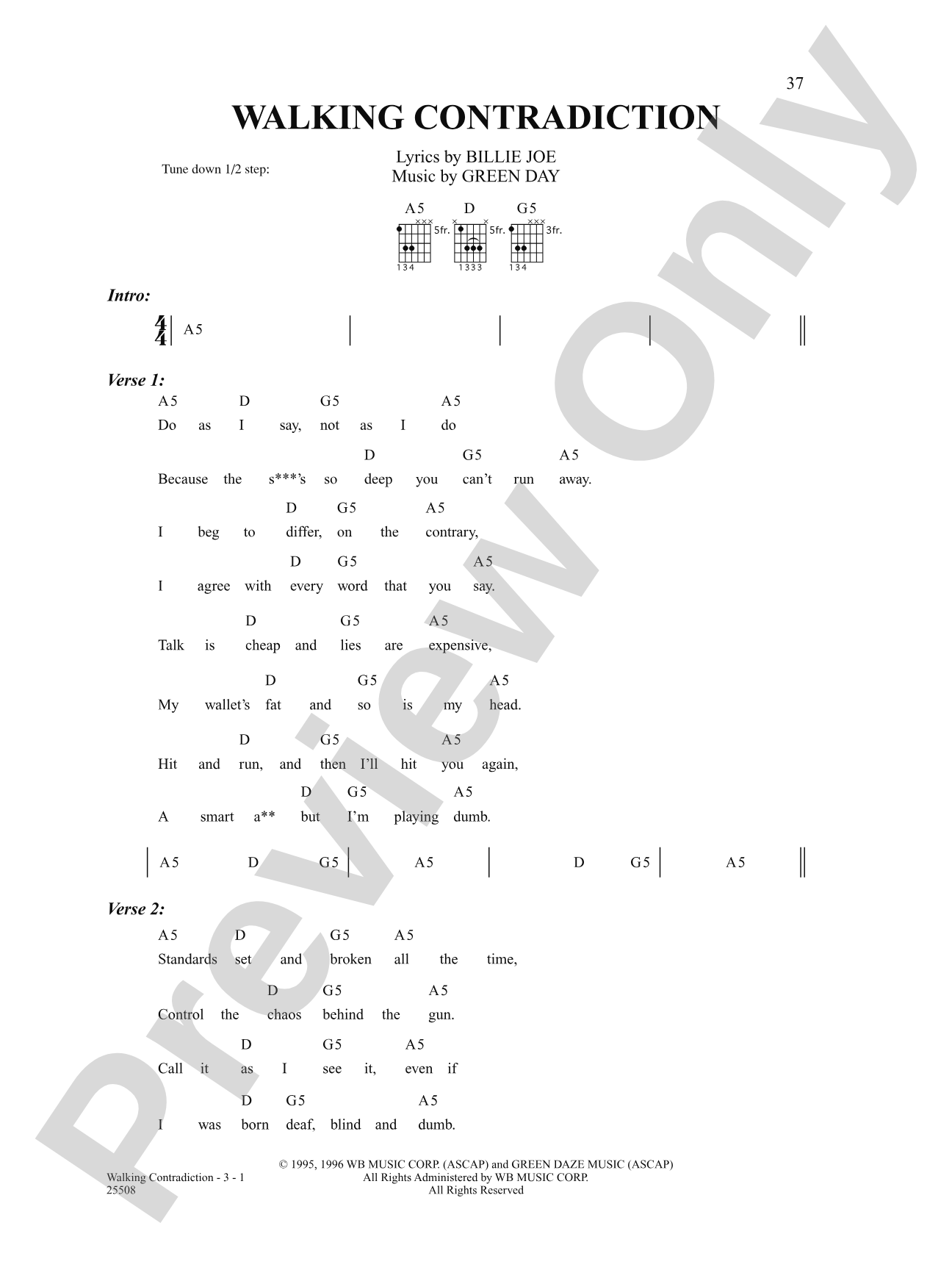

Walking Contradiction: Strum and Sing
Green Day
Item: 00-PS-0000170
$4.99
One moment…
Related Items
Nice Guys Finish Last: Strum and Sing |
$4.99
|
View | |
Hitchin' a Ride: Strum and Sing |
$4.99
|
View | |
Redundant: Strum and Sing |
$4.99
|
View | |
Good Riddance (Time of Your Life): Strum and Sing |
$4.99
|
View | |
Warning: Strum and Sing |
$4.99
|
View | |
Waiting: Strum and Sing |
$4.99
|
View | |
Minority: Strum and Sing |
$4.99
|
View | |
Macy's Day Parade: Strum and Sing |
$4.99
|
View | |
Maria: Strum and Sing |
$4.99
|
View | |
Poprocks and Coke: Strum and Sing |
$4.99
|
View | |
Longview: Strum and Sing |
$4.99
|
View | |
Welcome to Paradise: Strum and Sing |
$4.99
|
View | |
Basket Case: Strum and Sing |
$4.99
|
View | |
She: Strum and Sing |
$4.99
|
View | |
When I Come Around: Strum and Sing |
$4.99
|
View | |
Stuck With Me: Strum and Sing |
$4.99
|
View | |
Geek Stink Breath: Strum and Sing |
$4.99
|
View | |
Brain Stew: Strum and Sing |
$4.99
|
View | |
Jaded: Strum and Sing |
$4.99
|
View | |
J.A.R. (Jason Andrew Relva): Strum and Sing |
$4.99
|
View | |
American Idiot: Strum and Sing |
$4.99
|
View | |
Holiday: Strum and Sing |
$4.99
|
View | |
Wake Me Up When September Ends: Strum and Sing |
$4.99
|
View | |
Boulevard of Broken Dreams: Strum and Sing |
$4.99
|
View |
Description
Twenty-five of Green Day's greatest hits, arranged in an easy-to-use lyric and chord songbook format. All lyrics with the correct guitar chords placed above throughout. Plus, important riffs are included in tablature as well. Titles include: American Idiot * Basket Case * Boulevard of Broken Dreams * Brain Stew * Geek Stink Breath * Good Riddance (Time of Your Life) * Hitchin' a Ride * Holiday * Jaded * J.A.R. (Jason Andrew Relva) * Longview * Macy's Day Parade * Maria * Minority * Nice Guys Finish Last * Poprocks & Coke * Redundant * She * Stuck with Me * Waiting * Wake Me Up When September Ends * Walking Contradiction * Warning * Welcome to Paradise * When I Come Around.


Walking Contradiction: Strum and Sing isn't in MakeMusic Cloud just yet...but it could be. Let us know you'd like to see it, and you'll help shape what comes next. In the meantime, start a free trial and dive into thousands of interactive titles your students can play along with today.
Request This Title
Tell us you want it.
Start Your Free Trial
Explore everything that's ready to play right now.
Sample Audio
No sample audio found.
Sample Video
No sample videos found.
Additional Details
Publisher:
Alfred Music
Page Count:
64
SKU:
00-PS-0000170
More about this title
About the Composer: Green Day
Green Day emerged from the East Bay punk scene in the early 1990s and became one of rock music's most influential and commercially successful bands. Their 1994 album Dookie introduced punk rock to mainstream audiences, while their 2004 rock opera American Idiot cemented their status as generational voices addressing social and political themes. Across three decades, they have sold tens of millions of records worldwide and influenced countless musicians across rock, pop-punk, and alternative genres.
For music educators and students, Green Day's catalog offers accessible entry points into rock guitar playing. Their songs balance memorable melodies with straightforward chord progressions, making them ideal for developing guitarists who want to play songs they genuinely connect with. The band's rhythmic clarity and production quality also make their recordings excellent references for understanding how chords, riffs, and song structure work together in contemporary music.
Why we love this
This collection captures the songs that actually get students excited to pick up a guitar. Rather than asking young players to learn from instructional etudes, this songbook lets them engage with music they know and love while building real chops. The inclusion of both chord charts and tablature for key riffs means guitarists can approach each song at their own level, starting with strumming patterns and advancing to the distinctive lead parts that define these tracks.
What to expect
These songs carry the raw energy and emotional directness that made Green Day speak to so many listeners. From the anthemic punch of American Idiot and Basket Case to the reflective sincerity of Good Riddance and Wake Me Up When September Ends, the collection spans from explosive punk-rock moments to quieter, introspective passages. Whether you're strumming power chords or fingerpicking a quieter verse, the writing remains guitar-forward and immediately playable.
Who it's for
This songbook serves intermediate guitarists who have basic open and barre chord shapes under their fingers and want to expand into contemporary rock repertoire. It also works well for younger or newer players who are motivated by songs they already know and can hear, making the learning process immediate and rewarding. Teachers working with acoustic or electric guitar students will find these 25 tracks ideal for building performance confidence and understanding how professional songwriting structures actual songs.
How to get the most out of it
- Pay attention to strumming rhythm and dynamics alongside chord placement. Green Day's songs often hinge on rhythmic feel as much as harmonic content, so experiment with how pick attack and muting shape the character of each song.
- Use the tablature notation to nail the signature riffs and introductions. These iconic moments are what listeners immediately recognize, so spending time getting them accurate makes the entire song sound more authentic.
- Reference the original recordings as your primary reference for tempo, feel, and arrangement choices. Hearing how the band voices these chords and structures their songs will clarify how the tab and lyrics translate to performance.
- Work through the lyrics while playing chords to build fluency. Singing or speaking the melody while strumming helps lock in the phrasing and ensures your rhythm guitar supports the vocal line naturally.
How to use it
Use this songbook to connect with students who might not otherwise engage with traditional guitar repertoire. Dedicate rehearsal time to learning one or two songs each month, and consider informal performances, coffeehouse settings, or end-of-semester showcases where students can play the songs they've mastered. Alternatively, assign songs individually to students at different skill levels within the same ensemble, letting faster learners tackle more complex riffs while others focus on clean chord changes and strumming.
Skills your students will build
- Reading chord charts and lyric placement
- Translating tablature notation for riffs and lead passages
- Connecting rhythm guitar patterns to vocal phrasing
- Building finger strength and chord changes across varied barre and open shapes
- Understanding how riff and harmonic structure anchor a song
- Developing listening skills by comparing notation to recorded references