
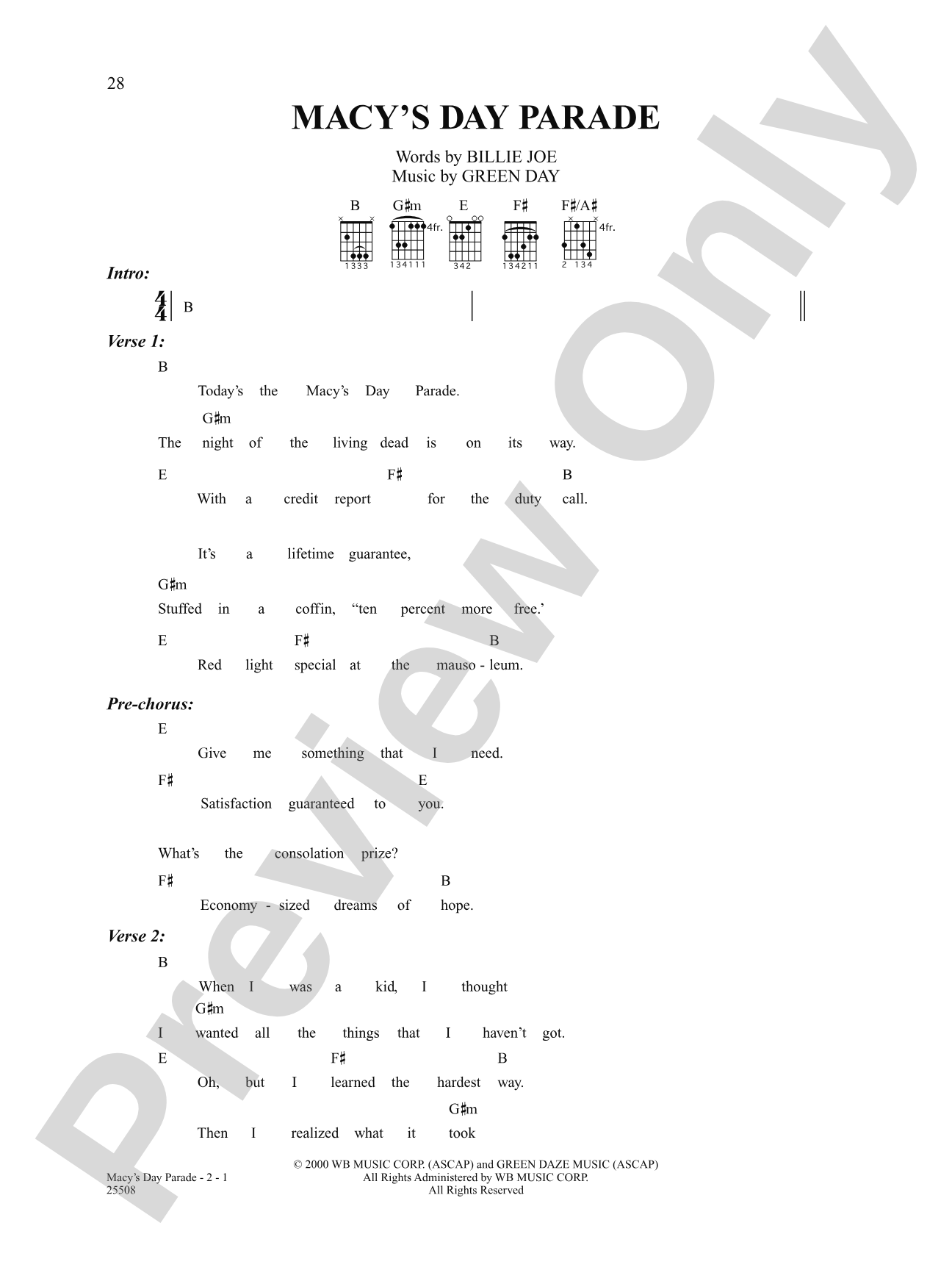

Macy's Day Parade: Strum and Sing
Green Day
Item: 00-PS-0000133
$4.99
One moment…
Related Items
Nice Guys Finish Last: Strum and Sing |
$4.99
|
View | |
Hitchin' a Ride: Strum and Sing |
$4.99
|
View | |
Redundant: Strum and Sing |
$4.99
|
View | |
Good Riddance (Time of Your Life): Strum and Sing |
$4.99
|
View | |
Warning: Strum and Sing |
$4.99
|
View | |
Waiting: Strum and Sing |
$4.99
|
View | |
Minority: Strum and Sing |
$4.99
|
View | |
Maria: Strum and Sing |
$4.99
|
View | |
Poprocks and Coke: Strum and Sing |
$4.99
|
View | |
Longview: Strum and Sing |
$4.99
|
View | |
Welcome to Paradise: Strum and Sing |
$4.99
|
View | |
Basket Case: Strum and Sing |
$4.99
|
View | |
She: Strum and Sing |
$4.99
|
View | |
When I Come Around: Strum and Sing |
$4.99
|
View | |
Stuck With Me: Strum and Sing |
$4.99
|
View | |
Geek Stink Breath: Strum and Sing |
$4.99
|
View | |
Brain Stew: Strum and Sing |
$4.99
|
View | |
Jaded: Strum and Sing |
$4.99
|
View | |
Walking Contradiction: Strum and Sing |
$4.99
|
View | |
J.A.R. (Jason Andrew Relva): Strum and Sing |
$4.99
|
View | |
American Idiot: Strum and Sing |
$4.99
|
View | |
Holiday: Strum and Sing |
$4.99
|
View | |
Wake Me Up When September Ends: Strum and Sing |
$4.99
|
View | |
Boulevard of Broken Dreams: Strum and Sing |
$4.99
|
View |
Description
Twenty-five of Green Day's greatest hits, arranged in an easy-to-use lyric and chord songbook format. All lyrics with the correct guitar chords placed above throughout. Plus, important riffs are included in tablature as well. Titles include: American Idiot * Basket Case * Boulevard of Broken Dreams * Brain Stew * Geek Stink Breath * Good Riddance (Time of Your Life) * Hitchin' a Ride * Holiday * Jaded * J.A.R. (Jason Andrew Relva) * Longview * Macy's Day Parade * Maria * Minority * Nice Guys Finish Last * Poprocks & Coke * Redundant * She * Stuck with Me * Waiting * Wake Me Up When September Ends * Walking Contradiction * Warning * Welcome to Paradise * When I Come Around.


Macy's Day Parade: Strum and Sing isn't in MakeMusic Cloud just yet...but it could be. Let us know you'd like to see it, and you'll help shape what comes next. In the meantime, start a free trial and dive into thousands of interactive titles your students can play along with today.
Request This Title
Tell us you want it.
Start Your Free Trial
Explore everything that's ready to play right now.
Sample Audio
No sample audio found.
Sample Video
No sample videos found.
Additional Details
Publisher:
Alfred Music
Page Count:
64
SKU:
00-PS-0000133
More about this title
About the Composer: Green Day
Green Day emerged from the East Bay punk scene in the 1990s and became one of rock's most commercially dominant and artistically influential bands. Their 1994 debut "Dookie" established them as leaders of the pop-punk movement, while later albums like "American Idiot" (2004) expanded their scope into concept-driven rock that earned Grammy Awards and critical acclaim. The band's songwriting combines infectious melodies with socially conscious lyrics and raw energy, making their catalog enduring material for musicians of all ages.
Why we love this
This collection captures 25 of Green Day's most recognizable songs in an arrangement format that keeps young guitarists engaged without overwhelming them. The mix of straightforward strums and essential riffs (notated in tab) means students can learn hits like "Boulevard of Broken Dreams" and "Wake Me Up When September Ends" while building practical chord-reading and fingerpicking skills. It's the rare songbook that balances accessibility with genuine rock credibility.
What to expect
Raw, immediate, and energized. These songs carry the urgency and catchiness that made Green Day a cultural force, with chord progressions that feel both familiar and driving. Whether you're strumming the opening of "Basket Case" or digging into the fingerpicked intro of "Good Riddance," there's a sense of momentum and emotional directness throughout.
Who it's for
Intermediate beginner guitarists who want to play recognizable material without waiting years to build advanced skills. This book is ideal for students motivated by contemporary rock and pop-punk, and for teachers looking to assign songs that students will actually practice at home.
How to get the most out of it
- Anchor the verse rhythm by locking into the kick drum on the recording; this band's patterns often sit on the pocket rather than on the beat itself.
- Study the tabbed riffs closely before attempting them at tempo; they're often the hook that holds the song's identity, even if the verse chords are simple.
- Pay attention to dynamics within each song. Even the power-chord-heavy tracks benefit from contrast between quiet verses and explosive choruses.
- Use the lyric placement as a guide to phrasing. Green Day's vocal lines often syncopate against the chord changes, so let the words guide your strumming patterns rather than fighting against them.
How to use it
Assign individual songs as weekly practice pieces tied to specific technical goals (barre chords for "American Idiot," fingerpicking for "Good Riddance"). For recitals or informal performances, students can prepare a mashup of 2-3 songs from the collection, creating a set-list-style performance that feels contemporary and achievable.
Skills your students will build
- Reading chord charts and chord-to-tab conversion
- Alternating strumming patterns (eighth-note and sixteenth-note rhythm variations)
- Fingerpicking technique on essential riffs
- Syncopation and laying back against the beat
- Transitioning between basic open chords at tempo
- Recognizing and playing power-chord based progressions