
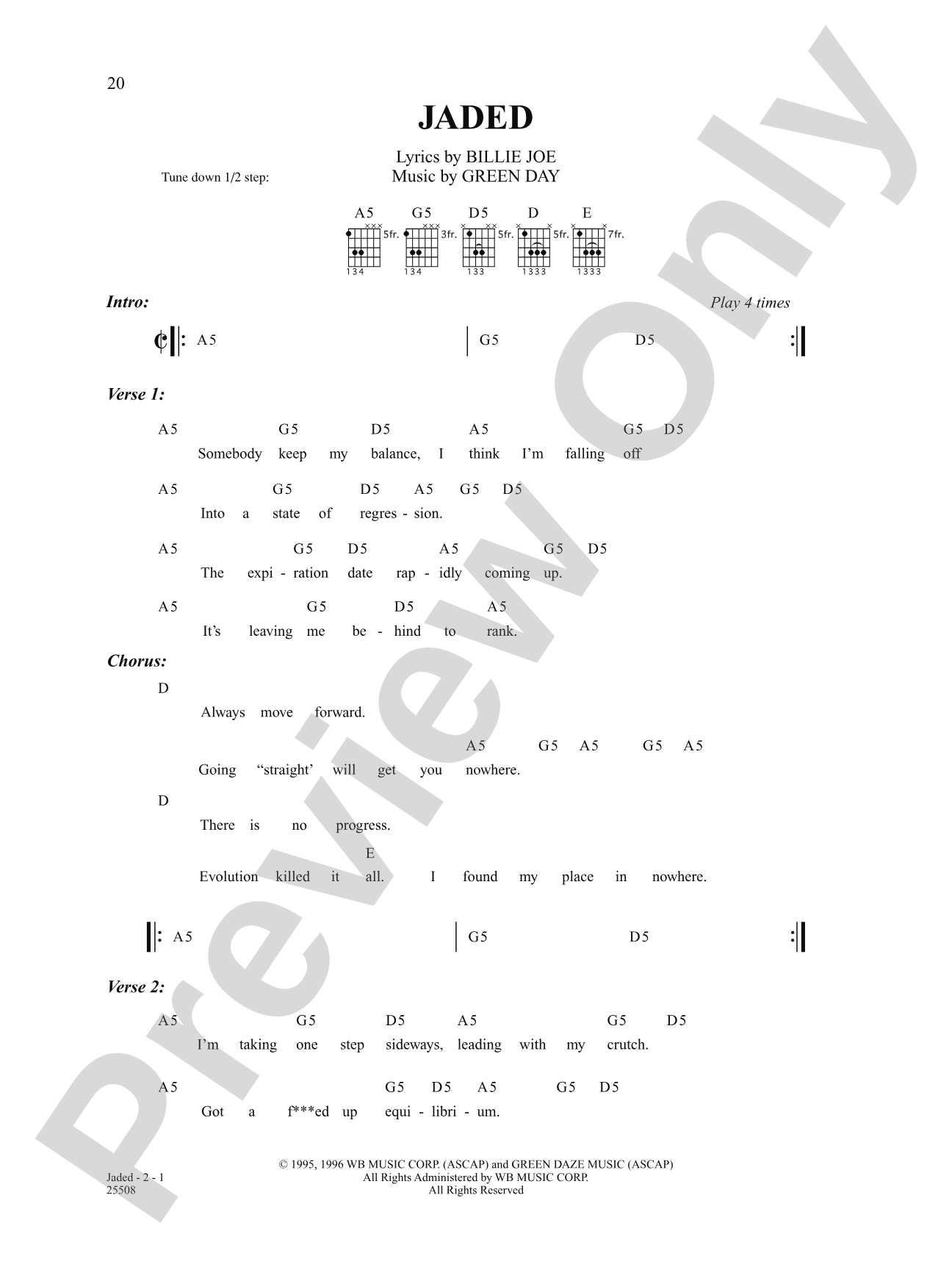

Jaded: Strum and Sing
Green Day
Item: 00-PS-0000168
$4.99
One moment…
Related Items
Nice Guys Finish Last: Strum and Sing |
$4.99
|
View | |
Hitchin' a Ride: Strum and Sing |
$4.99
|
View | |
Redundant: Strum and Sing |
$4.99
|
View | |
Good Riddance (Time of Your Life): Strum and Sing |
$4.99
|
View | |
Warning: Strum and Sing |
$4.99
|
View | |
Waiting: Strum and Sing |
$4.99
|
View | |
Minority: Strum and Sing |
$4.99
|
View | |
Macy's Day Parade: Strum and Sing |
$4.99
|
View | |
Maria: Strum and Sing |
$4.99
|
View | |
Poprocks and Coke: Strum and Sing |
$4.99
|
View | |
Longview: Strum and Sing |
$4.99
|
View | |
Welcome to Paradise: Strum and Sing |
$4.99
|
View | |
Basket Case: Strum and Sing |
$4.99
|
View | |
She: Strum and Sing |
$4.99
|
View | |
When I Come Around: Strum and Sing |
$4.99
|
View | |
Stuck With Me: Strum and Sing |
$4.99
|
View | |
Geek Stink Breath: Strum and Sing |
$4.99
|
View | |
Brain Stew: Strum and Sing |
$4.99
|
View | |
Walking Contradiction: Strum and Sing |
$4.99
|
View | |
J.A.R. (Jason Andrew Relva): Strum and Sing |
$4.99
|
View | |
American Idiot: Strum and Sing |
$4.99
|
View | |
Holiday: Strum and Sing |
$4.99
|
View | |
Wake Me Up When September Ends: Strum and Sing |
$4.99
|
View | |
Boulevard of Broken Dreams: Strum and Sing |
$4.99
|
View |
Description
Twenty-five of Green Day's greatest hits, arranged in an easy-to-use lyric and chord songbook format. All lyrics with the correct guitar chords placed above throughout. Plus, important riffs are included in tablature as well. Titles include: American Idiot * Basket Case * Boulevard of Broken Dreams * Brain Stew * Geek Stink Breath * Good Riddance (Time of Your Life) * Hitchin' a Ride * Holiday * Jaded * J.A.R. (Jason Andrew Relva) * Longview * Macy's Day Parade * Maria * Minority * Nice Guys Finish Last * Poprocks & Coke * Redundant * She * Stuck with Me * Waiting * Wake Me Up When September Ends * Walking Contradiction * Warning * Welcome to Paradise * When I Come Around.


Jaded: Strum and Sing isn't in MakeMusic Cloud just yet...but it could be. Let us know you'd like to see it, and you'll help shape what comes next. In the meantime, start a free trial and dive into thousands of interactive titles your students can play along with today.
Request This Title
Tell us you want it.
Start Your Free Trial
Explore everything that's ready to play right now.
Sample Audio
No sample audio found.
Sample Video
No sample videos found.
Additional Details
Publisher:
Alfred Music
Page Count:
64
SKU:
00-PS-0000168
More about this title
About the Composer: Green Day
Green Day formed in the East Bay in 1987 and became one of rock's defining bands of the 1990s and beyond. Their albums American Idiot and Dookie redefined punk accessibility for mainstream audiences, combining three-chord urgency with sharply crafted lyrics about alienation, identity, and social commentary. The band's catalog spans three decades of consistent songwriting that balances raw energy with genuine melodic craft.
Why we love this
This collection captures Green Day's most recognizable material in a format that lets guitarists focus on what matters: the songs themselves. The chord-and-lyric layout makes learning efficient, while the included tablature for key riffs gives players the signature moments that define each track. For students who might otherwise find traditional method books disconnected from their musical interests, this songbook bridges that gap with repertoire they already love.
What to expect
These songs carry the distinctive energy of late 1990s and 2000s punk: catchy without being cute, urgent without being rushed, emotionally direct without sentimentality. The collection spans moments of raw aggression alongside genuine vulnerability, giving players a full picture of the band's range within one volume.
Who it's for
Guitarists drawn to rock repertoire who want to build real songs rather than abstract exercises. This works equally well for bedroom players building confidence and ensemble musicians looking to expand their working knowledge of contemporary rock standards. Any guitarist who has hummed these melodies will find learning them here practical and rewarding.
How to get the most out of it
- Study the tablature sections first to lock in the iconic riffs that anchor each song; they're the quickest way to feel the track's identity.
- Use the chord placements to practice switching cleanly between changes; Green Day songs rarely linger on one chord long enough to be sloppy.
- Vary your strumming texture across the collection; some tracks need driving downstrokes while others benefit from lighter, syncopated patterns.
- Sing or hum the melody while playing the chords to internalize the relationship between harmony and vocal line.
How to use it
Build a rock repertoire night where guitarists perform selections from this book alongside acoustic or electric ensemble setups. Use individual songs as reference material in a popular music or rock history unit, or assign pieces as enrichment for students working through traditional method books who need motivation. This songbook also serves as a bridge for ensemble musicians learning to read chord charts and tablature notation.
Skills your students will build
- Reading chord symbols and chord charts above lyrical text
- Interpreting tablature notation for melodic riffs and signature passages
- Coordinating chord changes with rhythmic strumming patterns
- Connecting melody, harmony, and lyrics while performing
- Building repertoire across multiple song styles within a single genre