

Wade in the Water: SATB Choral Octavo
Traditional Spiritual / arr. Patsy Ford Simms and Andy Beck
Item: 00-PO-0000365
$1.75
Minimum order quantity: 20 copies
Pickup currently not available
Related Items
Wade in the Water: SoundTrax Digital Audio Download |
$22.95
|
View | |
Wade in the Water: 3-Part Mixed Choral Octavo |
$1.85
|
View | |
Wade in the Water: 2-Part Choral Octavo |
$1.75
|
View | |
Wade in the Water: Choral SoundPax |
$35.00
|
View | |
Wade in the Water: SATB Choral Octavo |
$1.75
|
View | |
Wade in the Water: 3-Part Mixed Choral Octavo |
$1.85
|
View | |
Wade in the Water: 2-Part Choral Octavo |
$1.75
|
View | |
Wade in the Water: Choral Octavo SoundTrax CD |
$22.95
|
View | |
Wade in the Water: Choral SoundPax |
$35.00
|
View |
Description
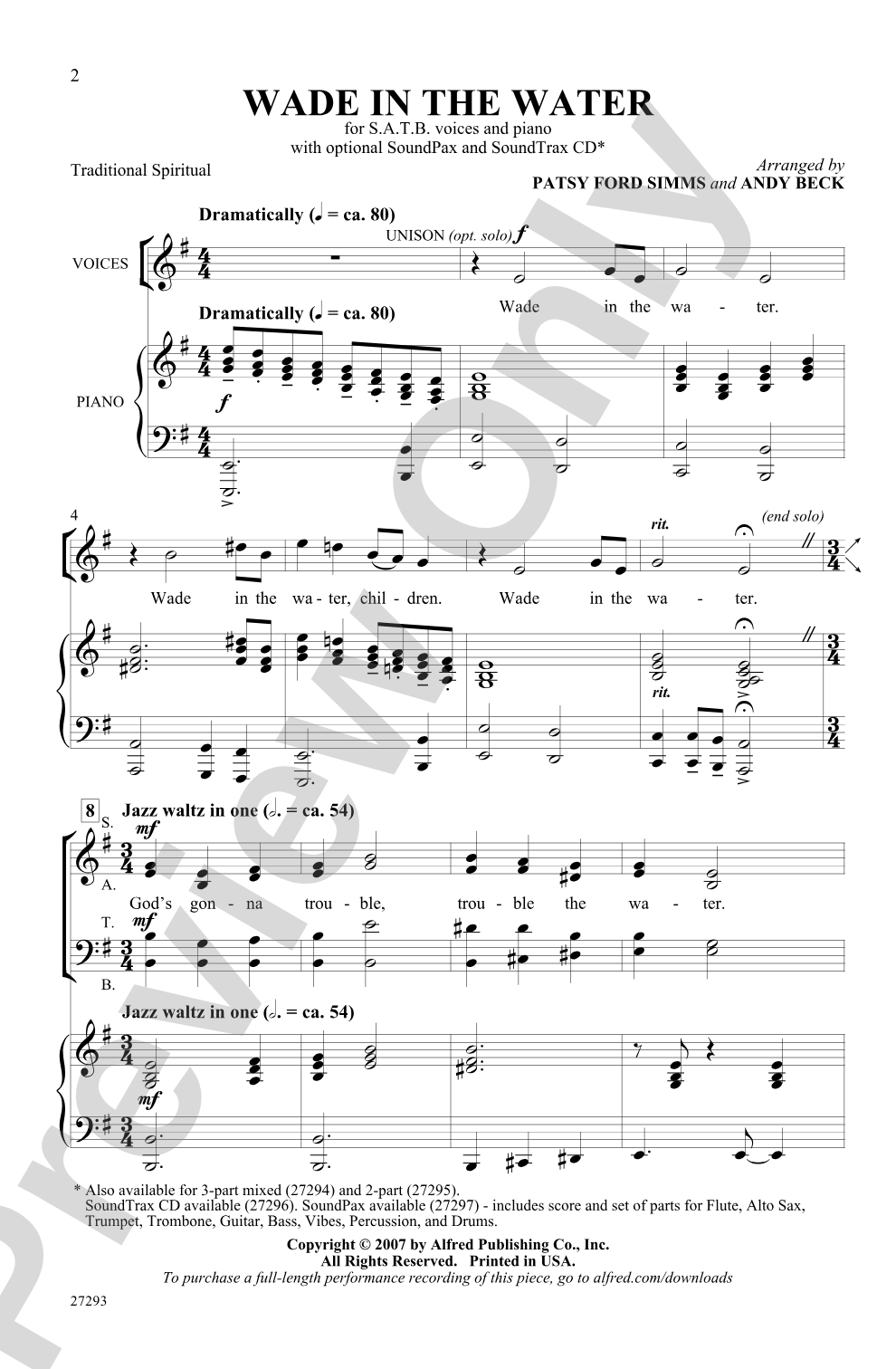
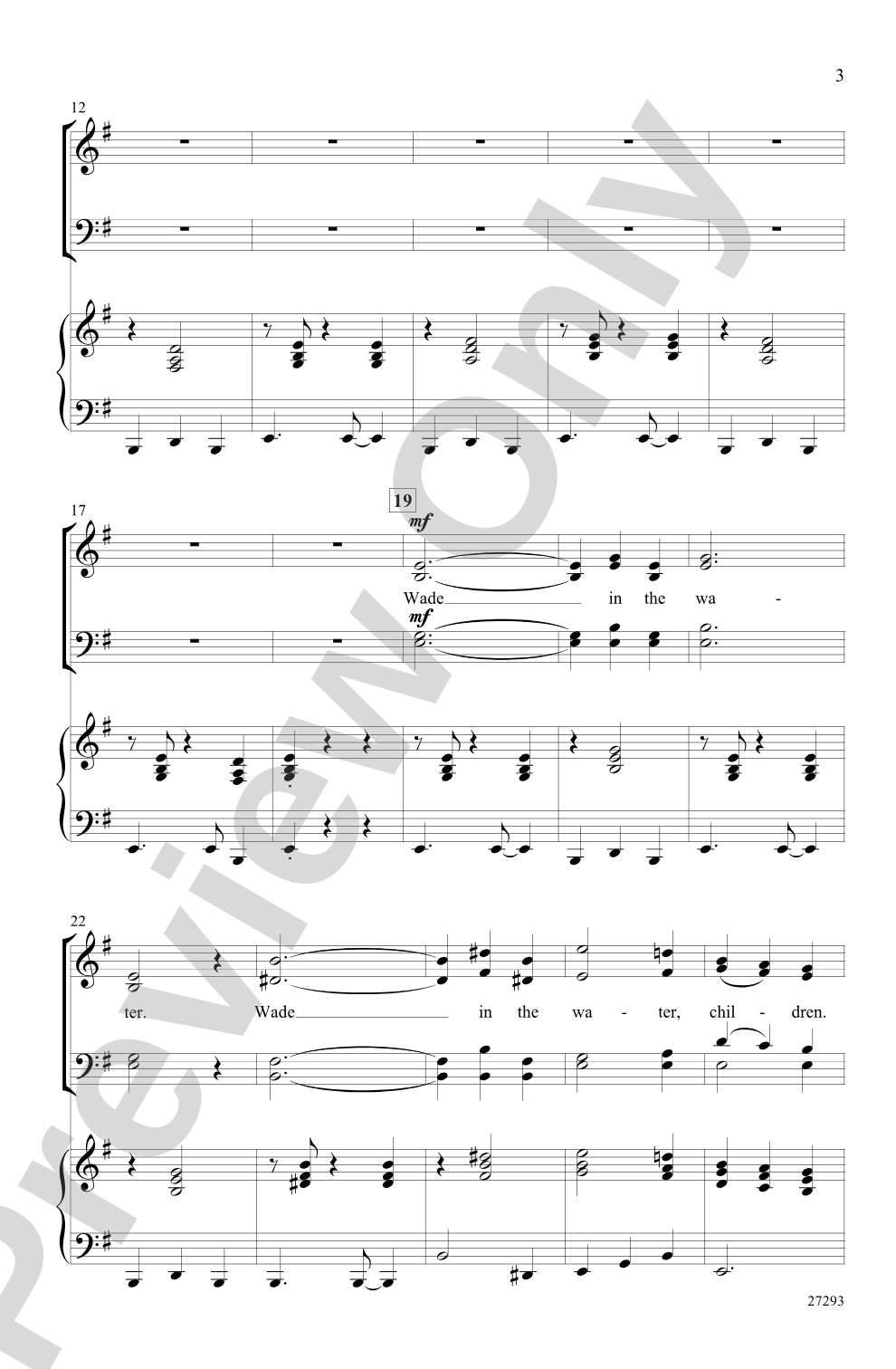
You've never heard it like this before! A dramatic solo provides the powerful introduction before this hip spiritual arrangement kicks into a groovy jazz waltz. A call and response verse highlights individual sections of the choir (or soloists), and an ultra-cool transition builds and modulates into the final choral refrain. Great to perform with a jazz combo.


Wade in the Water: SATB Choral Octavo isn't in MakeMusic Cloud just yet...but it could be. Let us know you'd like to see it, and you'll help shape what comes next. In the meantime, start a free trial and dive into thousands of interactive titles your students can play along with today.
Request This Title
Tell us you want it.
Start Your Free Trial
Explore everything that's ready to play right now.
Sample Audio
1
Audio File
--:--
0:00
0:00
Sample Video
No sample videos found.
Additional Details
Series:
Alfred Choral Designs
Publisher:
Alfred Music
Page Count:
12
SKU:
00-PO-0000365
More about this title
About the Arranger: Patsy Ford Simms
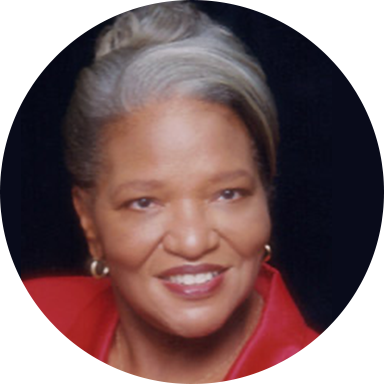
Patsy Ford Simms has spent her career filling a critical gap in choral music for developing singers. Over 300 published works for educational and church settings reflect her deep understanding of what middle and high school choirs need—accessible yet musically rich arrangements that engage students without oversimplifying. She holds degrees from Knoxville College, the University of Louisville, and Columbia Pacific University, and taught across grades K-12 for three decades before retiring to focus on composing and arranging full time.
Recognized internationally as an arranger, composer, and clinician, Simms has presented workshops in Italy and Africa, received multiple ASCAP Special Music Awards, and had compositions selected for MENC World's Largest Concerts. Her work with Shawnee Press and other major publishers has made her a trusted voice in sacred and educational choral music.
Why we love this
This arrangement captures the spiritual's power while infusing it with genuine contemporary groove. The dramatic solo entrance, jazz waltz rhythm, and section-by-section call and response keep every voice engaged and accountable, which middle and high school singers find motivating. The optional instrumentation and recorded accompaniment make it equally viable as a warm-up showcase or a full production number.
What to expect
Rooted and celebratory, with an unmistakable contemporary edge. The piece moves from intimate vulnerability in the opening solo through rhythmic momentum in the waltz, building toward a final statement that feels both respectful of the spiritual tradition and alive in the present moment. Singers feel the jazz influence in every phrase, making the spiritual feel like something they discovered rather than something handed down.
Who it's for
Middle school, high school, and college choirs looking for a contemporary spiritual arrangement that's genuinely performable but still fresh. Directors who want to program sacred music with contemporary flair without sacrificing musicality will find this a strong choice. Jazz combos and directors with access to rhythm section players will especially appreciate the arrangement's groove-oriented design.
How to get the most out of it
- Balance the opening solo carefully so it registers as a genuine moment of power before the ensemble enters; the soloist should own the space without overwhelming the choral entrance.
- Lock the jazz waltz feel in early rehearsals by having rhythm sections (or your strongest readers) internalize the 3/4 pulse before adding text; the groove is essential to the arrangement's success.
- Shape the call and response sections with clear dynamic contrast between soloists or sections; let each voice part breathe when it's not singing.
- Use the transition passage to build momentum deliberately; resist the urge to rush the modulation, as the architectural shift is what makes the final refrain land.
How to use it
Program this as a standalone contemporary spiritual arrangement during a concert that mixes classical and modern repertoire, or pair it with other arranged spirituals for a thematic set. It works equally well as a midconcert energy shift or a closing number that sends audiences out with warmth and movement. If you have a jazz combo available, make that instrumentation a feature; it becomes a genuine collaboration rather than accompaniment.
Skills your students will build
- Singing in a jazz waltz meter (3/4) with contemporary rhythmic precision
- Responding to solo and call-and-response leadership, building ensemble listening
- Balancing blended sound during section-specific passages
- Modulation awareness and the harmonic thinking required to track key changes
- Interpretation of contemporary spiritual arrangement within a sacred context