
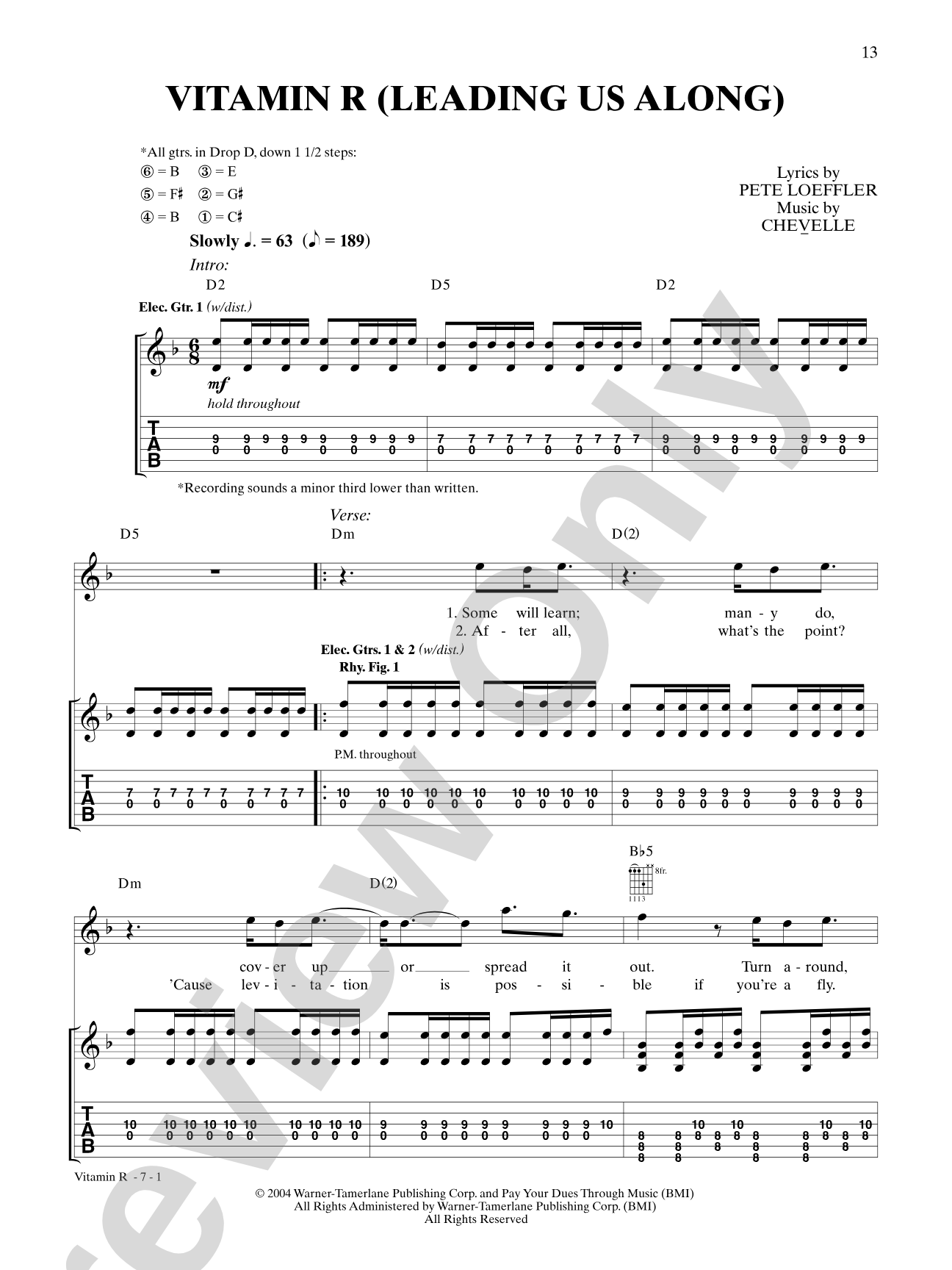
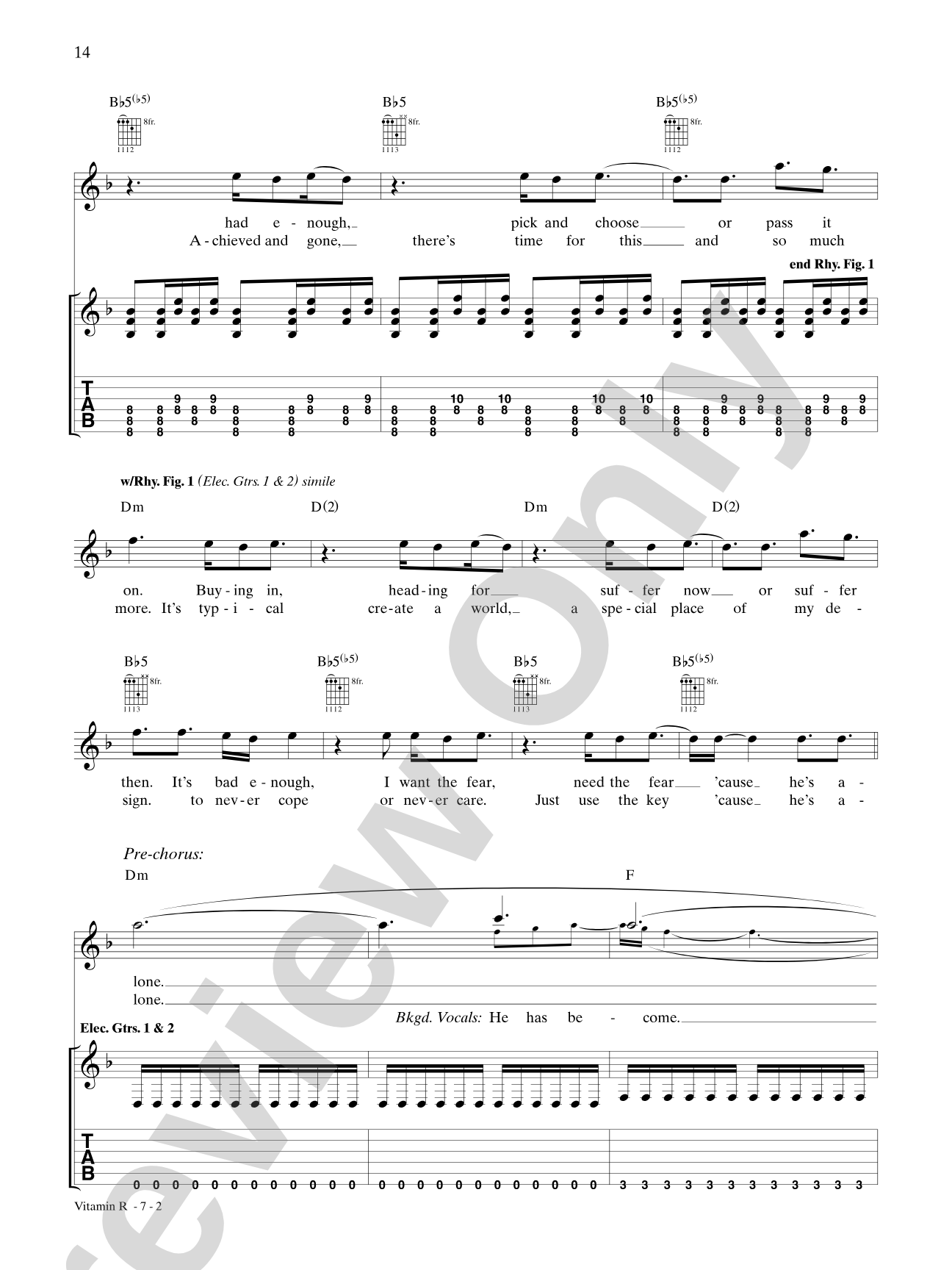

Vitamin R (Leading Us Along): Authentic Guitar TAB
4 Artists * 16 Songs * Your Playlist: Nickelback, Chevelle, Theory of a Deadman, Paramore
Item: 00-PS-0012676
$5.99
One moment…
Description
Get the real, full TAB for 16 of the biggest rock hits of the decade.
Titles: All or Nothing (Theory of a Dead Man) * Bad Girlfriend (Theory of a Dead Man) * The Clincher (Chevelle) * CrushCrushCrush (Paramore) * Far Away (Nickelback) * Gotta Be Somebody (Nickelback) * Hallelujah (Paramore) * Hate My Life (Theory of a Dead Man) * I Get It (Chevelle) * Misery Business (Paramore) * Photograph (Nickelback) * Rockstar (Nickelback) * Send the Pain Below (Chevelle) * So Happy (Theory of a Dead Man) * That's What You Get (Paramore) * Vitamin R (Chevelle).


Titles: All or Nothing (Theory of a Dead Man) * Bad Girlfriend (Theory of a Dead Man) * The Clincher (Chevelle) * CrushCrushCrush (Paramore) * Far Away (Nickelback) * Gotta Be Somebody (Nickelback) * Hallelujah (Paramore) * Hate My Life (Theory of a Dead Man) * I Get It (Chevelle) * Misery Business (Paramore) * Photograph (Nickelback) * Rockstar (Nickelback) * Send the Pain Below (Chevelle) * So Happy (Theory of a Dead Man) * That's What You Get (Paramore) * Vitamin R (Chevelle).
Vitamin R (Leading Us Along): Authentic Guitar TAB isn't in MakeMusic Cloud just yet...but it could be. Let us know you'd like to see it, and you'll help shape what comes next. In the meantime, start a free trial and dive into thousands of interactive titles your students can play along with today.
Request This Title
Tell us you want it.
Start Your Free Trial
Explore everything that's ready to play right now.
Sample Audio
No sample audio found.
Sample Video
No sample videos found.
Additional Details
Series:
MyTunes 4 x 4 Series
Publisher:
Alfred Music
Page Count:
112
SKU:
00-PS-0012676
More about this title
About the Composer: Chevelle
Chevelle emerged from Chicago in the late 1990s as one of the defining rock bands of the 2000s. Fronted by brothers Pete Loeffler (vocals and guitar) and Sam Loeffler (bass), the band built their reputation on heavy, groove-oriented riffs and introspective songwriting that bridged alternative rock and mainstream hard rock.
Their work across multiple platinum albums showcases a distinctive compositional voice characterized by syncopated rhythms, layered guitar textures, and emotionally direct lyrics. The material in this collection represents their most recognizable songs, each demonstrating the precision and musicality that have made Chevelle perennial fixtures in rock education and performance.
Why we love this
This folio captures 16 essential rock compositions that students already know and want to play, which cuts straight through motivation barriers. The mix spans Chevelle, Nickelback, Paramore, and Theory of a Dead Man, so there's genuine variety in riff construction, tuning, and technical demand even within a single session. Authentic tabs from actual recordings mean students develop their ear against the real thing, not simplified versions.
What to expect
Heavy, angular, and rhythmically precise. These songs sit in the pocket of modern rock where technical accuracy matters as much as attitude, balancing distorted power and melodic sensibility. Each track has its own identity, from the syncopated chug of Chevelle's riffs to Paramore's sharper, more percussive attack.
Who it's for
Guitarists in grades 9 and up who are drawn to contemporary rock and want to build repertoire from songs they already listen to. This works equally well for self-directed learners building technique through music they love and for teachers looking to engage reluctant students with material that connects to their world.
How to get the most out of it
- Study the original recordings for rhythm feel and dynamics before diving into the tab; many of these songs rely on subtle palm-muting and attack variation that notation alone won't convey.
- Pay particular attention to tuning information at the start of each song. Several tracks use alternate tunings, and getting this right from the start saves frustration later.
- Work the riffs slowly with a metronome to lock the rhythmic pocket. Rock grooves often sit behind the beat in ways that feel unnatural at first but define the song's character.
- Track your finger positioning on larger passages; the tab shows what fret to hit but not always the most efficient left-hand path, especially on tracks with frequent position shifts.
How to use it
Assign individual songs as performance pieces in studio recitals or ensemble showcases, or use them as technical studies for specific skills throughout the year. The sheer number of tracks means you can rotate fresh material regularly while students develop ownership over their own repertoire choices.
Skills your students will build
- Reading authentic guitar tablature notation
- Adapting to alternate guitar tunings (drop D, half-step down, etc.)
- Mastering syncopated rhythmic riffs and pocket-dependent grooves
- Palm-muting techniques and dynamic control within distorted tone
- Transitioning between chordal and single-note passages efficiently
- Developing ear training by comparing tab to recorded versions