
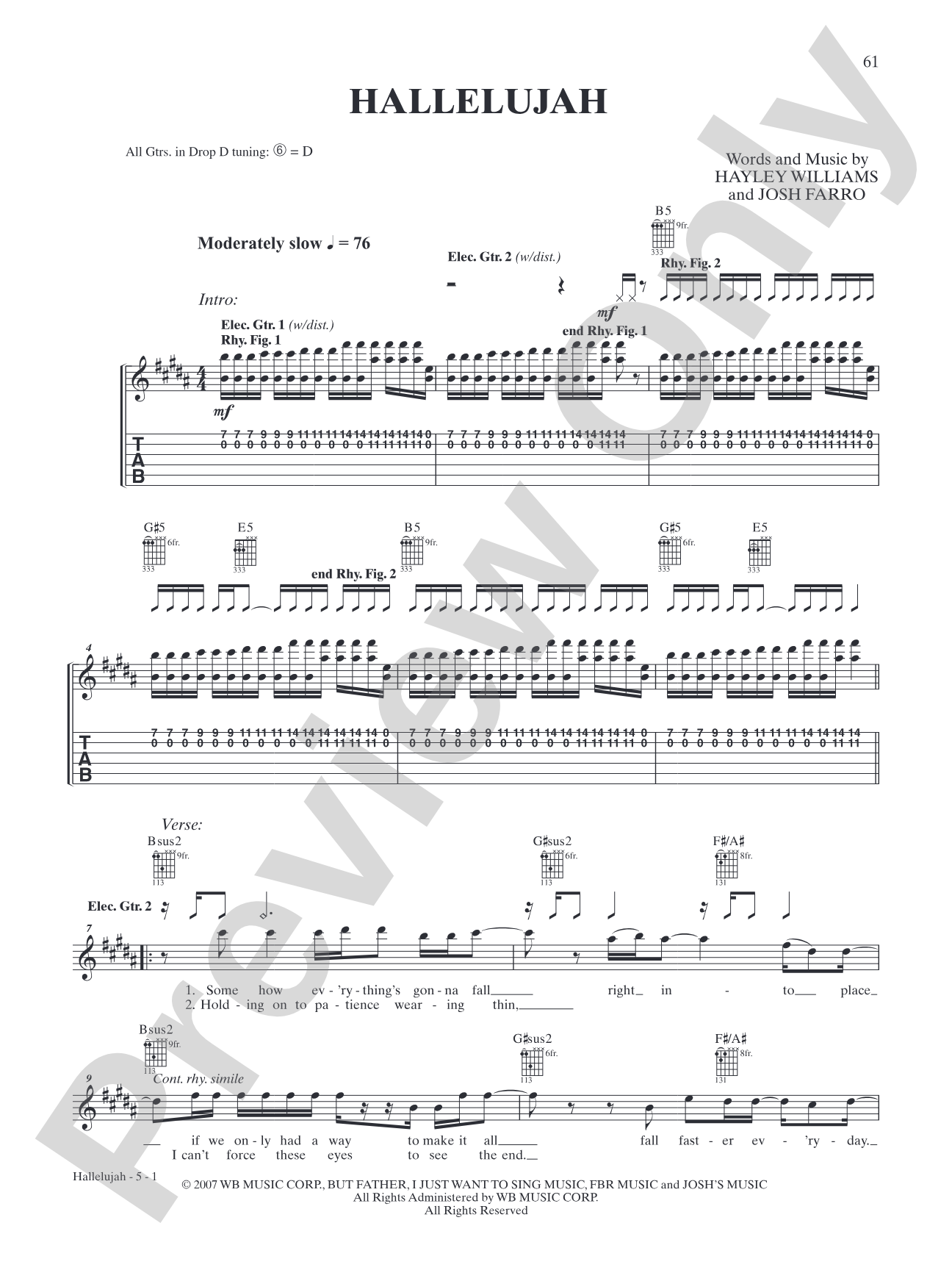

Hallelujah: Authentic Guitar TAB
4 Artists * 16 Songs * Your Playlist: Nickelback, Chevelle, Theory of a Deadman, Paramore
Item: 00-PS-0012685
$4.99
One moment…
Related Items
The Clincher: Authentic Guitar TAB |
$5.99
|
View | |
Vitamin R (Leading Us Along): Authentic Guitar TAB |
$5.99
|
View | |
I Get It: Authentic Guitar TAB |
$5.99
|
View | |
CrushCrushCrush: Authentic Guitar TAB |
$4.99
|
View | |
Misery Business: Authentic Guitar TAB |
$5.99
|
View | |
That's What You Get: Authentic Guitar TAB |
$4.99
|
View |
Description
Get the real, full TAB for 16 of the biggest rock hits of the decade.
Titles: All or Nothing (Theory of a Dead Man) * Bad Girlfriend (Theory of a Dead Man) * The Clincher (Chevelle) * CrushCrushCrush (Paramore) * Far Away (Nickelback) * Gotta Be Somebody (Nickelback) * Hallelujah (Paramore) * Hate My Life (Theory of a Dead Man) * I Get It (Chevelle) * Misery Business (Paramore) * Photograph (Nickelback) * Rockstar (Nickelback) * Send the Pain Below (Chevelle) * So Happy (Theory of a Dead Man) * That's What You Get (Paramore) * Vitamin R (Chevelle).


Titles: All or Nothing (Theory of a Dead Man) * Bad Girlfriend (Theory of a Dead Man) * The Clincher (Chevelle) * CrushCrushCrush (Paramore) * Far Away (Nickelback) * Gotta Be Somebody (Nickelback) * Hallelujah (Paramore) * Hate My Life (Theory of a Dead Man) * I Get It (Chevelle) * Misery Business (Paramore) * Photograph (Nickelback) * Rockstar (Nickelback) * Send the Pain Below (Chevelle) * So Happy (Theory of a Dead Man) * That's What You Get (Paramore) * Vitamin R (Chevelle).
Discover MakeMusic Cloud: thousands of interactive titles your students can play along with today.
Sample Audio
No sample audio found.
Sample Video
No sample videos found.
Additional Details
Series:
MyTunes 4 x 4 Series
Publisher:
Alfred Music
Page Count:
112
SKU:
00-PS-0012685
More about this title
About the Composer: Hayley Williams
Hayley Williams is the lead vocalist and primary songwriter for Paramore, the band that emerged from the post-hardcore scene in the mid-2000s and became one of rock's most distinctive voices. Her songwriting blends introspective lyrics with angular guitar work and dynamic arrangements, establishing a sound that influenced countless rock and alternative bands. Williams has demonstrated both compositional depth and a keen ear for what resonates with players learning their craft.
Why we love this
This collection captures authentic transcriptions of songs that already live in your students' ears and playlists. The TAB format meets guitarists where they want to learn, and the mix of bands (Paramore, Nickelback, Chevelle, Theory of a Dead Man) offers varied rhythmic demands and playing styles without venturing into overly technical territory.
What to expect
Direct, energetic, and utterly familiar. These are songs built on solid riffs, clear vocal melodies, and arrangements that sit naturally under your fingers once you find the shape. The collection spans both heavier, distortion-driven textures and more melodic, introspective passages.
Who it's for
Guitarists who want to learn current rock repertoire directly from the source material. This works well for intermediate players who are comfortable with TAB but may still be building sight-reading skills on standard notation. It's equally valuable for self-taught players and students in group lessons.
How to get the most out of it
- Study the original recordings first; these songs rely heavily on tone and dynamics, not just note accuracy. Pay attention to how each guitarist shapes the attack and sustain.
- Work through one song at a time rather than jumping between pieces. Each band has distinct picking patterns and string techniques that become easier once you internalize one style.
- Use the TAB as a learning tool, but push yourself to recognize chord shapes and progression patterns so you're not always looking down at the page during performance.
How to use it
Offer this as supplemental material for electric guitarists learning outside classical or jazz contexts. You might assign one song per week as technique exploration, letting students choose which ones appeal to them and report back on what made each guitarist's approach distinctive. It's also effective as a bridge for students who know these songs well, turning familiarity into focused skill-building.
Skills your students will build
- Reading and executing guitar TAB with consistent accuracy
- Recognizing and playing power chords, barre chords, and open chord shapes across multiple positions
- Understanding distortion, tone control, and how amp/effects settings shape the final sound
- Developing consistent picking technique and rhythm precision on rock material
- Listening analytically to identify guitar parts and translating them into playable form