
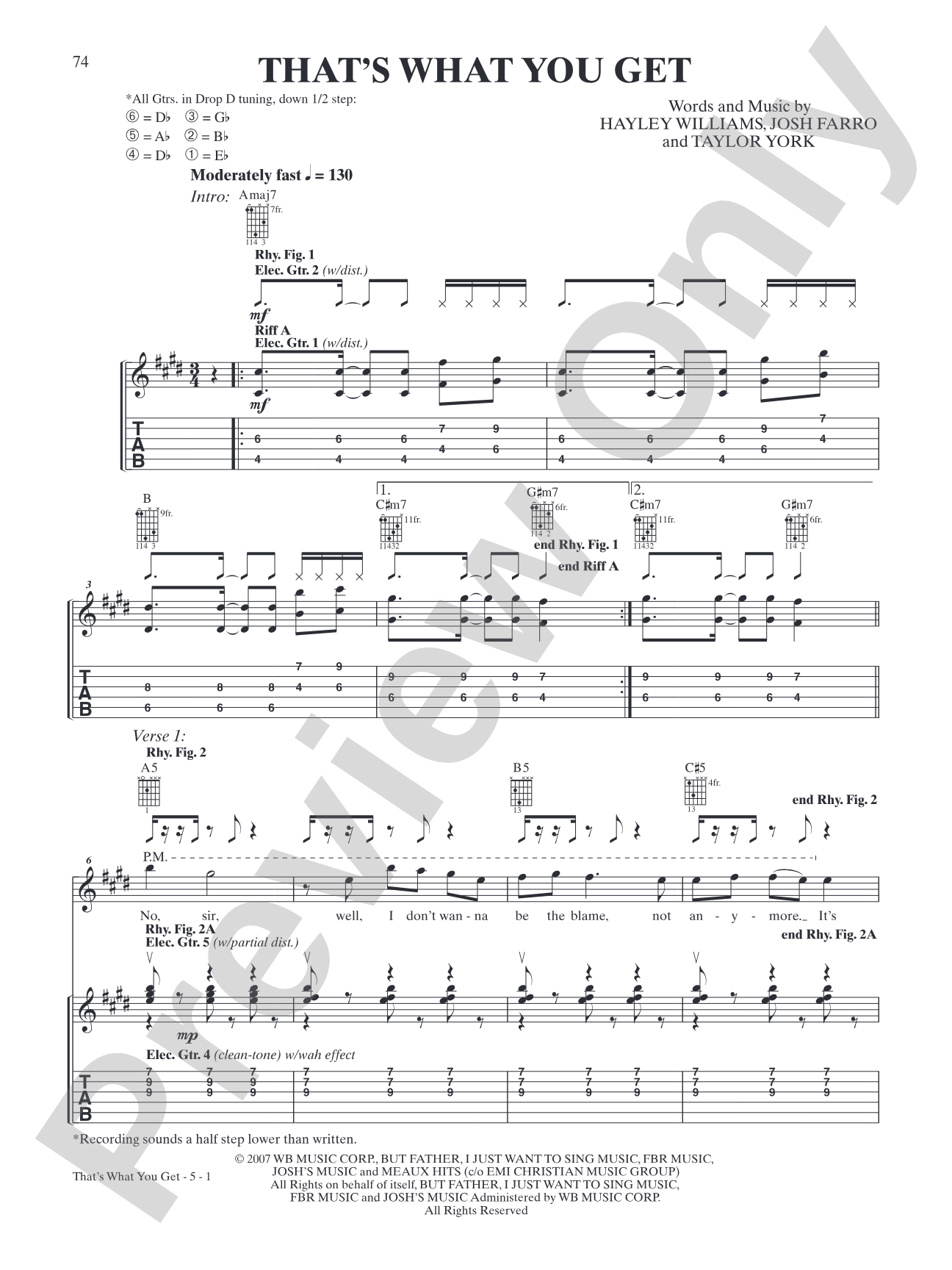

That's What You Get: Authentic Guitar TAB
4 Artists * 16 Songs * Your Playlist: Nickelback, Chevelle, Theory of a Deadman, Paramore
Item: 00-PS-0012684
$4.99
One moment…
Related Items
The Clincher: Authentic Guitar TAB |
$5.99
|
View | |
Vitamin R (Leading Us Along): Authentic Guitar TAB |
$5.99
|
View | |
I Get It: Authentic Guitar TAB |
$5.99
|
View | |
CrushCrushCrush: Authentic Guitar TAB |
$4.99
|
View | |
Misery Business: Authentic Guitar TAB |
$5.99
|
View | |
Hallelujah: Authentic Guitar TAB |
$4.99
|
View |
Description
Get the real, full TAB for 16 of the biggest rock hits of the decade.
Titles: All or Nothing (Theory of a Dead Man) * Bad Girlfriend (Theory of a Dead Man) * The Clincher (Chevelle) * CrushCrushCrush (Paramore) * Far Away (Nickelback) * Gotta Be Somebody (Nickelback) * Hallelujah (Paramore) * Hate My Life (Theory of a Dead Man) * I Get It (Chevelle) * Misery Business (Paramore) * Photograph (Nickelback) * Rockstar (Nickelback) * Send the Pain Below (Chevelle) * So Happy (Theory of a Dead Man) * That's What You Get (Paramore) * Vitamin R (Chevelle).


Titles: All or Nothing (Theory of a Dead Man) * Bad Girlfriend (Theory of a Dead Man) * The Clincher (Chevelle) * CrushCrushCrush (Paramore) * Far Away (Nickelback) * Gotta Be Somebody (Nickelback) * Hallelujah (Paramore) * Hate My Life (Theory of a Dead Man) * I Get It (Chevelle) * Misery Business (Paramore) * Photograph (Nickelback) * Rockstar (Nickelback) * Send the Pain Below (Chevelle) * So Happy (Theory of a Dead Man) * That's What You Get (Paramore) * Vitamin R (Chevelle).
That's What You Get: Authentic Guitar TAB isn't in MakeMusic Cloud just yet...but it could be. Let us know you'd like to see it, and you'll help shape what comes next. In the meantime, start a free trial and dive into thousands of interactive titles your students can play along with today.
Request This Title
Tell us you want it.
Start Your Free Trial
Explore everything that's ready to play right now.
Sample Audio
No sample audio found.
Sample Video
No sample videos found.
Additional Details
Series:
MyTunes 4 x 4 Series
Publisher:
Alfred Music
Page Count:
112
SKU:
00-PS-0012684
More about this title
About the Composer: Hayley Williams
Hayley Williams formed Paramore in 2004 at age fifteen and has since become one of rock music's most distinctive voices and songwriters. Her work balances technical precision with emotional directness, crafting songs that appeal equally to casual listeners and serious musicians. Williams' compositions span multiple albums and have defined a generation of alternative rock, making her a significant figure in contemporary music education and student repertoire.
Why we love this
This collection captures the exact arrangements that made these songs iconic, giving guitarists access to the real parts rather than simplified approximations. The mix of power chords, technical passages, and melodic lines provides substantive material for intermediate to advanced players working toward authentic interpretations of modern rock staples.
What to expect
Immediate and energetic. These are songs built on memorable riffs, driving rhythms, and hooks that stick. The playing feels rewarding because the parts are recognizable and satisfying to execute, combining technical challenge with the gratification of sounding like the original recordings.
Who it's for
Guitar students and performers seeking authentic transcriptions of contemporary rock songs that appear frequently in lessons, recitals, and informal performance settings. This collection works for intermediate to advanced players who want to learn songs they actually hear on the radio and streaming services.
How to get the most out of it
- Study the original recordings alongside the TAB to lock in the rhythmic feels and dynamics that define each song's character; studio production often includes subtle articulations that notation alone cannot capture.
- Work through sections at half-tempo first, paying special attention to chord transitions and any fingerstyle passages before building to performance speed.
- Pay attention to the tunings listed for each piece; several Paramore songs use alternate tunings that affect both the fingering mechanics and the overall tonal quality.
- Balance precision with attitude. These songs demand clean execution but also thrive when played with edge and confidence rather than mechanical perfection.
How to use it
Incorporate individual songs as recital pieces, audition material, or as part of a unit exploring modern rock songwriting and arrangement. The variety of styles across the 16 tracks allows students to select pieces matching their technical level and musical interests.
Skills your students will build
- Reading guitar TAB notation accurately and translating it to the fretboard
- Executing power chord progressions and barre chords with consistency
- Playing rhythm parts that sit solidly in a band or ensemble context
- Interpreting tablature to identify alternate tunings and adjust fingering accordingly
- Recognizing and replicating the articulation and tone quality of recorded performances
- Building speed and precision on technically demanding passages through systematic practice