
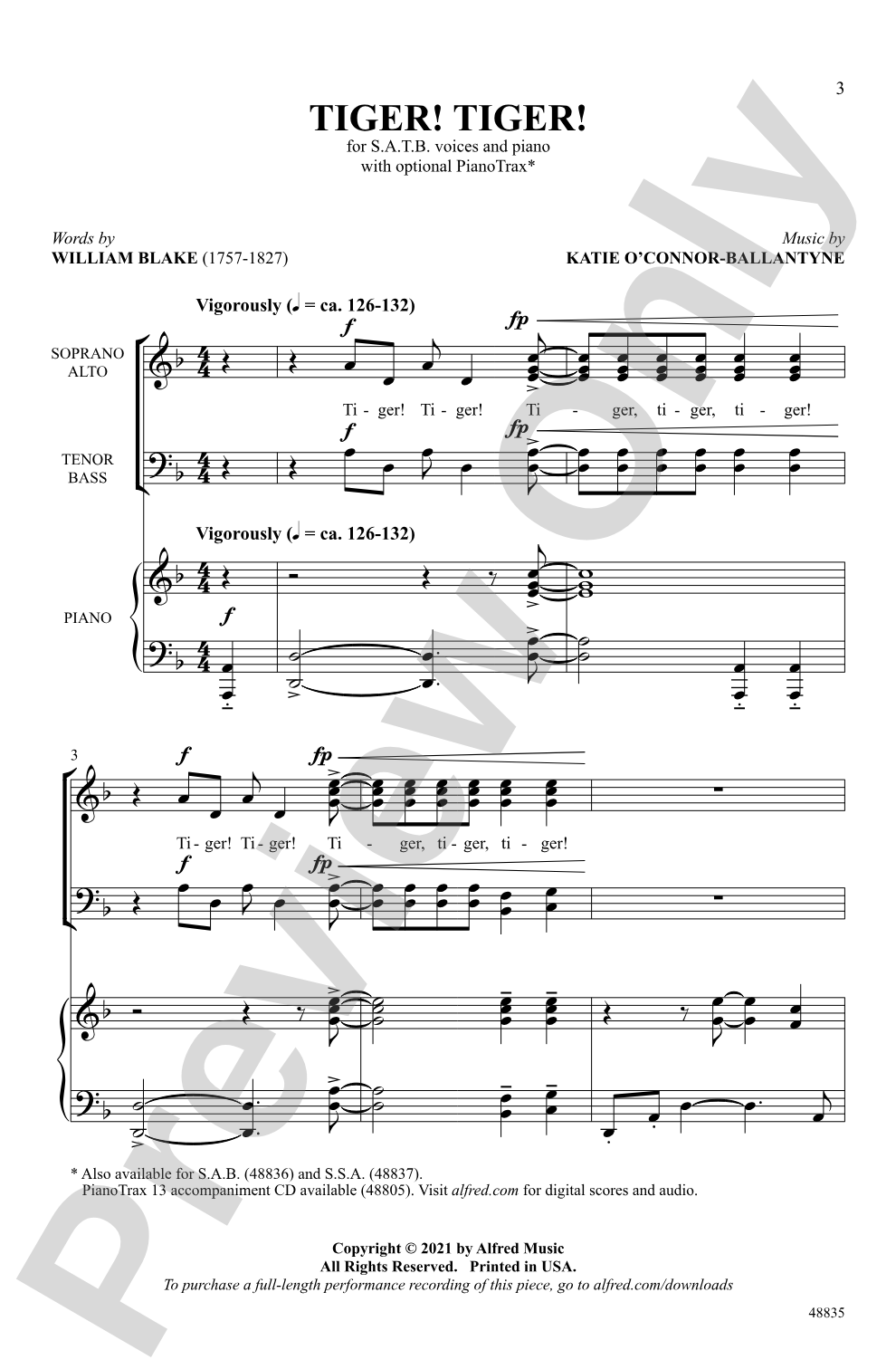

Tiger! Tiger!: SATB Choral Octavo
Words by William Blake, music by Katie O'Connor-Ballantyne
Item: 00-PO-0006634
$2.05
Minimum order quantity: 20 copies
Pickup currently not available
Description
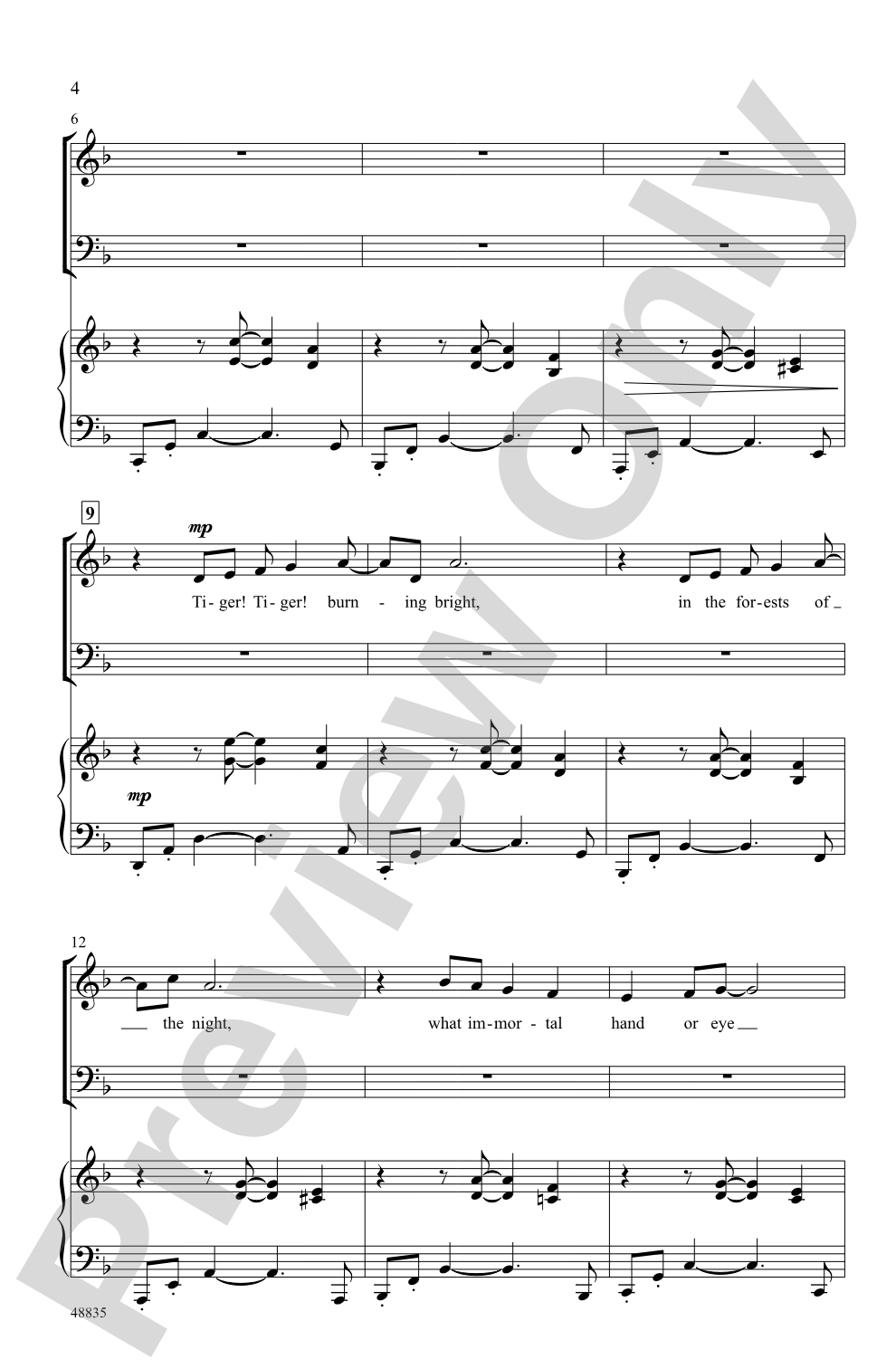
Captivating. Adventurous. With just a hint of danger. This feisty minor key setting of William Blake's gripping poem immediately garners attention with a ferocious fanfare. Then a jaunty, detached piano motive (which later becomes a choral counterline), leads to contemporary choral writing firmly rooted in traditional techniques. Angular intervals and syncopated agitation provide energy, vim, and vigor. Guaranteed to be a highlight of rehearsals, concerts, contests, and festivals. Visit to download a free choral rehearsal guide: www.alfred.com/tigerrehearsalguide This title is available in MakeMusic Cloud.


Tiger! Tiger!: SATB Choral Octavo isn't in MakeMusic Cloud just yet...but it could be. Let us know you'd like to see it, and you'll help shape what comes next. In the meantime, start a free trial and dive into thousands of interactive titles your students can play along with today.
Request This Title
Tell us you want it.
Start Your Free Trial
Explore everything that's ready to play right now.
Sample Audio
1
Audio File
--:--
0:00
0:00
Sample Video
Additional Details
Series:
Alfred Choral Designs
Publisher:
Alfred Music
Page Count:
12
SKU:
00-PO-0006634
More about this title
About the Composer: Katie O'Connor-Ballantyne

Katie O'Connor-Ballantyne has shaped music education across multiple levels and contexts. She has taught general music and piano in elementary schools, directed high school choirs, and instructed undergraduate students in aural skills and music theory. Her work as adjunct faculty at Ithaca College's School of Music and artistic director of the Ithaca Children and Youth Chorus reflects her commitment to developing young musicians at every stage.
Beyond the classroom, O'Connor-Ballantyne serves the broader music education community as a guest conductor, adjudicator, and clinician at festivals and conferences throughout the United States. She has authored Harmony Handbook and Finding Your Teacher Voice, both respected resources for music educators, and her choral compositions appear in catalogs from Alfred Music and Heritage Music Press. Her degrees from Ithaca College (BM in Music Education and Vocal Performance) and the University of Limerick (MA in Chant and Ritual Song) ground her work in both Western choral tradition and world music practice.
Why we love this
O'Connor-Ballantyne's setting transforms Blake's fierce poem into a piece with genuine theatrical presence. The opening fanfare and the distinctive piano motive that evolves into a choral counterline create immediately memorable moments that audiences absorb on first hearing. The writing balances contemporary technique with traditional choral craft, making it equally effective in concert, festival, and contest settings.
What to expect
Danger lurks beneath a deceptively spirited surface. The opening fanfare announces predatory energy, and the syncopated rhythms and angular melodic leaps sustain that tension even as the piano motive bounces along with an almost sardonic detachment. From first note to last, this piece crackles with vim and vigor, never settling into comfort.
Who it's for
This piece suits intermediate to advanced SATB choirs with solid intonation and rhythmic confidence. Singers who respond to poetry and contemporary idiom will find the minor key setting and literary text engaging, while directors seeking a showstopping festival or concert selection will appreciate the dramatic arc and guaranteed audience attention.
How to get the most out of it
- Lean into the rhythmic syncopation and angular intervals as intentional compositional choices, not difficulties to smooth over. These elements are what create the piece's distinctive energy and urgency.
- Work the fanfare as a unified gesture across all four parts. Clarity of articulation and precise rhythmic alignment make the ferocious opening land with full impact.
- Balance the jaunty piano motive so it remains audible when the choir enters. This counterline shapes the listener's perception of the harmonic landscape throughout.
- Use the free rehearsal guide available from Alfred Music to streamline your preparation and address any tricky passages before full rehearsal.
How to use it
Program this as a centerpiece in a concert or festival set built around literary texts and contemporary choral works. Its theatrical punch and memorable opening make it ideal for contests where making a strong first impression matters. Pair it with contrasting material to highlight its restless energy and minor key atmosphere.
Skills your students will build
- Reading angular intervals and non-traditional melodic shapes
- Executing syncopated rhythms with precision and musicality
- Balancing independent voice parts while maintaining harmonic unity
- Interpreting contemporary choral idiom rooted in traditional technique
- Connecting poetic text to compositional choices in modern classical music