
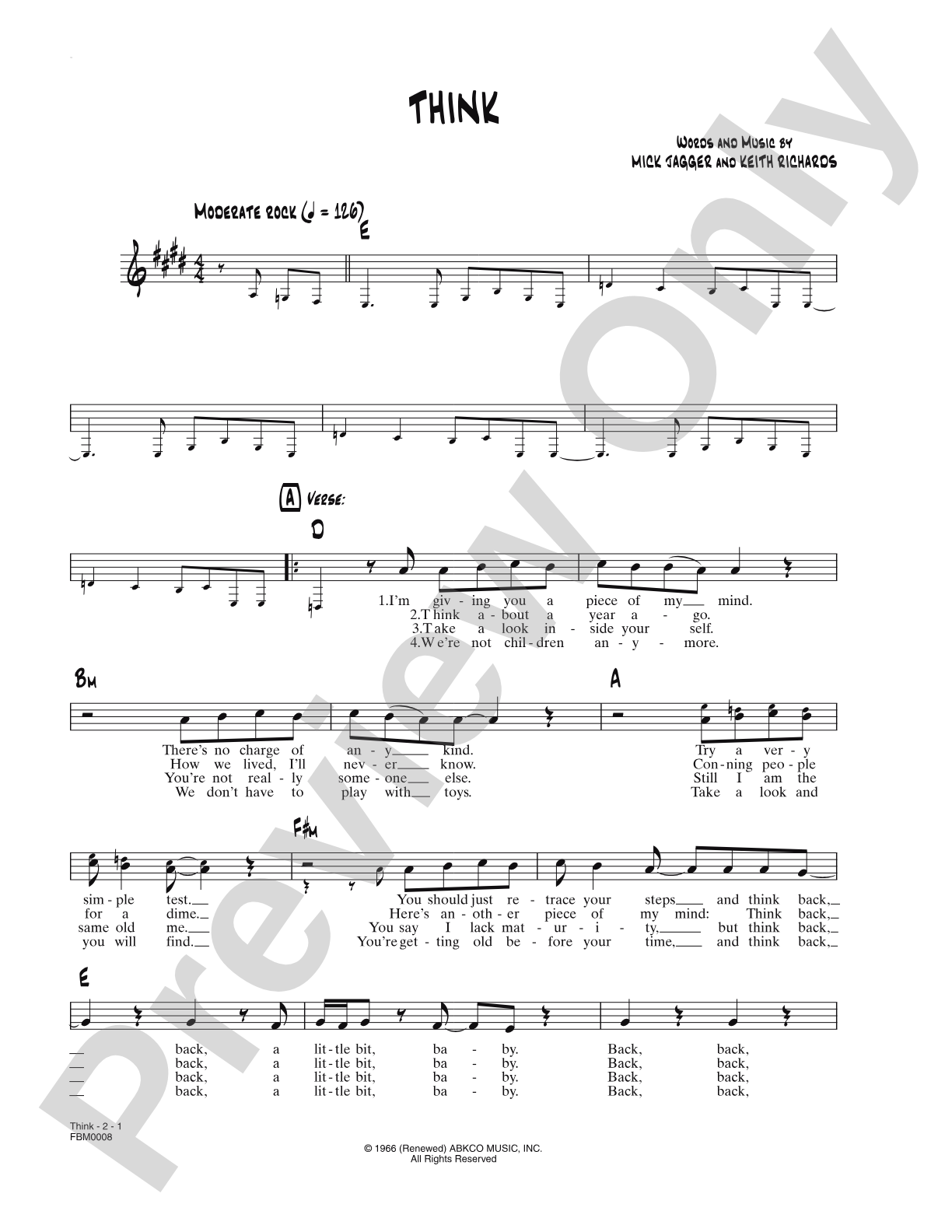

Think: Lead Sheet
The Rolling Stones
Item: 00-PS-0012281
$4.99
Pickup currently not available
Related Items
(Get Your Kicks On) Route 66: Lead Sheet |
$4.99
|
View | |
Time is on My Side: Lead Sheet |
$4.99
|
View | |
You Better Move On: Lead Sheet |
$4.99
|
View | |
I'm Movin' On: Lead Sheet |
$4.99
|
View | |
Mercy, Mercy: Lead Sheet |
$4.99
|
View | |
If You Need Me: Lead Sheet |
$4.99
|
View | |
Fortune Teller: Lead Sheet |
$4.99
|
View | |
19th Nervous Breakdown: Lead Sheet |
$4.99
|
View | |
2000 Light Years From Home: Lead Sheet |
$4.99
|
View | |
2000 Man: Lead Sheet |
$4.99
|
View | |
2120 South Michigan Avenue: Lead Sheet |
$4.99
|
View | |
All Sold Out: Lead Sheet |
$4.99
|
View | |
All Down the Line: Lead Sheet |
$4.99
|
View | |
As Tears Go By: Lead Sheet |
$4.99
|
View | |
Backstreet Girl: Lead Sheet |
$4.99
|
View | |
Bitch: Lead Sheet |
$4.99
|
View | |
Brown Sugar: Lead Sheet |
$4.99
|
View | |
Blue Turns to Grey: Lead Sheet |
$4.99
|
View | |
Citadel: Lead Sheet |
$4.99
|
View | |
Can't You Hear Me Knocking: Lead Sheet |
$4.99
|
View | |
Child of the Moon: Lead Sheet |
$4.99
|
View | |
Connection: Lead Sheet |
$4.99
|
View | |
Complicated: Lead Sheet |
$4.99
|
View | |
Congratulations: Lead Sheet |
$4.99
|
View | |
Country Honk: Lead Sheet |
$4.99
|
View | |
Dead Flowers: Lead Sheet |
$4.99
|
View | |
Cool, Calm and Collected: Lead Sheet |
$4.99
|
View | |
Dandelion: Lead Sheet |
$4.99
|
View | |
Dear Doctor: Lead Sheet |
$4.99
|
View | |
Don't Lie to Me: Lead Sheet |
$4.99
|
View | |
Doncha Bother Me: Lead Sheet |
$4.99
|
View | |
Downtown Suzie: Lead Sheet |
$4.99
|
View | |
Empty Heart: Lead Sheet |
$4.99
|
View | |
Each and Every Day of the Year: Lead Sheet |
$4.99
|
View | |
Factory Girl: Lead Sheet |
$4.99
|
View | |
Family: Lead Sheet |
$4.99
|
View | |
Gimme Shelter: Lead Sheet |
$4.99
|
View | |
Good Times, Bad Times: Lead Sheet |
$4.99
|
View | |
Flight 505: Lead Sheet |
$4.99
|
View | |
Get Off of My Cloud: Lead Sheet |
$4.99
|
View | |
Goin' Home: Lead Sheet |
$4.99
|
View | |
Gomper: Lead Sheet |
$4.99
|
View | |
Good Times: Lead Sheet |
$4.99
|
View | |
Grown Up Wrong: Lead Sheet |
$4.99
|
View | |
Gotta Get Away: Lead Sheet |
$4.99
|
View | |
Have You Seen Your Mother, Baby, Standing in the Shadow?: Lead Sheet |
$4.99
|
View | |
Heart of Stone: Lead Sheet |
$4.99
|
View | |
Honky Tonk Women: Lead Sheet |
$4.99
|
View | |
High and Dry: Lead Sheet |
$4.99
|
View | |
I Am Waiting: Lead Sheet |
$4.99
|
View |
Description
The Rolling Stones Fake Book includes 167 classic Stones songs recorded between 1963 and 1971 -- from early blues covers (Chuck Berry and Buddy Holly songs) to the psychedelia of Their Satanic Majesties Request. All songs are in complete, professional-style lead sheets with fundamental instrumental riffs and figures included. There is also a special guitar TAB section, featuring the pivotal guitar riffs and solos from 29 of their most legendary songs, an introductory essay, a full-color ABKCO years discography (with album art), and 40 pages of classic early sheet music covers reproduced in full color. The comb binding creates a lay-flat book that is perfect for study and performance. The ultimate Rolling Stones songbook!


Think: Lead Sheet isn't in MakeMusic Cloud just yet...but it could be. Let us know you'd like to see it, and you'll help shape what comes next. In the meantime, start a free trial and dive into thousands of interactive titles your students can play along with today.
Request This Title
Tell us you want it.
Start Your Free Trial
Explore everything that's ready to play right now.
Sample Audio
No sample audio found.
Sample Video
No sample videos found.
Additional Details
Series:
Just Real Books Series
Publisher:
Alfred Music
Page Count:
432
SKU:
00-PS-0012281
More about this title
About the Composer: Mick Jagger
Mick Jagger emerged as one of rock music's most dynamic frontmen and songwriters, crafting songs with Keith Richards that defined the sound of 1960s rock and roll. His lyrical voice ranged from blues interpretation to social commentary, creating a catalog that shaped popular music across decades. As a composer, Jagger's work demonstrates how traditional song structure can be bent toward rhythm, attitude, and raw emotional intensity, offering guitarists and performers a masterclass in how melody and groove work together.
Why we love this
This collection captures the Stones' formative years when their songwriting was sharpest and their musical reach was broadest. The inclusion of guitar TAB for 29 signature riffs means your students aren't just learning songs; they're learning the exact figures that made these recordings iconic. The lay-flat binding and full-color album art reproductions create a resource that feels as much like a visual archive as a playable songbook.
What to expect
Raw, inventive, and historically grounded. These songs pulse with the energy of a band discovering their voice, moving from straight blues interpretation into increasingly sophisticated arrangements. The mix of swagger, groove, and melodic sophistication creates a collection that rewards repeated listening and playing.
Who it's for
Guitarists exploring classic rock repertoire, music educators building rock history curricula, and performers preparing for period-specific programming or tribute contexts. This book serves intermediate to advanced players who want authentic arrangements with professional notation and can benefit from historical context alongside playable material.
How to get the most out of it
- Study the instrumental riffs notated in the lead sheets before attempting the vocal melody line. These figures establish the groove and are often what listeners remember first.
- Use the TAB section strategically. Learning the riff from 'Satisfaction' or 'Jumpin' Jack Flash' by ear first, then checking the tab, deepens your understanding of the arrangement.
- Pay attention to the early blues covers in the collection. They reveal how the Stones adapted existing material, a technique worth understanding when interpreting any standard.
- Refer to the discography and original sheet music covers while learning. Knowing the recording context and era helps you capture the right feel and tempo.
How to use it
Build a rock history unit around decades or songwriting evolution. Early Stones material pairs well with blues standards to show the connection, while later pieces in the collection demonstrate increasing arrangement complexity. Solo guitarists can spotlight individual riffs as interludes in mixed-genre recitals, or ensembles can use the lead sheets as frameworks for group arrangements.
Skills your students will build
- Reading lead sheet notation and interpreting instrumental riffs within a song structure
- Translating guitar TAB to fretboard technique and understanding idiomatic rock guitar figures
- Analyzing song form and groove patterns across blues-based and psychedelic rock styles
- Connecting historical context to arrangement choices and performance interpretation