

The Sound of Winter: 2-Part Choral Octavo
Music by Jay Althouse
Item: 00-PO-0007947
$2.05
Minimum order quantity: 20 copies
Pickup currently not available
Description
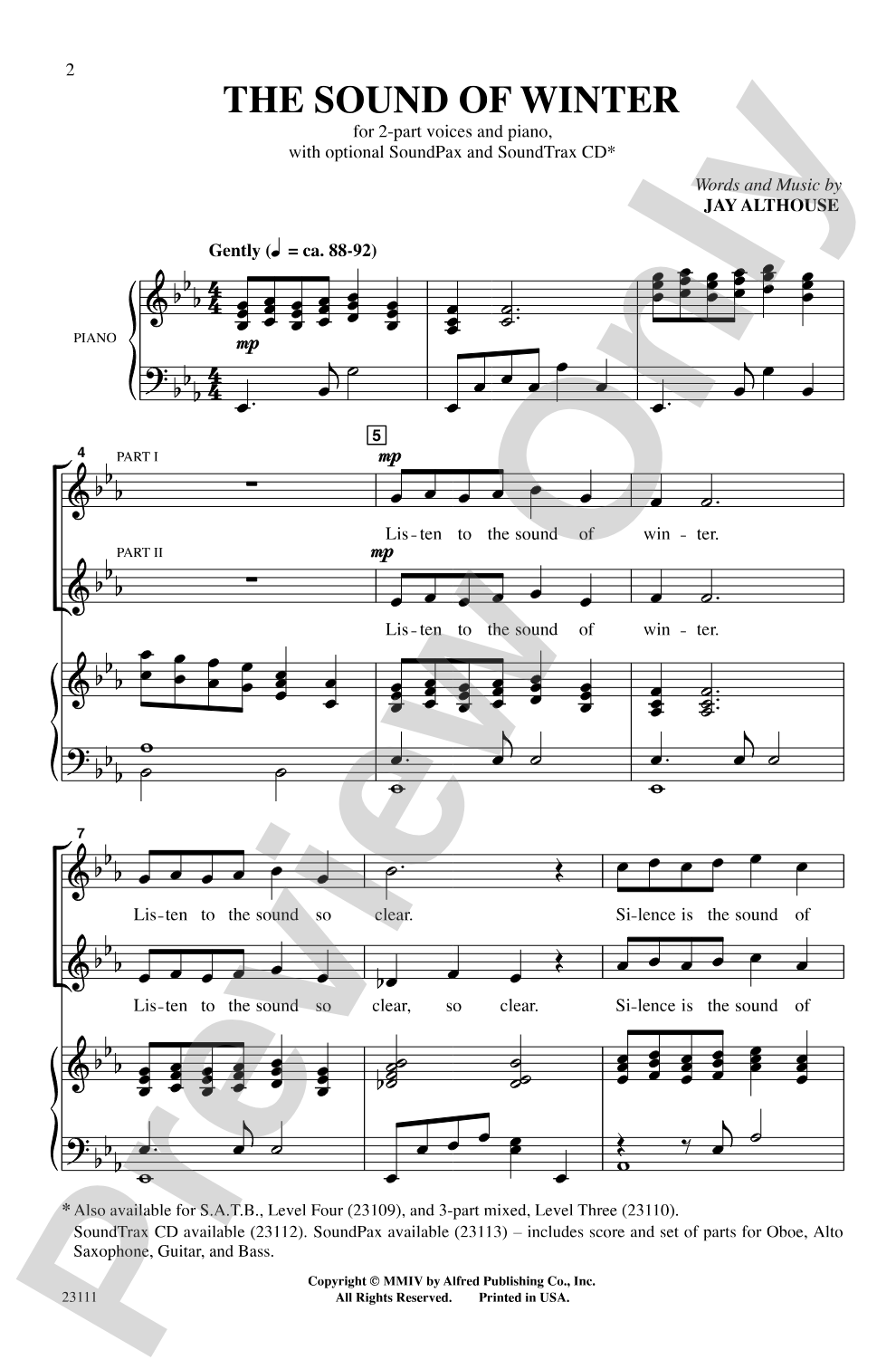
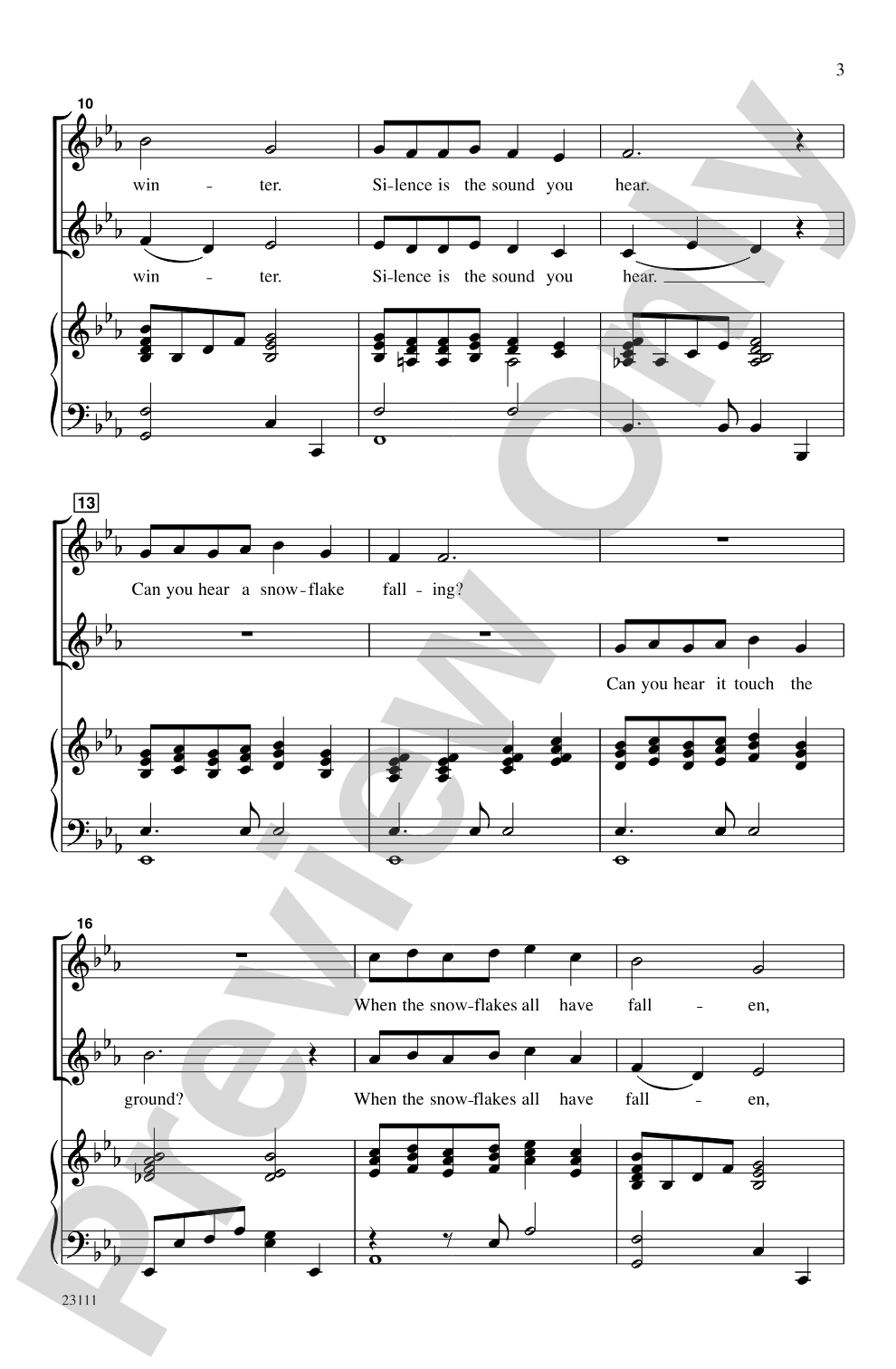
"Can you hear a snowflake falling? Can you hear it touch the ground?" A simple, curious question from a thought provoking wintertime song. Fresh parallel chords move gracefully over a pedal tone bass as your choir sings this hushed, reflective piece. Reminiscent of a Karen Carpenter ballad, it's uncomplicated, yet sophisticated; subtle, yet elegant. The optional SoundTrax CD and SoundPax are highlighted by a delicate solo oboe (or alto sax).


The Sound of Winter: 2-Part Choral Octavo isn't in MakeMusic Cloud just yet...but it could be. Let us know you'd like to see it, and you'll help shape what comes next. In the meantime, start a free trial and dive into thousands of interactive titles your students can play along with today.
Request This Title
Tell us you want it.
Start Your Free Trial
Explore everything that's ready to play right now.
Sample Audio
1
Audio File
--:--
0:00
0:00
Sample Video
No sample videos found.
Additional Details
Series:
Alfred Choral Designs
Publisher:
Alfred Music
Page Count:
8
SKU:
00-PO-0007947
More about this title
About the Composer: Jay Althouse

Jay Althouse holds degrees in Music Education and Music from Indiana University of Pennsylvania, where he was later honored as a Distinguished Alumnus. His eight years working as a rights and licenses administrator for a major educational music publisher gave him deep insight into what teachers and singers actually need, an experience that shaped his approach to composition across more than 800 published works.
Althouse's catalog spans choirs of every level and his compositions are performed regularly throughout English-speaking countries. He is an ASCAP writer member and a consistent recipient of the ASCAP Special Award for his contributions to standard music. Beyond composing, he has co-created children's musicals with his wife Sally K. Albrecht, edited widely-used vocal collections, and authored several classroom resources including The Complete Choral Warm-up Book and Accent on Composers. He currently serves on the National Advisory Board of the Folk Art Society of America and resides in North Carolina.
Why we love this
Althouse captures something elusive here: a piece that sounds effortless but demands refined musicianship. The parallel chord movement and sustained pedal tone create atmospheric depth without requiring advanced vocal technique, making this accessible for younger or less experienced singers while offering enough harmonic sophistication to engage mature choirs. The optional oboe solo transforms this from pleasant accompaniment piece into genuine concert material.
What to expect
Opening with quiet wonder, this piece unfolds like watching snow accumulate in stillness. The harmonic language drifts gently forward without urgency, creating space for contemplation while the optional oboe solo brings a moment of crystalline beauty that makes the simplicity feel intentional rather than sparse.
Who it's for
This work suits middle school and high school choirs seeking repertoire that builds musicianship without overwhelming singers. Directors looking for pieces with genuine expressive depth but accessible technical demands will find real value here.
How to get the most out of it
- Shape the parallel chords as a unified gesture rather than individual vertical sonorities; think of the harmony as a single entity moving through space, which clarifies the piece's architectural logic.
- Let the pedal tone bass anchor the piece without heaviness; it should feel like a sustained breath underneath the melody, not a harmonic anchor that locks everything in place.
- If using the oboe solo, rehearse it separately with the choir present so singers understand the relationship between the instrumental melody and their accompanying lines.
- Keep the opening question intimate and unforced; this piece invites listeners into private reflection, not proclamation.
How to use it
Position this as a moment of stillness within a winter concert, perhaps following more energetic seasonal pieces to reset the emotional temperature of the room. It also works well as an opening number when you want to settle an audience into attentiveness before moving into fuller repertoire.
Skills your students will build
- Sustaining uniform vowels across parallel harmonic movement
- Listening to and balancing with a sustained pedal tone
- Interpreting text with restraint and clarity
- Ensemble blend when voices move in similar rather than independent motion