

The Sound of Winter: 3-Part Choral Octavo
Music by Jay Althouse
Item: 00-PO-0007946
$1.65
Minimum order quantity: 20 copies
Pickup currently not available
Description
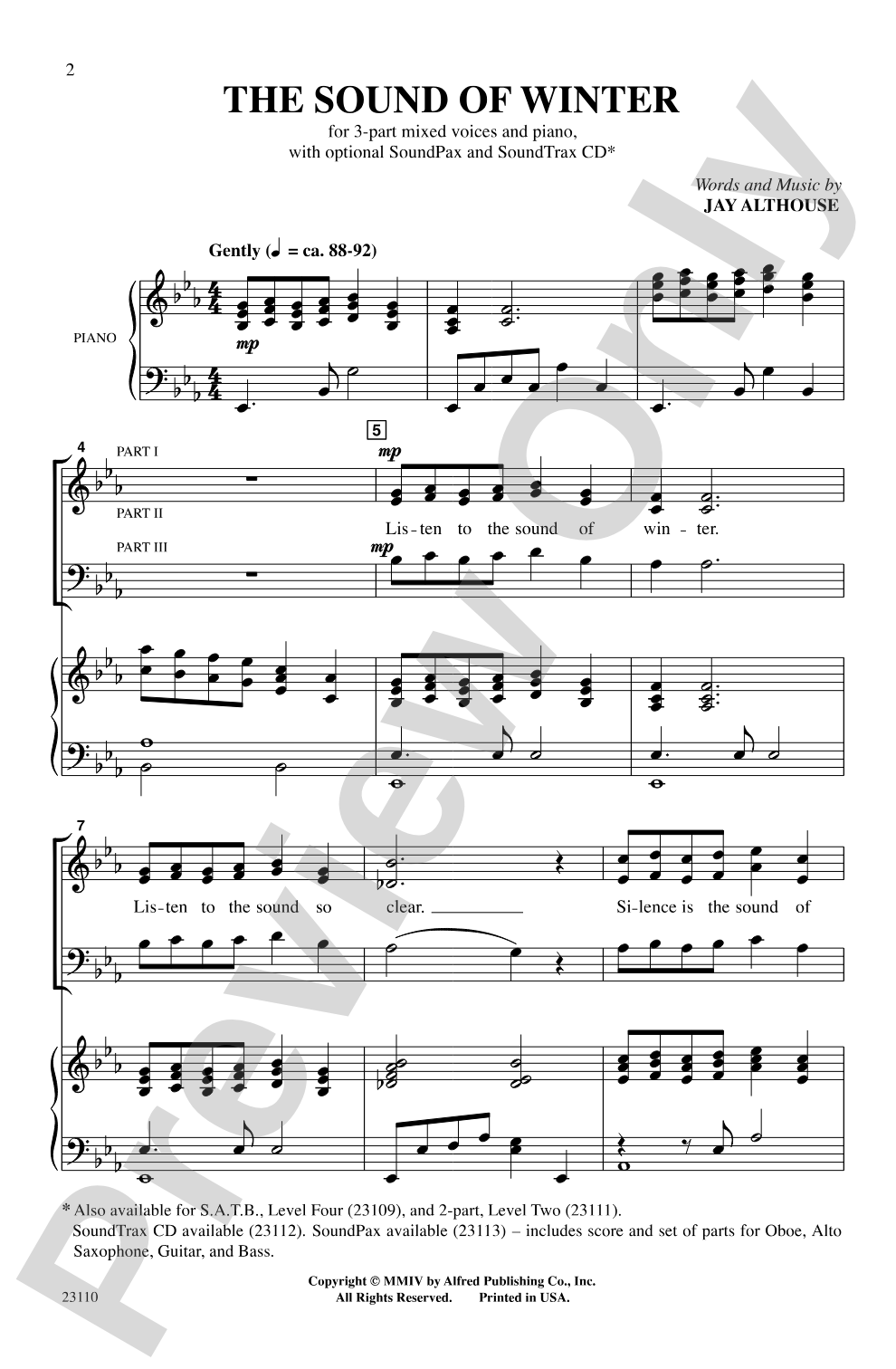
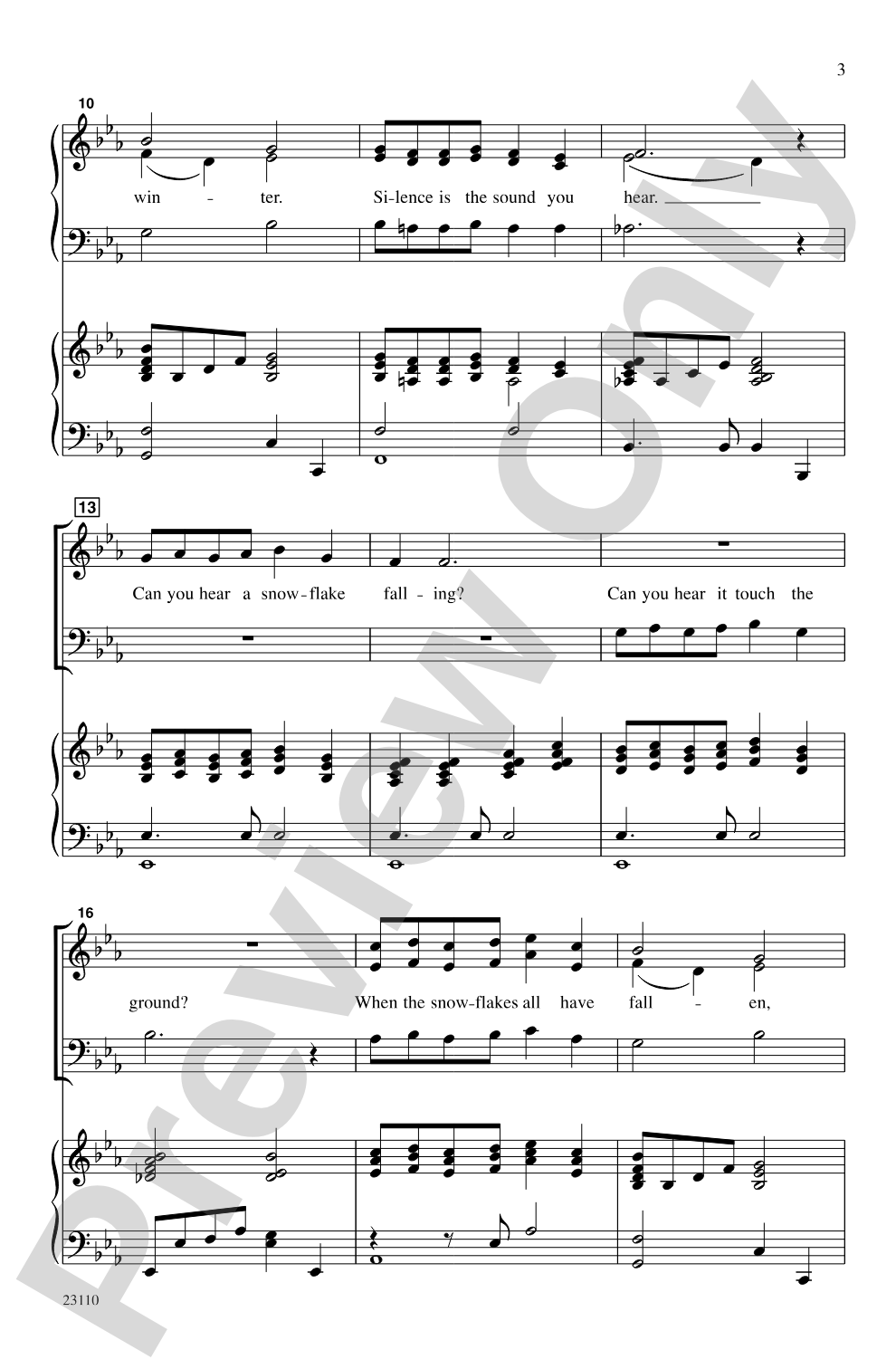
"Can you hear a snowflake falling? Can you hear it touch the ground?" A simple, curious question from a thought provoking wintertime song. Fresh parallel chords move gracefully over a pedal tone bass as your choir sings this hushed, reflective piece. Reminiscent of a Karen Carpenter ballad, it's uncomplicated, yet sophisticated; subtle, yet elegant. The optional SoundTrax CD and SoundPax are highlighted by a delicate solo oboe (or alto sax).


The Sound of Winter: 3-Part Choral Octavo isn't in MakeMusic Cloud just yet...but it could be. Let us know you'd like to see it, and you'll help shape what comes next. In the meantime, start a free trial and dive into thousands of interactive titles your students can play along with today.
Request This Title
Tell us you want it.
Start Your Free Trial
Explore everything that's ready to play right now.
Sample Audio
1
Audio File
--:--
0:00
0:00
Sample Video
No sample videos found.
Additional Details
Series:
Alfred Choral Designs
Publisher:
Alfred Music
Page Count:
8
SKU:
00-PO-0007946
More about this title
About the Composer: Jay Althouse

Jay Althouse studied music education and music at Indiana University of Pennsylvania, where the university later honored him with its Distinguished Alumni award. His career spans both administrative and creative work; he spent eight years managing rights and licensing for a major educational publisher and served on the Executive Board of the Music Publishers Association of America. As a composer, he has written more than 800 choral works performed widely across the English-speaking world and holds membership in ASCAP, where he is a regular recipient of the Special Award.
Beyond composition, Althouse has shaped music education through multiple channels. He co-authored several children's musicals with Sally K. Albrecht (his wife and frequent collaborator), compiled respected vocal solo collections including Folk Songs for Solo Singers, and wrote widely adopted classroom resources such as Ready to Read Music and Sixty Music Quizzes. His collaborative work I Hear America Singing achieved national recognition when the San Francisco Girls and Boys Choirs performed it at President Barack Obama's inauguration. He currently resides in North Carolina and serves on the National Advisory Board of the Folk Art Society of America.
Why we love this
Althouse captures something genuinely introspective here. The parallel chord movement over a sustained bass creates a sound world that feels both modern and timeless, reminiscent of the restrained elegance that defined Karen Carpenter's artistry. For choirs ready to move beyond rhythmic drive into subtlety, this piece teaches restraint as its own form of power.
What to expect
The piece unfolds like snow falling in still air. There's curiosity in the opening question, but no urgency. Parallel chords create a dreamlike harmonic shimmer while the bass holds steady underneath, grounding the sound in something real and tangible. The overall effect is meditative, with moments of genuine beauty emerging from simplicity.
Who it's for
This works beautifully for mixed choirs (SAB voicing) who have developed basic blend and tone awareness. It's sized appropriately for groups in the middle grades through high school, or adult community choirs seeking literature that values quietness over size.
How to get the most out of it
- The pedal tone bass anchors everything; your lowest voices should commit to singing it with steady, unwavering support, as any wavering will undermine the meditative quality.
- Let the parallel chords ring without forcing. The sophistication lives in clean voice leading and balance, not volume.
- The optional oboe or alto saxophone solo should sit slightly back in the mix, floating above rather than competing with the choral texture.
- Pay attention to how the text is set relative to the harmonic movement; the simple, curious question demands intimate phrasing that follows the shape of the chords rather than sentence punctuation.
How to use it
Consider pairing this with other reflective winter repertoire to build a thematic concert segment focused on quietude and natural observation. It also serves as an excellent palate cleanser in programs heavy with larger works, giving your audience space to breathe. The 8-page length and manageable range make it feasible even as an earlier-season piece when sightreading stamina is still developing.
Skills your students will build
- Sustaining tone over a pedal point without drifting from center
- Singing parallel harmony with consistent intonation
- Building musical shape through text expression rather than dynamic contrast
- Balancing individual voice lines within a homophonic texture
- Interpreting minimal articulation markings to create intimate character