
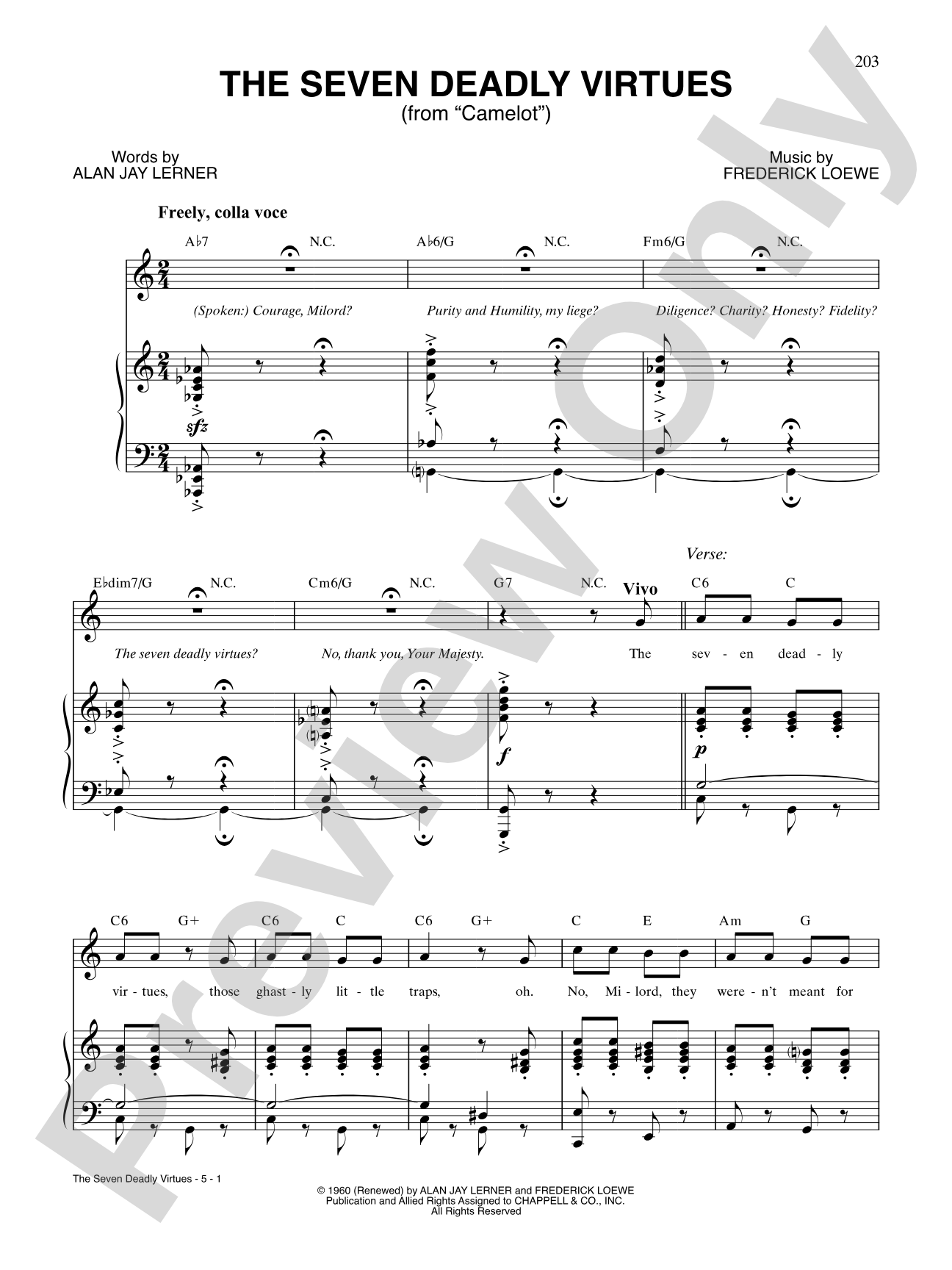

The Seven Deadly Virtues (from "Camelot"): Piano/Vocal/Chords
Songs of Classic Heroes and Villains of Musical Theater
Item: 00-XS-0000344
$4.99
One moment…
Related Items
Horton Hear a Who (from "Seussical the Musical"): Piano/Vocal/Chords |
$5.99
|
View | |
Dentist! (from "Little Shop of Horrors"): Piano/Vocal/Chords |
$5.99
|
View | |
Two Lost Souls (from "Damn Yankees"): Piano/Vocal/Chords |
$4.99
|
View | |
C'est Moi (from "Camelot"): Piano/Vocal/Chords |
$5.99
|
View | |
Bring Me My Bride (from "A Funny Thing Happened on the Way to the Forum"): Piano/Vocal/Chords |
$5.99
|
View | |
I've Gotta Be Me (from "Golden Rainbow"): Piano/Vocal/Chords |
$4.99
|
View |
Description
Learn these songs from the classic heroes and villains of musical theater now! Good guy titles include C'est Moi (Camelot) * Get Me to the Church On Time (My Fair Lady) * The Impossible Dream (Man of La Mancha) * Make Someone Happy (Do-Re-Mi) * Two Lost Souls (Damn Yankees) * and many more.
Bad guy titles include Alive (Jekyll & Hyde) * Everybody's Got the Right (Assassins) * Razzle Dazzle (Chicago) * Think Vulgar (Chitty Chitty Bang Bang) * and many more.


Bad guy titles include Alive (Jekyll & Hyde) * Everybody's Got the Right (Assassins) * Razzle Dazzle (Chicago) * Think Vulgar (Chitty Chitty Bang Bang) * and many more.
The Seven Deadly Virtues (from "Camelot"): Piano/Vocal/Chords isn't in MakeMusic Cloud just yet...but it could be. Let us know you'd like to see it, and you'll help shape what comes next. In the meantime, start a free trial and dive into thousands of interactive titles your students can play along with today.
Request This Title
Tell us you want it.
Start Your Free Trial
Explore everything that's ready to play right now.
Sample Audio
No sample audio found.
Sample Video
No sample videos found.
Additional Details
Publisher:
Alfred Music
Page Count:
224
SKU:
00-XS-0000344
More about this title
About the Composer: Frederick Loewe
Frederick Loewe (1901-1988) was an Austrian-American composer whose sophisticated melodies and harmonic language defined the golden age of Broadway musical theater. His collaborations with lyricist Alan Jay Lerner produced some of the most enduring scores in American musical history, including My Fair Lady, Camelot, and Gigi. Loewe's gift for crafting memorable, singable melodies that served character development and storytelling made his work a cornerstone of music theater education and performance.
As a composer, Loewe brought continental European musical training to American popular song. His piano writing is idiomatic and accessible without being simplistic, making his work valuable for developing musicians learning to balance accompaniment texture with melodic support. His influence on musical theater composition remains foundational to how contemporary songwriters approach character voice and dramatic arc through music.
Why we love this
This collection captures the theatrical heart of Loewe's work by pairing characters with their defining songs, giving singers and pianists insight into how music builds personality and intention. The mix of heroic and villainous numbers creates natural programming flexibility, allowing you to build concerts around character studies, moral complexity, or simply the joy of great melodies. The familiar repertoire means your students will connect immediately to the material while learning the score literacy skills needed to perform Broadway at an artful level.
What to expect
Opening these pages feels like stepping into the theater itself. Loewe's melodies are direct and honest, whether they're soaring with hope or twisting with cunning. The piano writing sparkles with elegance and drama in equal measure, supporting singers through moments of vulnerability, triumph, and theatrical mischief. Each song carries the weight of character and story, inviting performers to inhabit the world of classic musical theater.
Who it's for
Music theater singers preparing audition material, repertoire, or concert programming will find a wealth of accessible, well-known songs across a range of character types and voice ranges. Pianists accompanying vocalists in lessons, rehearsals, or performances need flexible, singable accompaniments that support without overwhelming. Directors building concert programs around musical theater themes can draw from this collection to create compelling mixed programming.
How to get the most out of it
- Balance the vocal line with accompaniment clarity. Loewe's piano writing often contains the harmonic architecture, so voice independence matters; avoid drowning out the singer even in fuller chord voicings.
- Attend to the character arc within each song. Whether playing for a hero or villain, shape the accompaniment to support the emotional journey and the singer's dramatic choices, not just the melody.
- Observe the specifics of rhythm and rubato indicated in the score. Loewe's writing often includes subtle tempo variations that serve the lyrical content; these details elevate a competent performance into a musical one.
- Coordinate with the singer on phrase breathing and dynamic shaping. The piano/vocal relationship works best when both musicians shape phrases together rather than the accompaniment remaining static.
How to use it
Program a full concert around the heroes-and-villains concept, alternating character songs to explore how music reveals intention and personality. Use individual selections as audition repertoire or recital material for developing singers studying musical theater style and interpretation. Feature these songs in educational settings where students learn about Loewe's compositional approach alongside theater history and character study.
Skills your students will build
- Reading piano/vocal/chord charts and understanding how text underlay affects rhythmic precision
- Interpreting character through musical choices, dynamics, and phrasing
- Collaborating as a piano-vocal duo, negotiating independence while maintaining ensemble
- Navigating musical theater style, including legit soprano writing, character song conventions, and dramatic timing
- Harmonic literacy through Loewe's sophisticated jazz-influenced and classical-rooted chord progressions