
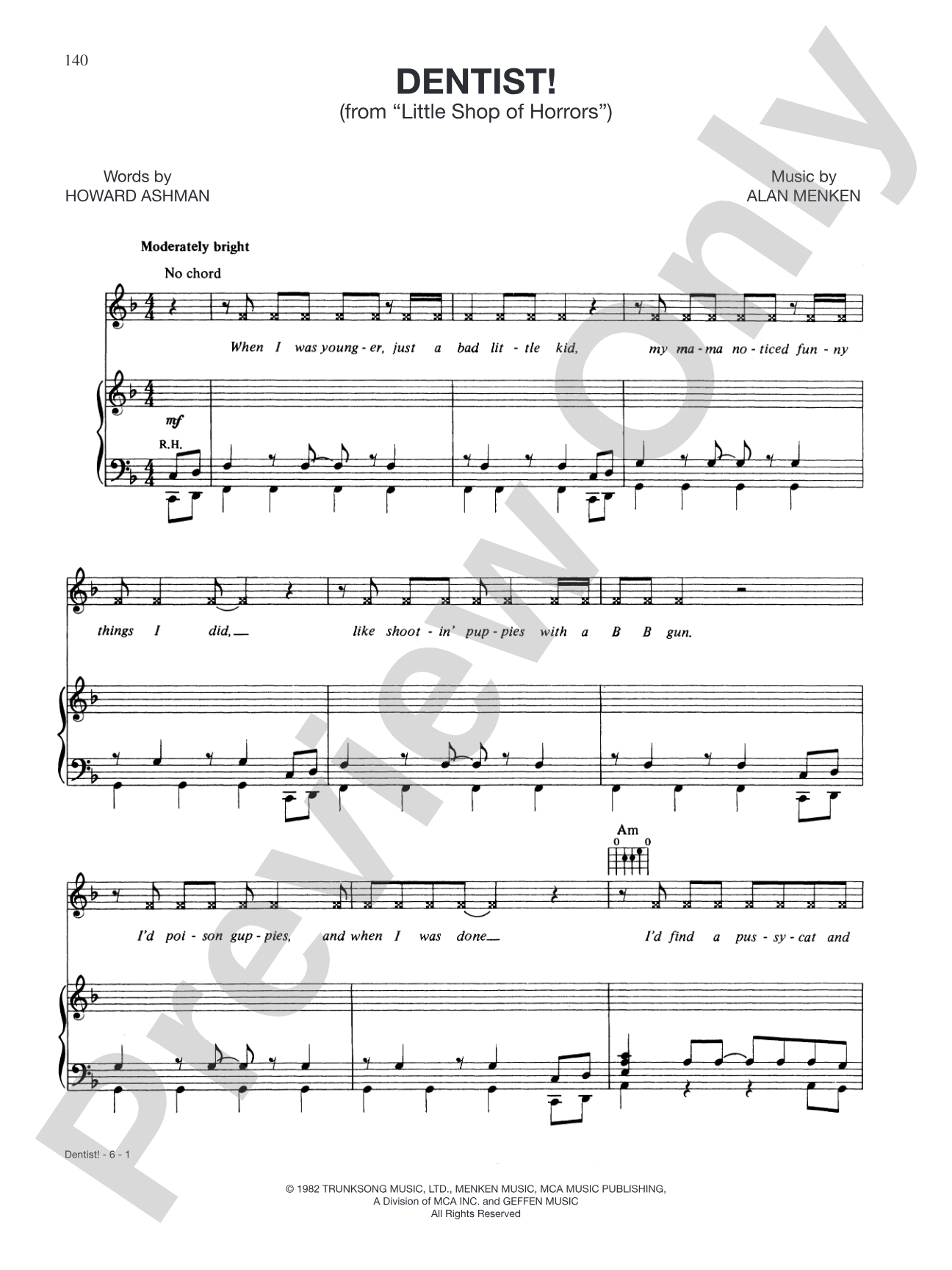
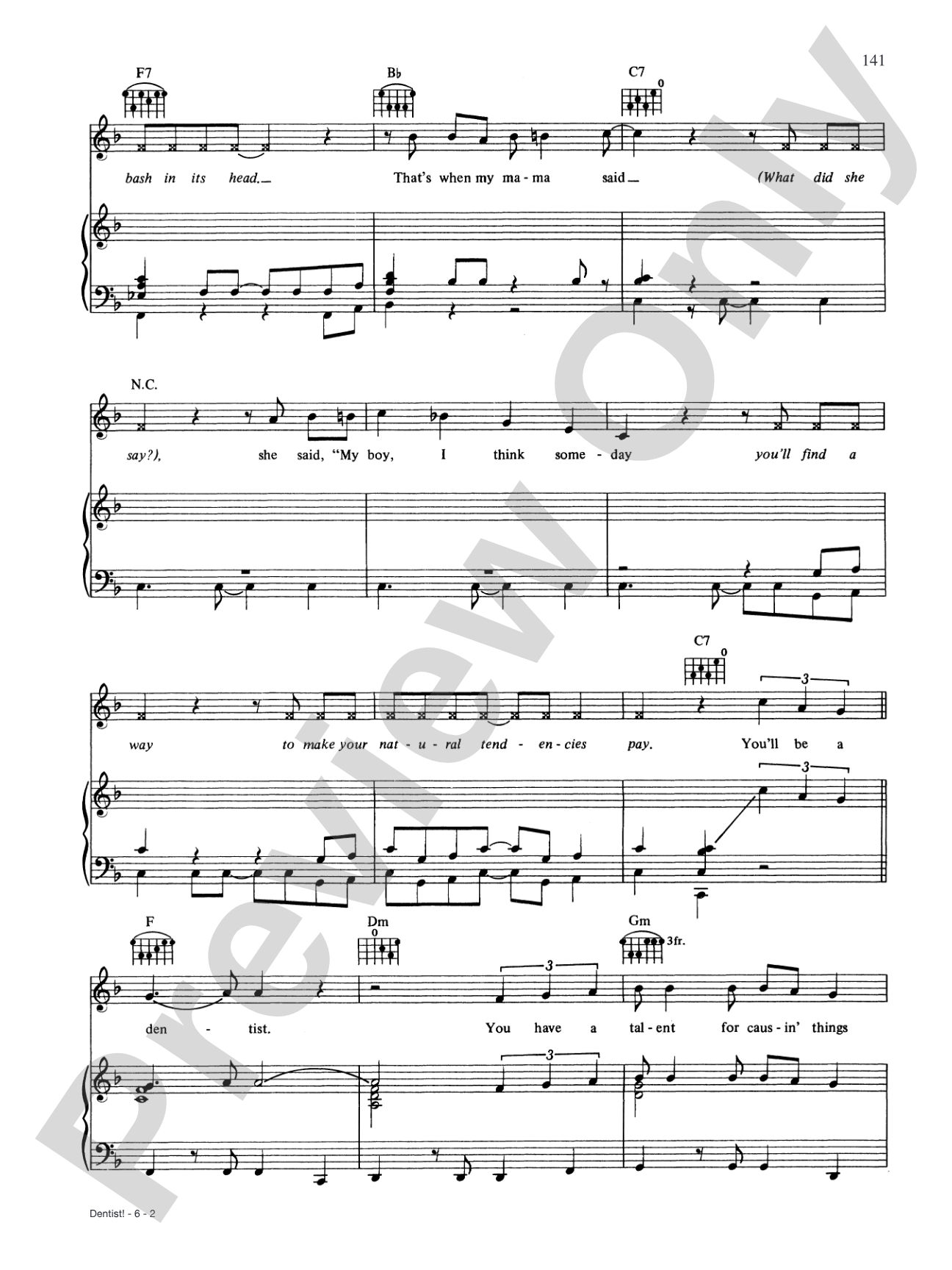

Dentist! (from "Little Shop of Horrors"): Piano/Vocal/Chords
Songs of Classic Heroes and Villains of Musical Theater
Item: 00-PS-0013159
$5.99
One moment…
Related Items
Horton Hear a Who (from "Seussical the Musical"): Piano/Vocal/Chords |
$5.99
|
View | |
Two Lost Souls (from "Damn Yankees"): Piano/Vocal/Chords |
$4.99
|
View | |
C'est Moi (from "Camelot"): Piano/Vocal/Chords |
$5.99
|
View | |
Bring Me My Bride (from "A Funny Thing Happened on the Way to the Forum"): Piano/Vocal/Chords |
$5.99
|
View | |
The Seven Deadly Virtues (from "Camelot"): Piano/Vocal/Chords |
$4.99
|
View | |
I've Gotta Be Me (from "Golden Rainbow"): Piano/Vocal/Chords |
$4.99
|
View |
Description
Learn these songs from the classic heroes and villains of musical theater now! Good guy titles include C'est Moi (Camelot) * Get Me to the Church On Time (My Fair Lady) * The Impossible Dream (Man of La Mancha) * Make Someone Happy (Do-Re-Mi) * Two Lost Souls (Damn Yankees) * and many more.
Bad guy titles include Alive (Jekyll & Hyde) * Everybody's Got the Right (Assassins) * Razzle Dazzle (Chicago) * Think Vulgar (Chitty Chitty Bang Bang) * and many more.


Bad guy titles include Alive (Jekyll & Hyde) * Everybody's Got the Right (Assassins) * Razzle Dazzle (Chicago) * Think Vulgar (Chitty Chitty Bang Bang) * and many more.
Dentist! (from "Little Shop of Horrors"): Piano/Vocal/Chords isn't in MakeMusic Cloud just yet...but it could be. Let us know you'd like to see it, and you'll help shape what comes next. In the meantime, start a free trial and dive into thousands of interactive titles your students can play along with today.
Request This Title
Tell us you want it.
Start Your Free Trial
Explore everything that's ready to play right now.
Sample Audio
No sample audio found.
Sample Video
No sample videos found.
Additional Details
Publisher:
Alfred Music
Page Count:
224
SKU:
00-PS-0013159
More about this title
About the Composer: Alan Menken
Alan Menken stands among Broadway's most prolific and celebrated composers, with a catalog spanning four decades of musical theater, film, and concert works. His gift for crafting memorable melodies that serve character and story has made him a mainstay of music education curricula, from high school productions to university musical theater programs. Menken's scores balance accessibility with sophistication, offering performers of varying levels pathways into genuinely rewarding material.
Beyond Broadway, Menken's film work (including multiple Disney animated features and live-action adaptations) has expanded his reach into general music classrooms and piano studios. His ability to write singable, harmonically interesting material that works equally well in a theater pit or a practice room makes his compositions perennially useful for voice teachers, accompanists, and ensemble directors.
Why we love this
This folio pairs high-recognition songs with the flexibility of lead sheet notation, letting singers and pianists focus on interpretation rather than hunting down scattered arrangements. The villain songs especially offer vocal character work that goes beyond belting; they demand personality, phrasing nuance, and dramatic commitment that elevate a rehearsal room's standards. Menken's harmonic language is sophisticated enough to sustain a pianist's interest while remaining learnable for students building their sight-reading.
What to expect
Menken's melodies lodge themselves immediately in memory, but they never feel simple once you're inside them. There's a theatrical generosity in these songs; they invite performers to be bold, vulnerable, funny, and dangerous by turns. The combination of hummable hooks and genuine harmonic color creates the peculiar pleasure of musical theater: a piece that satisfies both the audience's ear and the performer's need for substance.
Who it's for
This collection serves singers preparing audition material, voice students expanding their musical theater literacy, pianists building a repertoire of accompaniments across character types, and ensemble directors programming songs with immediate dramatic impact and audience recognition. Whether you're working through a single showstopper or building a revue, these arrangements provide sturdy, singable foundation work.
How to get the most out of it
- Study the character's arc and motivation before diving into melody; Menken writes accompaniment patterns that reinforce emotional subtext, and knowing what the character wants shapes every phrase.
- Use the chord symbols not as safety nets but as harmonic scaffolding. Playing rootless voicings and jazz reharmonizations will deepen your understanding of Menken's harmonic intentions.
- Lock the vocal line and piano accompaniment together through rhythm section feel rather than metronomic precision; these songs breathe and pulse like conversation.
- Balance legibility with expression when accompanying; clean chord comping in the left hand lets the vocalist own the space without unnecessary competition.
How to use it
These songs work beautifully in sectional rehearsals with solo singers or as audition prep material, but they also program naturally into a musical theater revue or cabaret concert. Pair a hero song with its corresponding villain piece to explore character contrast and storytelling through repertoire selection. Because the folio covers multiple Menken properties, you can build a thematic program around his compositional voice across different eras.
Skills your students will build
- Reading and interpreting lead sheet notation with chord symbols
- Sustained legit singing with character-driven phrasing and emotional specificity
- Playing from chord charts and constructing spontaneous accompaniments
- Understanding musical theater's dramatic archetypes through song structure and melody placement
- Sight-reading melodic lines with dramatic text and interpretive markings
- Coordinating vocal line and accompaniment across varied tempos and emotional registers