
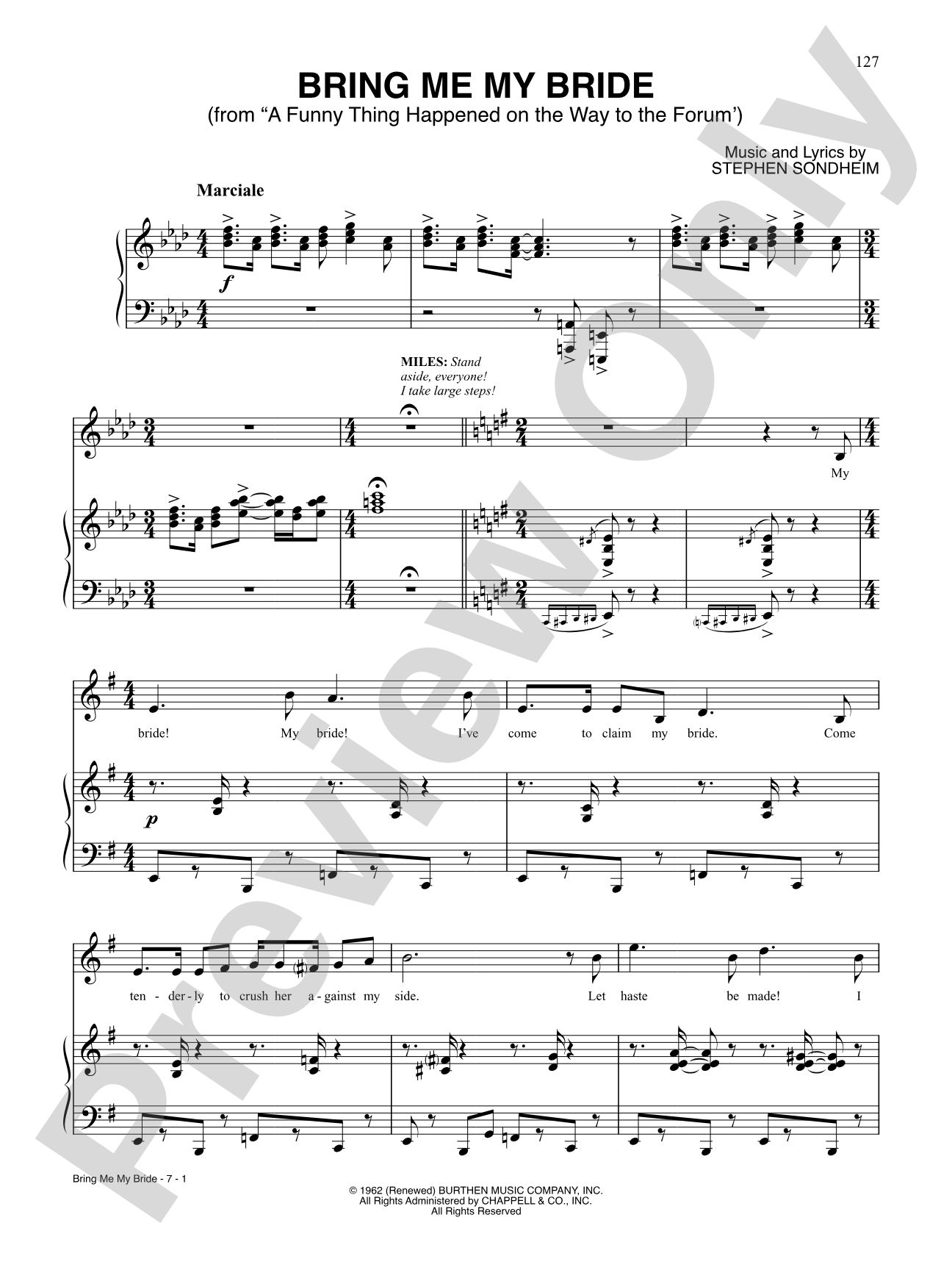
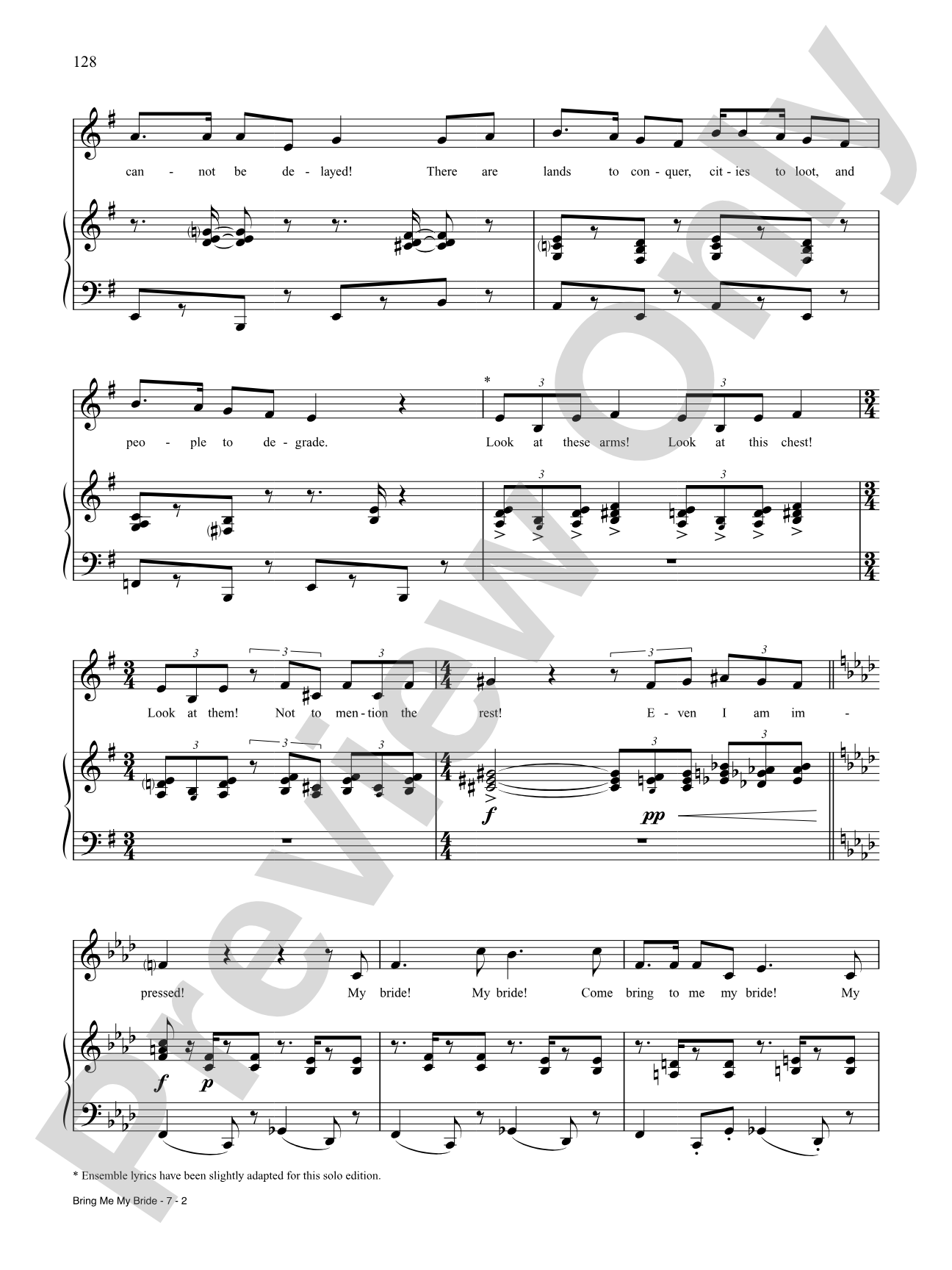

Bring Me My Bride (from "A Funny Thing Happened on the Way to the Forum"): Piano/Vocal/Chords
Songs of Classic Heroes and Villains of Musical Theater
Item: 00-XS-0000343
$5.99
One moment…
Related Items
Horton Hear a Who (from "Seussical the Musical"): Piano/Vocal/Chords |
$5.99
|
View | |
Dentist! (from "Little Shop of Horrors"): Piano/Vocal/Chords |
$5.99
|
View | |
Two Lost Souls (from "Damn Yankees"): Piano/Vocal/Chords |
$4.99
|
View | |
C'est Moi (from "Camelot"): Piano/Vocal/Chords |
$5.99
|
View | |
The Seven Deadly Virtues (from "Camelot"): Piano/Vocal/Chords |
$4.99
|
View | |
I've Gotta Be Me (from "Golden Rainbow"): Piano/Vocal/Chords |
$4.99
|
View |
Description
Learn these songs from the classic heroes and villains of musical theater now! Good guy titles include C'est Moi (Camelot) * Get Me to the Church On Time (My Fair Lady) * The Impossible Dream (Man of La Mancha) * Make Someone Happy (Do-Re-Mi) * Two Lost Souls (Damn Yankees) * and many more.
Bad guy titles include Alive (Jekyll & Hyde) * Everybody's Got the Right (Assassins) * Razzle Dazzle (Chicago) * Think Vulgar (Chitty Chitty Bang Bang) * and many more.


Bad guy titles include Alive (Jekyll & Hyde) * Everybody's Got the Right (Assassins) * Razzle Dazzle (Chicago) * Think Vulgar (Chitty Chitty Bang Bang) * and many more.
Bring Me My Bride (from "A Funny Thing Happened on the Way to the Forum"): Piano/Vocal/Chords isn't in MakeMusic Cloud just yet...but it could be. Let us know you'd like to see it, and you'll help shape what comes next. In the meantime, start a free trial and dive into thousands of interactive titles your students can play along with today.
Request This Title
Tell us you want it.
Start Your Free Trial
Explore everything that's ready to play right now.
Sample Audio
No sample audio found.
Sample Video
No sample videos found.
Additional Details
Publisher:
Alfred Music
Page Count:
224
SKU:
00-XS-0000343
More about this title
About the Composer: Stephen Sondheim
Stephen Sondheim (1930-2021) shaped the landscape of musical theater through his intricate lyrics, sophisticated harmonies, and willingness to expand what the Broadway musical could express. His career spanned over six decades, during which he collaborated with composers like Richard Rodgers and Leonard Bernstein, and created original works that challenged audiences with complex narratives, unconventional structures, and emotional depth rarely heard in popular song.
Sondheim's influence on music education extends far beyond Broadway stages. His works demand serious musicianship from performers: singers must navigate wide intervallic leaps, shifting harmonic landscapes, and lyrics requiring crystalline diction and dramatic commitment. Pianists encounter sophisticated chord progressions and rhythmic complexity that develop harmonic literacy and stylistic flexibility. For students and teachers, Sondheim's catalog represents a masterclass in how popular music can be simultaneously accessible and artistically rigorous.
Why we love this
This collection captures one of Sondheim's earliest works with a tonal and harmonic sophistication that makes it ideal for singers advancing beyond standard musical theater repertoire. The range of characters—from swaggering villains to earnest heroes—provides pianists and singers alike with a genuine theatrical vocabulary for exploring character, intention, and dramatic contrast through melody and harmony. Each song sits comfortably enough for accomplished singers to perform while containing the harmonic and rhythmic nuance that rewards close study.
What to expect
These songs pulse with wit, cynicism, yearning, and theatrical swagger in equal measure. Sondheim's melodies can feel angular and unexpected one moment, then soar with genuine emotional weight the next. The piano parts shimmer with sophisticated jazz-influenced chords and dramatic punctuation that feels both modern and timeless.
Who it's for
Advanced high school singers and college-level music students ready to tackle sophisticated Broadway repertoire, along with pianists who want to deepen their harmonic fluency and stylistic range. Voice teachers preparing students for college auditions or recitals will find rich material here that demonstrates musical maturity and interpretive skill.
How to get the most out of it
- Pay attention to the lyric's emotional subtext before locking into the melody. Sondheim's words often contain irony or double meaning that shifts how you shape a phrase.
- Honor the harmonic movement at the piano; these chords are doing dramatic work. Resist the temptation to simplify or rush through unexpected resolutions.
- Work in character from the first note. Whether comic or sincere, commit fully to the dramatic situation the song establishes.
- Mark phrase boundaries clearly in your score so the melody breathes in psychologically sensible places rather than at metrically obvious moments.
How to use it
Program a character song or two in a recital to showcase both your singer's dramatic range and your pianist's harmonic sophistication. This collection also works beautifully in a musical theater history concert, pairing classic comic numbers with moments of genuine pathos to illustrate Sondheim's breadth. Academic settings can use individual songs to teach chromatic harmony, extended chords, and how composers use melody and harmony to reveal character.
Skills your students will build
- Navigating wide intervallic leaps and non-diatonic melody lines
- Understanding sophisticated chord progressions and chromatic voice leading at the piano
- Coordinating clear, articulate diction with sustained vocal lines
- Interpreting character intention and subtext through musical choices
- Reading and performing syncopated and complex rhythmic figures in both voice and accompaniment