
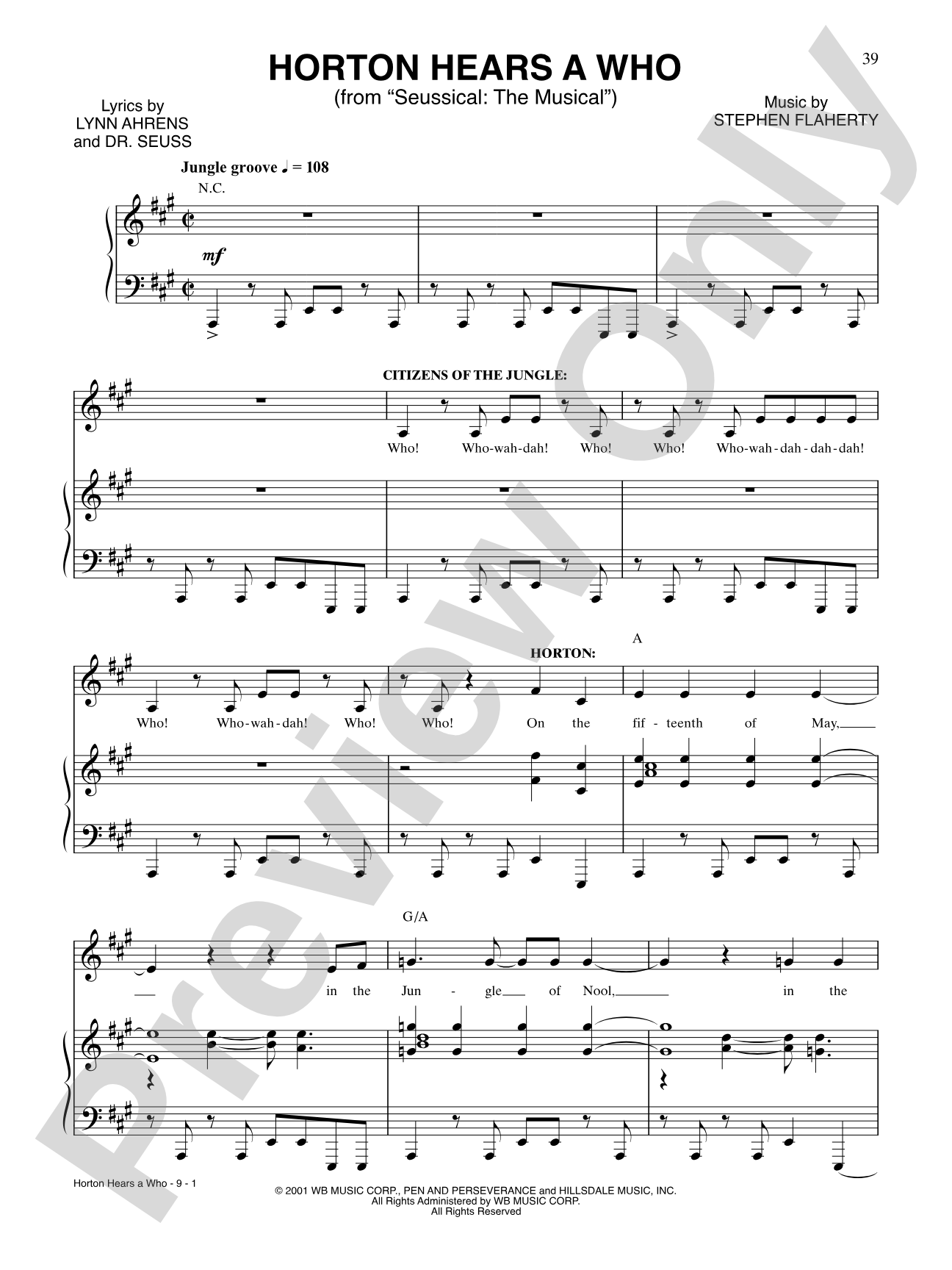
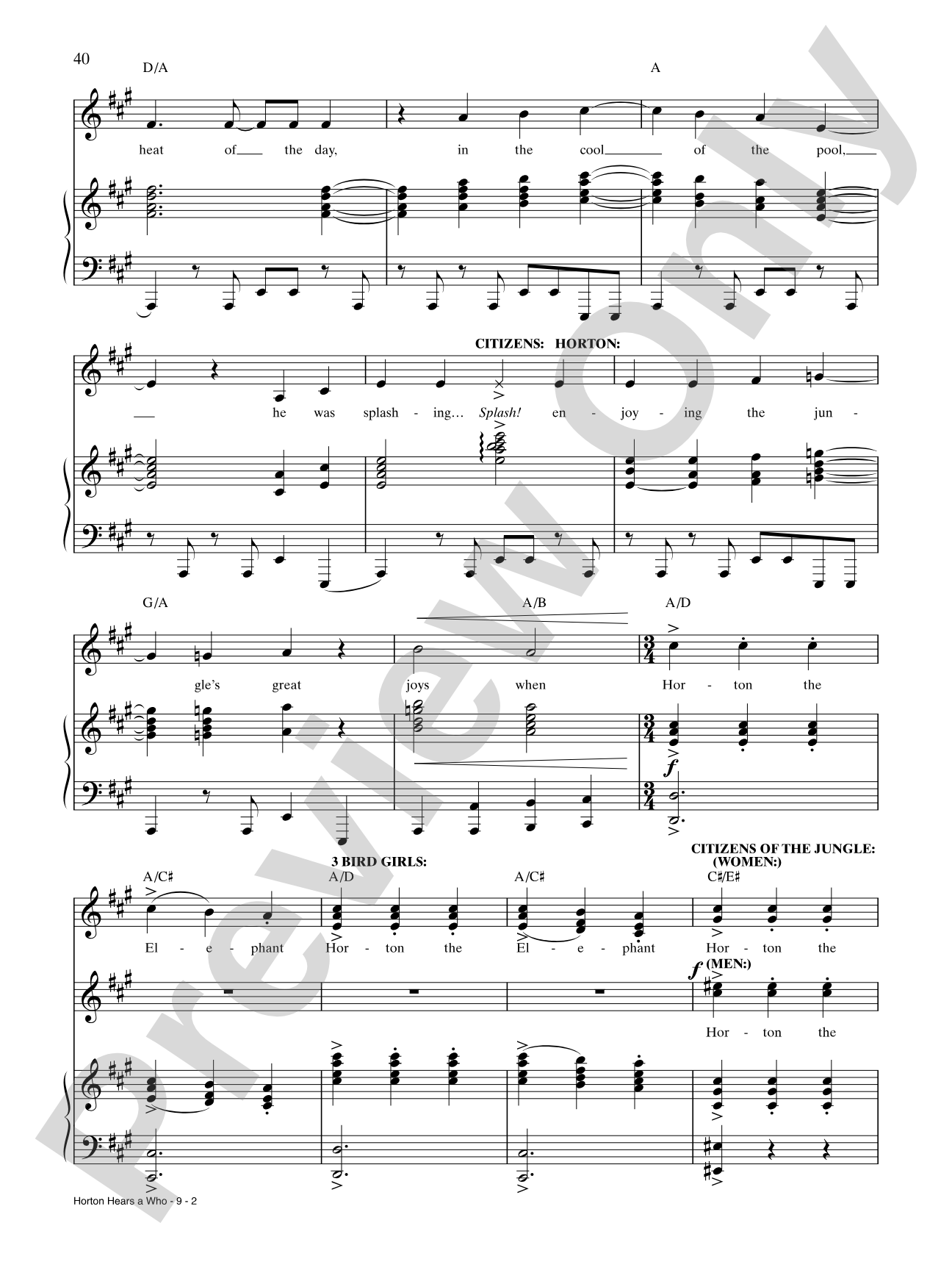

Horton Hear a Who (from "Seussical the Musical"): Piano/Vocal/Chords
Songs of Classic Heroes and Villains of Musical Theater
Item: 00-PS-0013158
$5.99
One moment…
Related Items
Dentist! (from "Little Shop of Horrors"): Piano/Vocal/Chords |
$5.99
|
View | |
Two Lost Souls (from "Damn Yankees"): Piano/Vocal/Chords |
$4.99
|
View | |
C'est Moi (from "Camelot"): Piano/Vocal/Chords |
$5.99
|
View | |
Bring Me My Bride (from "A Funny Thing Happened on the Way to the Forum"): Piano/Vocal/Chords |
$5.99
|
View | |
The Seven Deadly Virtues (from "Camelot"): Piano/Vocal/Chords |
$4.99
|
View | |
I've Gotta Be Me (from "Golden Rainbow"): Piano/Vocal/Chords |
$4.99
|
View |
Description
Learn these songs from the classic heroes and villains of musical theater now! Good guy titles include C'est Moi (Camelot) * Get Me to the Church On Time (My Fair Lady) * The Impossible Dream (Man of La Mancha) * Make Someone Happy (Do-Re-Mi) * Two Lost Souls (Damn Yankees) * and many more.
Bad guy titles include Alive (Jekyll & Hyde) * Everybody's Got the Right (Assassins) * Razzle Dazzle (Chicago) * Think Vulgar (Chitty Chitty Bang Bang) * and many more.


Bad guy titles include Alive (Jekyll & Hyde) * Everybody's Got the Right (Assassins) * Razzle Dazzle (Chicago) * Think Vulgar (Chitty Chitty Bang Bang) * and many more.
Horton Hear a Who (from "Seussical the Musical"): Piano/Vocal/Chords isn't in MakeMusic Cloud just yet...but it could be. Let us know you'd like to see it, and you'll help shape what comes next. In the meantime, start a free trial and dive into thousands of interactive titles your students can play along with today.
Request This Title
Tell us you want it.
Start Your Free Trial
Explore everything that's ready to play right now.
Sample Audio
No sample audio found.
Sample Video
No sample videos found.
Additional Details
Publisher:
Alfred Music
Page Count:
224
SKU:
00-PS-0013158
More about this title
About the Composer: Stephen Flaherty
Stephen Flaherty has composed music for some of Broadway's most imaginative and technically adventurous musicals. His work spans from the fantastical worlds of Seussical and Anastasia to the darker, more introspective storytelling of Ragtime and Natasha, Pierre & The Great Comet. His melodies are distinctly singable yet harmonically sophisticated, often layered with orchestral colors that translate surprisingly well to the piano.
Flaherty's gift for writing music that works across multiple skill levels makes his scores particularly valuable in educational settings. Whether arranging for young voices in school productions or for adult ensembles learning Broadway repertoire, his compositions reward both careful attention to detail and emotional commitment from performers.
Why we love this
This collection captures one of Broadway's most joyful and musically inventive scores, and "Horton Hears a Who" sits perfectly at the intersection of accessibility and genuine musical substance. The melody is instantly memorable and singable, but the harmony and accompaniment patterns offer enough sophistication to keep singers and pianists engaged through multiple rehearsals. Programming a Seussical song gives you both crowd appeal and legitimacy in any cabaret, concert, or musical theater showcase.
What to expect
Seussical lives in a world of whimsy that never becomes precious or condescending. Flaherty's music captures the gentle humor and genuine emotion woven through the story; "Horton Hears a Who" itself embodies quiet heroism and steadfast kindness. Singing or playing it, you're not performing camp or novelty, but a piece of real musical theater with heart.
Who it's for
This folio works for pianists and singers at the intermediate level and above who want reliable, musically rewarding Broadway repertoire. Voice students preparing audition material, pianist-accompanists building their theater library, and any musician interested in contemporary musical theater composition will find solid material here.
How to get the most out of it
- Pay close attention to Flaherty's dynamic markings and tempo indications; they shape the character of each moment. A rushed "Horton Hears a Who" loses the gentle determination that makes the song work.
- Balance the vocal line with the piano accompaniment. These arrangements are written to support the singer, but the accompaniment often carries harmonic color that shouldn't be buried.
- Explore the rhythmic swing and syncopation in the piano part. Flaherty frequently layers slightly offset rhythms that create lift without needing dramatic tempo changes.
- Use the chord symbols to understand the harmonic movement, especially in modulations. Knowing where the harmony is headed helps both pianist and singer shape phrases more intentionally.
How to use it
This title fits beautifully in a family-friendly concert or in a Broadway cabaret exploring contemporary musical theater. Pair it with other Flaherty numbers for a deeper dive into his compositional voice, or use it as a palate cleanser between heavier dramatic pieces. It's also an excellent choice for audition books, allowing performers to show musicality and character work simultaneously.
Skills your students will build
- Reading and executing dynamic contrast in mixed meters and rhythmic contexts
- Coordinating vocal phrasing with piano accompaniment patterns that don't always move in parallel rhythms
- Interpreting chord symbols in a contemporary musical theater context
- Sustaining emotional clarity and character work while managing moderate technical demands