
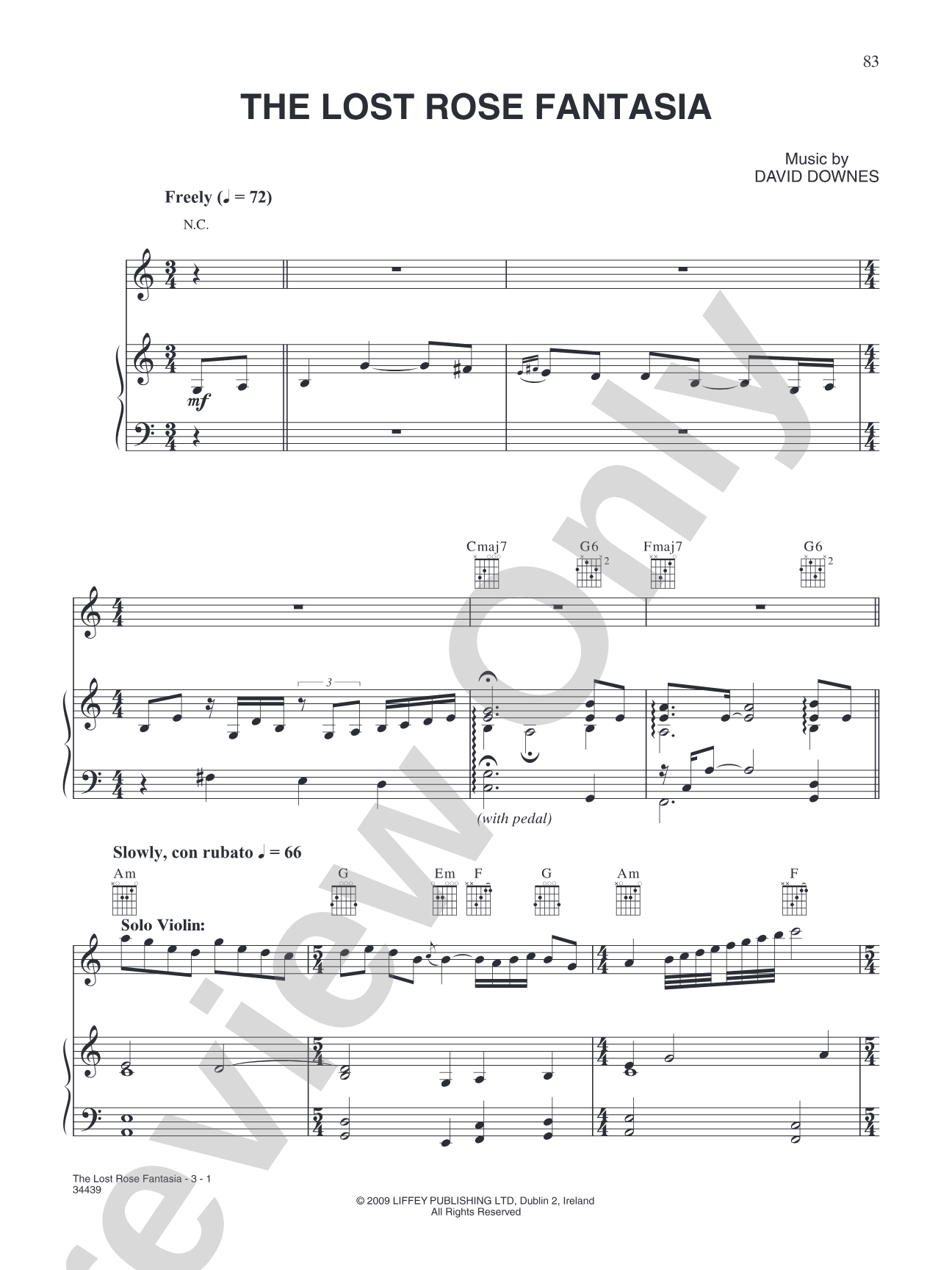

The Lost Rose Fantasia: Piano/Vocal/Chords
Celtic Woman
Item: 00-PS-0012077
$4.99
One moment…
Related Items
The Coast of Galicia: Piano/Vocal/Chords |
$5.99
|
View | |
The New Ground: Piano/Vocal/Chords |
$4.99
|
View | |
Non C'e Piu: Piano/Vocal/Chords |
$4.99
|
View | |
Nil Se'n La: Piano/Vocal/Chords |
$9.99
|
View | |
My Lagan Love: Piano/Vocal/Chords |
$4.99
|
View | |
Amazing Grace: Piano/Vocal/Chords |
$5.99
|
View | |
Slumber My Darling: Piano/Vocal/Chords |
$5.99
|
View | |
Danny Boy: Piano/Vocal/Chords |
$4.99
|
View | |
Finale/Mo Ghile Mear: Piano/Vocal/Chords |
$9.99
|
View | |
Celtic Woman: Songs from the Heart: Piano/Vocal/Chords Book |
$21.99
|
View |
Description
These piano/vocal/chord arrangements are based on Celtic Woman's PBS TV special and 2010 tour. This book showcases their unforgettable style and features four pages of color photos. Titles: Fields of Gold * Amazing Grace * Níl Sé'n Lá * My Lagan Love * When You Believe * The New Ground * Isle of Hope, Isle of Tears * The Coast of Galiçia * Non C'è Più * The Moon's a Harsh Mistress * You'll Be in My Heart * Goodnight My Angel * Galway Bay * The Lost Rose Fantasia * O, America! * The Call * Finale / Mo Ghile Mear * True Colors * Pie Jesu * Slumber My Darling / The Mason's Apron * Danny Boy * You Raise Me Up.


Discover MakeMusic Cloud: thousands of interactive titles your students can play along with today.
Sample Audio
No sample audio found.
Sample Video
No sample videos found.
Additional Details
Publisher:
Alfred Music
Page Count:
140
SKU:
00-PS-0012077
More about this title
About the Composer: David Downes
David Downes has shaped the sound of Celtic Woman since the ensemble's inception, serving as composer and musical director for their PBS television specials and international tours. His arrangements honor traditional Celtic melodies while creating accessible piano/vocal interpretations that bring these songs to contemporary audiences without sacrificing their cultural authenticity.
Why we love this
This collection captures the distinctive Celtic Woman sound in a format pianists and singers can actually use for performances and practice. The 22-song range means you'll find material suitable for recitals, competitions, or casual accompaniment scenarios, and the inclusion of both well-known standards (Danny Boy, Galway Bay) and lesser-known Celtic pieces broadens repertoire horizons.
What to expect
These arrangements capture the luminous, introspective quality that defines Celtic Woman's approach: spare textures that let lyrics and melody breathe, unexpected harmonic turns that honor traditional roots, and production values that feel both intimate and theatrical. You'll encounter songs that feel like quiet meditation alongside pieces with sweeping dramatic arc.
Who it's for
Pianists and vocalists preparing recital material or seeking contemporary world music repertoire with cultural depth. Teachers and students interested in Celtic traditions will find this collection offers both performance vehicles and cultural context through the ensemble's distinctive interpretive choices.
How to get the most out of it
- Balance the melody line with chord accompaniment by listening to the original recordings; Downes's arrangements assume familiarity with the vocal nuance and ornamentation Celtic Woman brings to each piece.
- Pay attention to key changes and modal shifts, particularly in pieces drawing from Irish traditional music, which often move fluidly between major and minor tonalities.
- Adapt the accompaniment density to your skill level; simpler voicings still maintain the Celtic character while letting you focus on phrasing and vocal tone.
- Use the chord symbols to explore substitutions and reharmonization if you're accompanying a vocalist, creating space for their interpretation rather than locking into a rigid arrangement.
How to use it
Program individual selections in a solo recital to create a thematic evening around Celtic culture and diaspora stories. The mix of sacred pieces (Pie Jesu, Amazing Grace), love songs, and narrative ballads allows you to build emotional arc across a full program or integrate selections into a mixed repertoire concert.
Skills your students will build
- Reading and interpreting chord symbols in a popular music context
- Adapting accompaniment texture and density to serve vocal phrasing
- Performing modal melodies and understanding their traditional origins
- Balancing rhythmic precision with the rubato and flexibility Celtic interpretation requires