
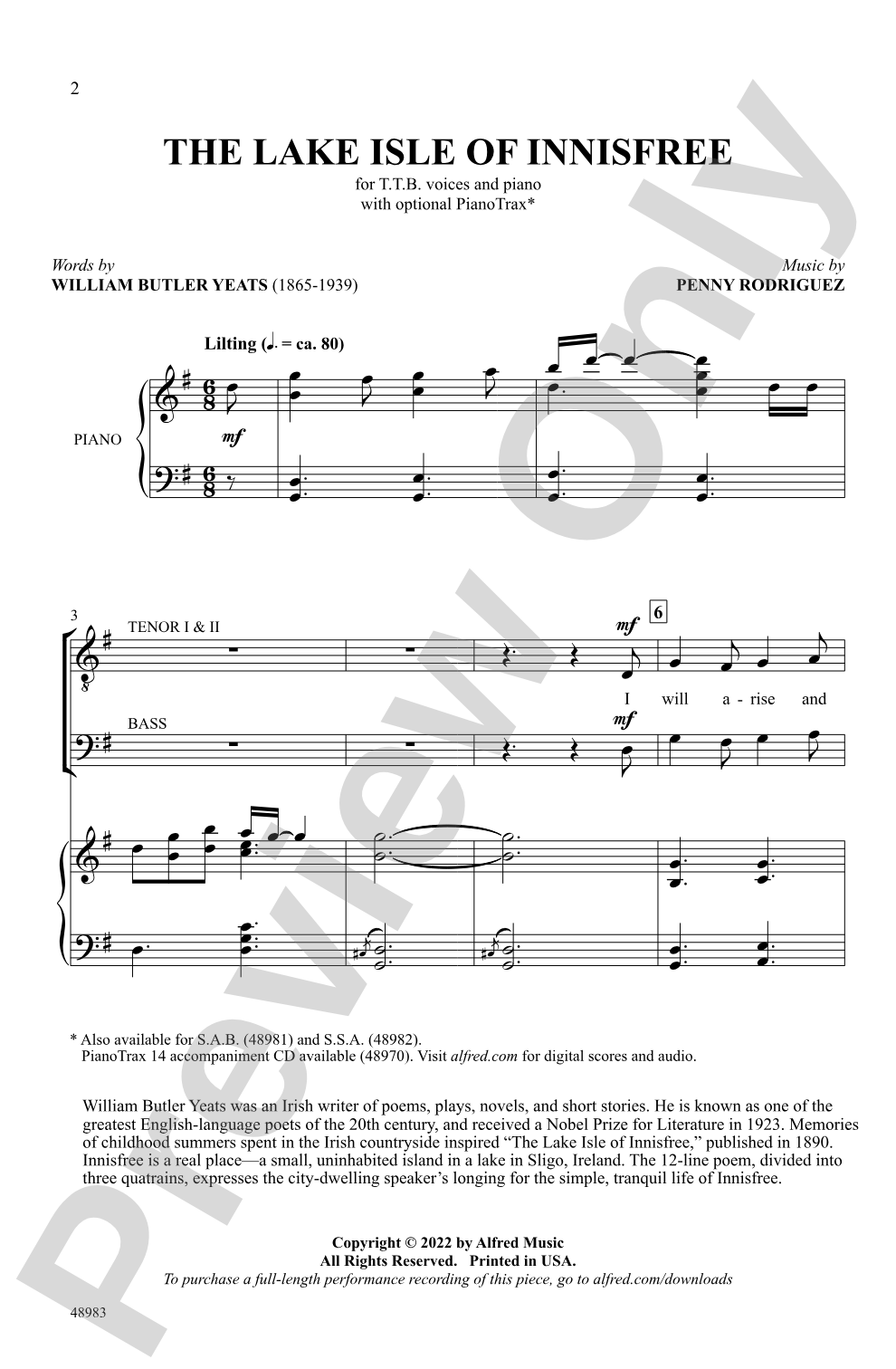

The Lake Isle of Innisfree: TTB Choral Octavo
Words by William Butler Yeats, music by Penny Rodriguez
Item: 00-PO-0006870
$2.05
Minimum order quantity: 20 copies
Pickup currently not available
Related Items
The Lake Isle of Innisfree: PianoTrax Digital Audio Download |
$9.99
|
View | |
The Lake Isle of Innisfree: SAB Choral Octavo |
$2.05
|
View | |
The Lake Isle of Innisfree: SSA Choral Octavo |
$2.05
|
View | |
The Lake Isle of Innisfree: SAB Choral Octavo |
$2.05
|
View | |
The Lake Isle of Innisfree: SSA Choral Octavo |
$2.05
|
View | |
The Lake Isle of Innisfree: TTB Choral Octavo |
$2.05
|
View |
Description
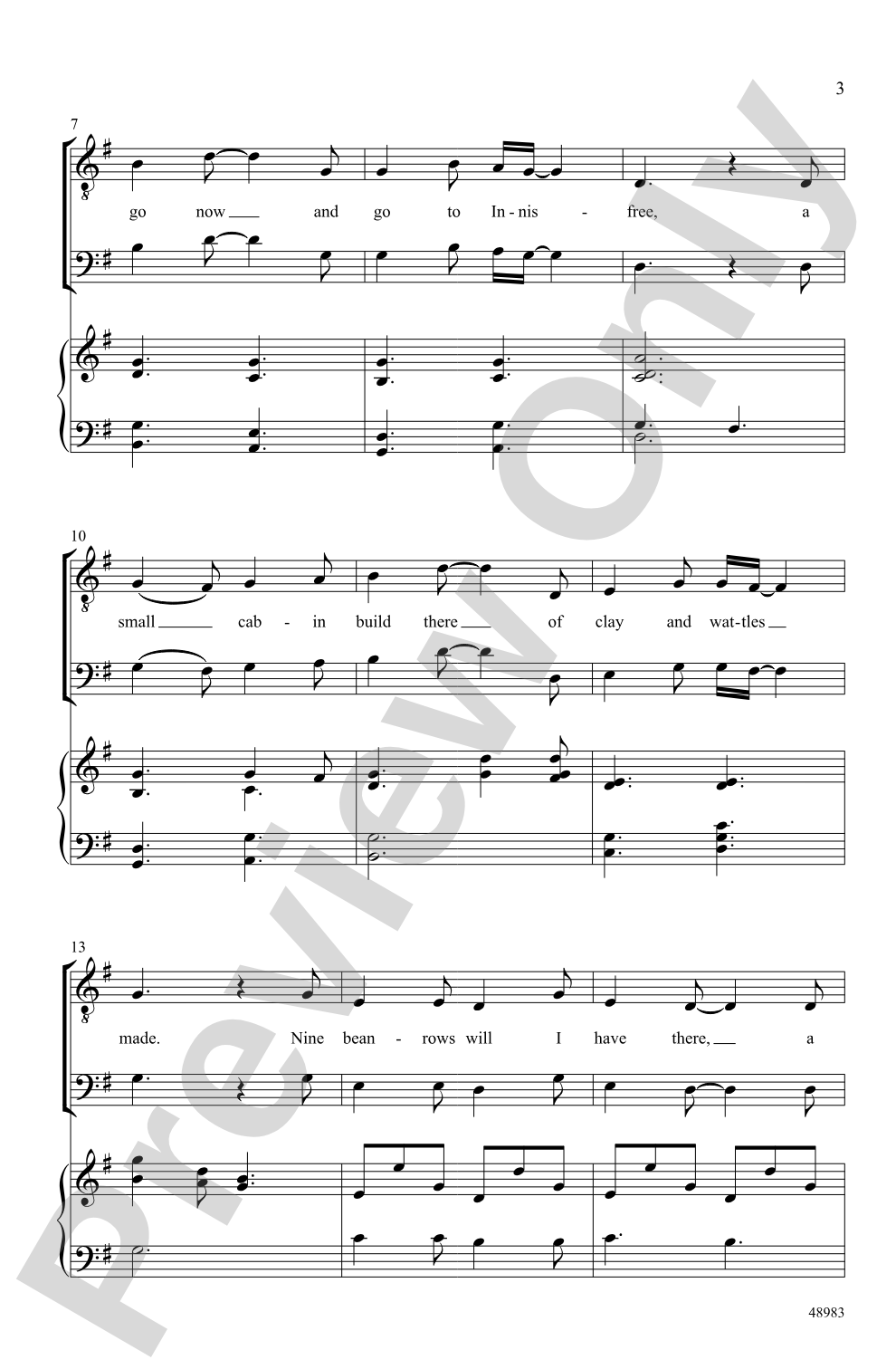
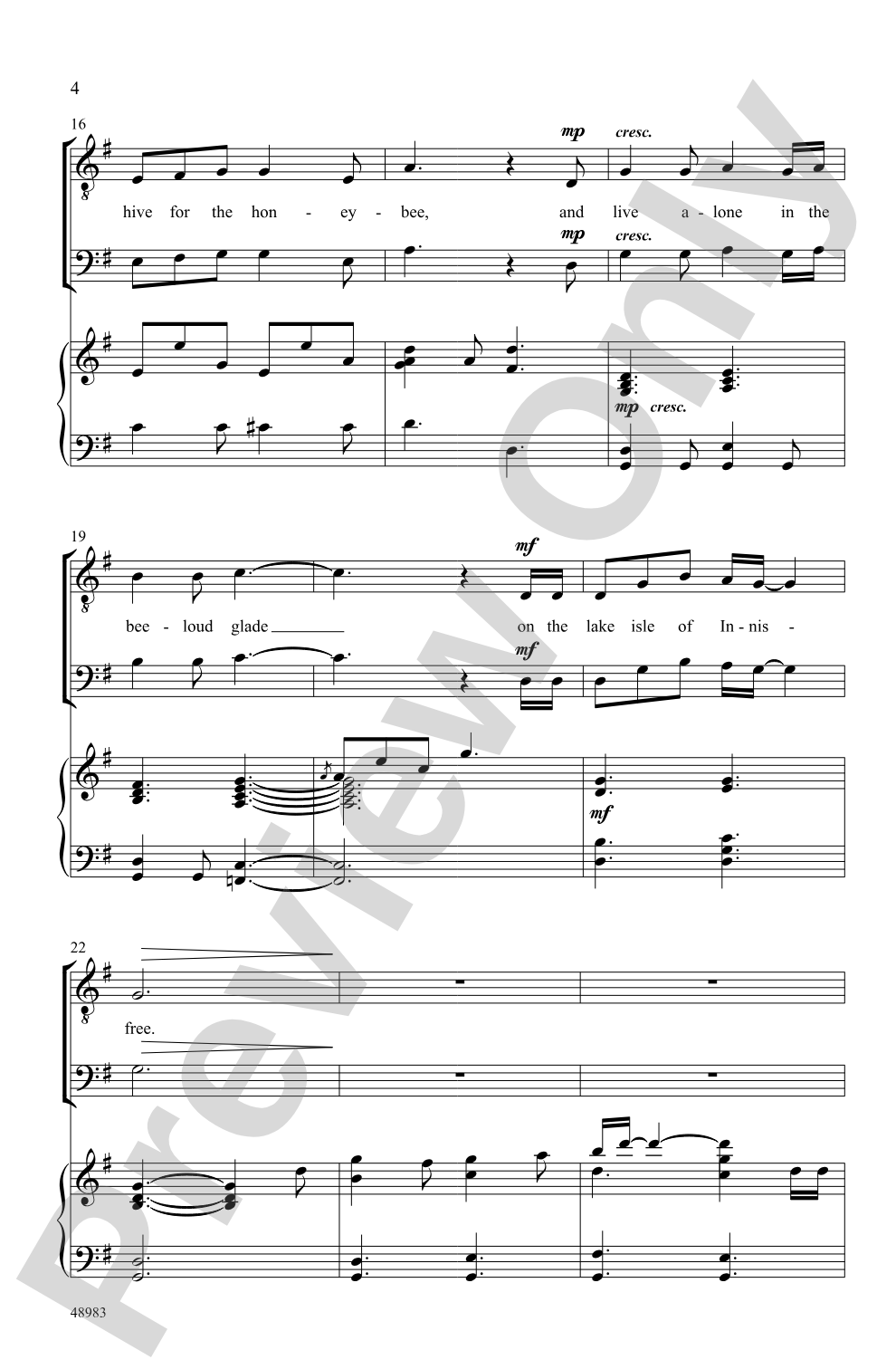
Lilting music resembles a folk song from the British Isles in this happy setting of Yeats' text, inspired by memories of childhood summers spent in the Irish countryside. The 12-line poem expresses a city-dweller's longing for the simple, tranquil life of Innisfree. Includes proven part-singing strategies---the tune first appears in unison, then becomes a canon; a peaceful bridge passes the melody through lower voice parts, while others sing sweet counterlines; and a modulation leads to full triadic harmony.


The Lake Isle of Innisfree: TTB Choral Octavo isn't in MakeMusic Cloud just yet...but it could be. Let us know you'd like to see it, and you'll help shape what comes next. In the meantime, start a free trial and dive into thousands of interactive titles your students can play along with today.
Request This Title
Tell us you want it.
Start Your Free Trial
Explore everything that's ready to play right now.
Sample Audio
1
Audio File
--:--
0:00
0:00
Sample Video
Additional Details
Series:
Alfred Choral Designs
Publisher:
Alfred Music
Page Count:
12
SKU:
00-PO-0006870
More about this title
About the Composer: Penny Rodriguez

Penny Rodriguez began her musical journey at age 6, studying piano in Peru while her parents worked as missionaries. She completed her piano performance degree at Moody/American Conservatory of Music and has since built a substantial catalog of published piano works and choral pieces alongside a recording career spanning 11 albums.
In recent years, Rodriguez has concentrated her compositional energy on art songs for solo voice and piano, pairing her melodies with carefully chosen poetry. She lives in the Indianapolis area with her husband, Dave, and finds creative inspiration in family life and the literary texts that shape her artistic voice.
Why we love this
Rodriguez writes with genuine understanding of how choirs learn music together. She builds the song from the ground up—unison establishing the melody, canon deepening the singers' awareness of the line, counterpoint layering independence, and modulation offering the payoff of full harmonic resonance. The result feels inevitable rather than imposed, making it rewarding to teach and beautiful to hear.
What to expect
Bright and reflective at once. The melody carries the open-air quality of a folk tune, while the harmonic language and carefully placed counterpoint suggest something more intimate and composed. There is longing in the text, but the music itself feels unhurried and settled, as if the singer has already found peace in remembering.
Who it's for
TTB choirs with singers who have solid part-independence but benefit from structured pedagogical scaffolding. The piece works equally well for high school ensembles, community choirs, and college programs seeking concert or festival repertoire that builds musicianship while remaining accessible.
How to get the most out of it
- Establish the unison melody clearly in early rehearsals. Once all three parts lock onto the same line, the canon that follows becomes a revelation rather than a coordination challenge.
- Shape the bridge section with attention to its role as a storytelling moment. The melody travels to lower voices while upper voices provide counterlines; resist the urge to rush through this passage, allowing each voice part to sing with the same lyrical weight.
- Approach the final modulation as a gentle lift in perspective rather than a dramatic shift. The shift in key should feel like stepping into clearer light, not a jarring change in terrain.
How to use it
Program this as a warm, emotionally grounded middle-of-the-concert piece between heavier choral works or as a closing selection on a lighter program. Its literary depth and folk-song quality make it particularly fitting for concerts themed around poetry, nature, or British Isles traditions. The piece also works well in festival or competition contexts where judges value both musical craft and emotional sincerity.
Skills your students will build
- Reading and sustaining unison as a foundation for part-singing
- Singing canonic material with rhythmic and harmonic awareness
- Balancing independent melodic lines while listening to counterpoint
- Responding to modulation and shifts in harmonic color
- Bringing interpretive depth to text-driven composition