
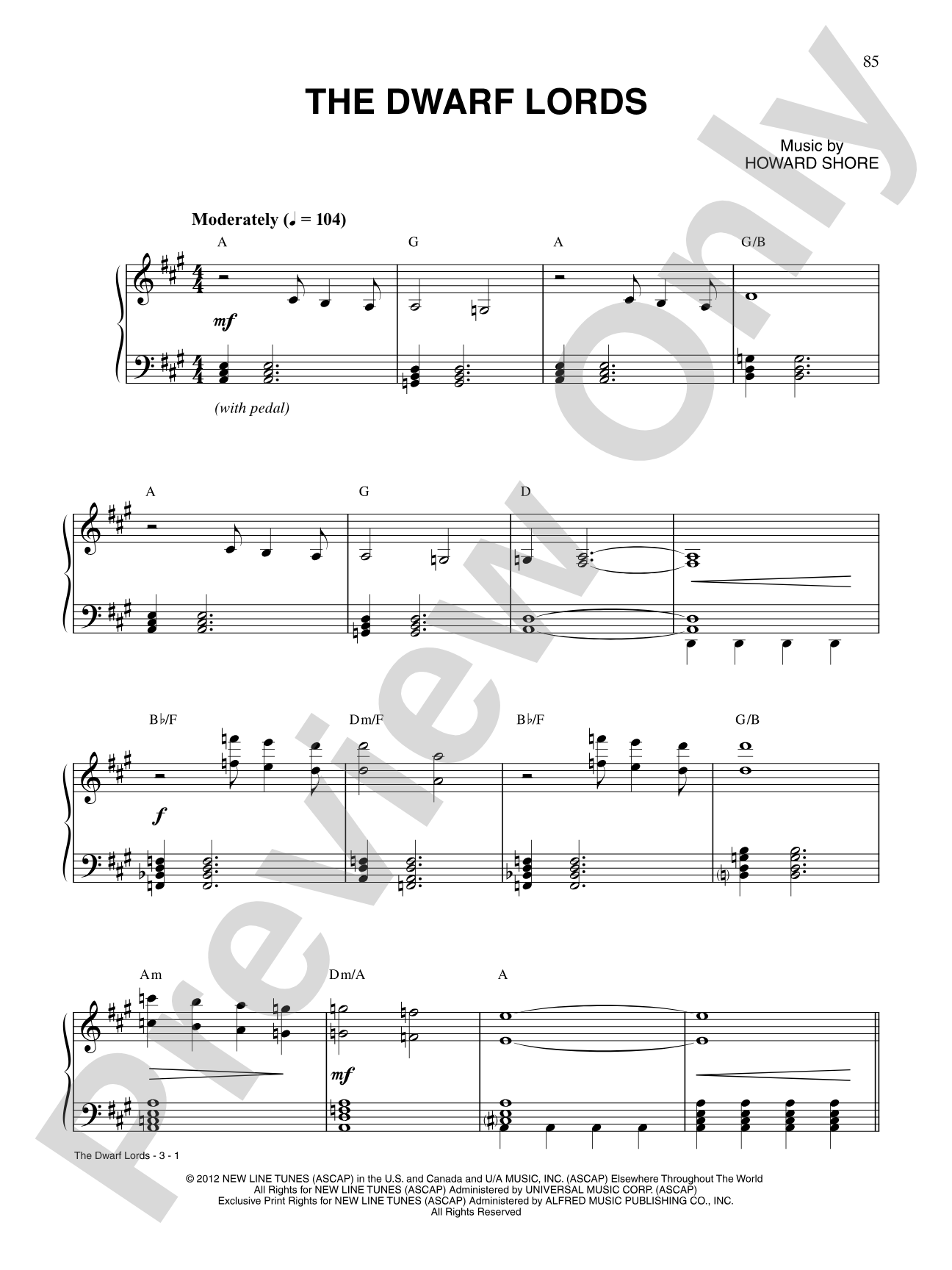

The Dwarf Lords: Piano/Vocal
Sheet Music Selections from the Original Motion Picture Soundtrack
Music composed by Howard Shore
Item: 00-PS-0013940
$4.99
One moment…
Related Items
My Dear Frodo: Piano/Vocal |
$9.99
|
View | |
Old Friends: Piano/Vocal |
$5.99
|
View | |
An Unexpected Party: Piano/Vocal |
$5.99
|
View | |
Axe or Sword?: Piano/Vocal |
$5.99
|
View | |
Misty Mountains: Piano/Vocal |
$4.99
|
View | |
The Adventure Begins: Piano/Vocal |
$4.99
|
View | |
Radagast the Brown: Piano/Vocal |
$5.99
|
View | |
Warg-scouts: Piano/Vocal |
$5.99
|
View | |
A Good Omen: Piano/Vocal |
$5.99
|
View | |
A Very Respectable Hobbit: Piano/Vocal |
$4.99
|
View | |
Erebor: Piano/Vocal |
$4.99
|
View | |
The Hobbit: An Unexpected Journey: Piano/Vocal Book |
$21.99
|
View |
Description
Pianists and aspiring media composers will delight in this officially licensed sheet music collection, which features piano renditions of 14 selections from Howard Shore's brilliant score to The Hobbit: An Unexpected Journey. Shore masterfully expands upon the musical palette of Middle-earth, blending familiar motifs from the The Lord of the Rings trilogy with an exciting array of memorable new themes. In addition to the piano arrangements, this beautifully produced souvenir folio features an array of colorful photos from the film. Titles: My Dear Frodo * Old Friends * An Unexpected Party * Axe or Sword? * Misty Mountains * The Adventure Begins * Radagast the Brown * Warg-scouts * A Good Omen * Song of the Lonely Mountain * Dreaming of Bag End * A Very Respectable Hobbit * Erebor * The Dwarf Lords.


The Dwarf Lords: Piano/Vocal isn't in MakeMusic Cloud just yet...but it could be. Let us know you'd like to see it, and you'll help shape what comes next. In the meantime, start a free trial and dive into thousands of interactive titles your students can play along with today.
Request This Title
Tell us you want it.
Start Your Free Trial
Explore everything that's ready to play right now.
Sample Audio
No sample audio found.
Sample Video
No sample videos found.
Additional Details
Publisher:
Alfred Music
Page Count:
88
SKU:
00-PS-0013940
More about this title
About the Composer: Howard Shore
Howard Shore is a three-time Academy Award-winning composer whose work has defined the sound of contemporary fantasy cinema. His orchestral scores for The Lord of the Rings trilogy and The Hobbit films represent some of the most ambitious and thematically complex film music ever written, earning him recognition as a master of leitmotif and large-scale musical narrative.
For music educators and students, Shore's work demonstrates how classical compositional techniques—thematic development, counterpoint, orchestration—function in dramatic storytelling. His ability to weave recurring motifs with fresh material makes his scores invaluable for studying how composers communicate character, place, and emotional arc through music.
Why we love this
These arrangements capture the emotional weight and dramatic sweep of Shore's Middle-earth music without requiring a full orchestra. The collection balances accessibility with genuine compositional sophistication, giving pianists real substance to sink their teeth into while remaining performable at a range of advanced levels. Film music at this caliber teaches young composers how themes evolve, how leitmotifs function dramatically, and how to write for the instrument in ways that honor the original vision.
What to expect
Journeying through Middle-earth at the piano. The score moves between moments of intimate wonder (the quieter character themes), rousing adventure (the dwarf and quest material), and sweeping grandeur (Erebor, the Lonely Mountain). Shore's melodies are singable and memorable, but the harmonic language is sophisticated enough to reward close listening and technical command.
Who it's for
Advanced pianists and aspiring media composers who want to explore how concert-level musical storytelling works in film. This collection also serves singers and pianists preparing audition material from contemporary film scores, or ensembles looking for supplementary repertoire that bridges classical technique with popular appeal.
How to get the most out of it
- Study the film scenes alongside the score. Knowing what's happening on screen when each theme plays will shape your phrasing, dynamics, and tempo choices in ways that pure score reading won't reveal.
- Pay close attention to Shore's layering of motifs, especially in longer pieces like 'The Dwarf Lords' and 'Erebor.' These themes often overlap or develop into one another; clarity between musical lines keeps the narrative transparent.
- Lean into the character of each theme. 'Misty Mountains' demands a different tonal quality and weight than 'Song of the Lonely Mountain'—let the personality of each piece guide your interpretation rather than treating them as uniform concert selections.
- Use the film's orchestral textures as a reference for balance and color. While you're working with a single instrument, thinking orchestrally about which voices carry the melody and which provide harmonic support will deepen your musical choices.
How to use it
Consider pairing these selections with other film score arrangements or concert music in fantasy/adventure styles to create a thematic recital. Individual pieces like 'Song of the Lonely Mountain' or 'Misty Mountains' work as standalone recital openers or finales. These arrangements also serve advanced students exploring composition and orchestration by studying how a master film composer handles thematic material.
Skills your students will build
- Reading and performing leitmotif-based structures across multiple movements
- Balancing melody, countermelody, and harmonic accompaniment with a single instrument
- Interpreting film music for concert performance without reducing emotional impact
- Understanding how orchestral textures and colors translate to piano writing
- Sustaining musical narrative across longer, theme-driven compositions