
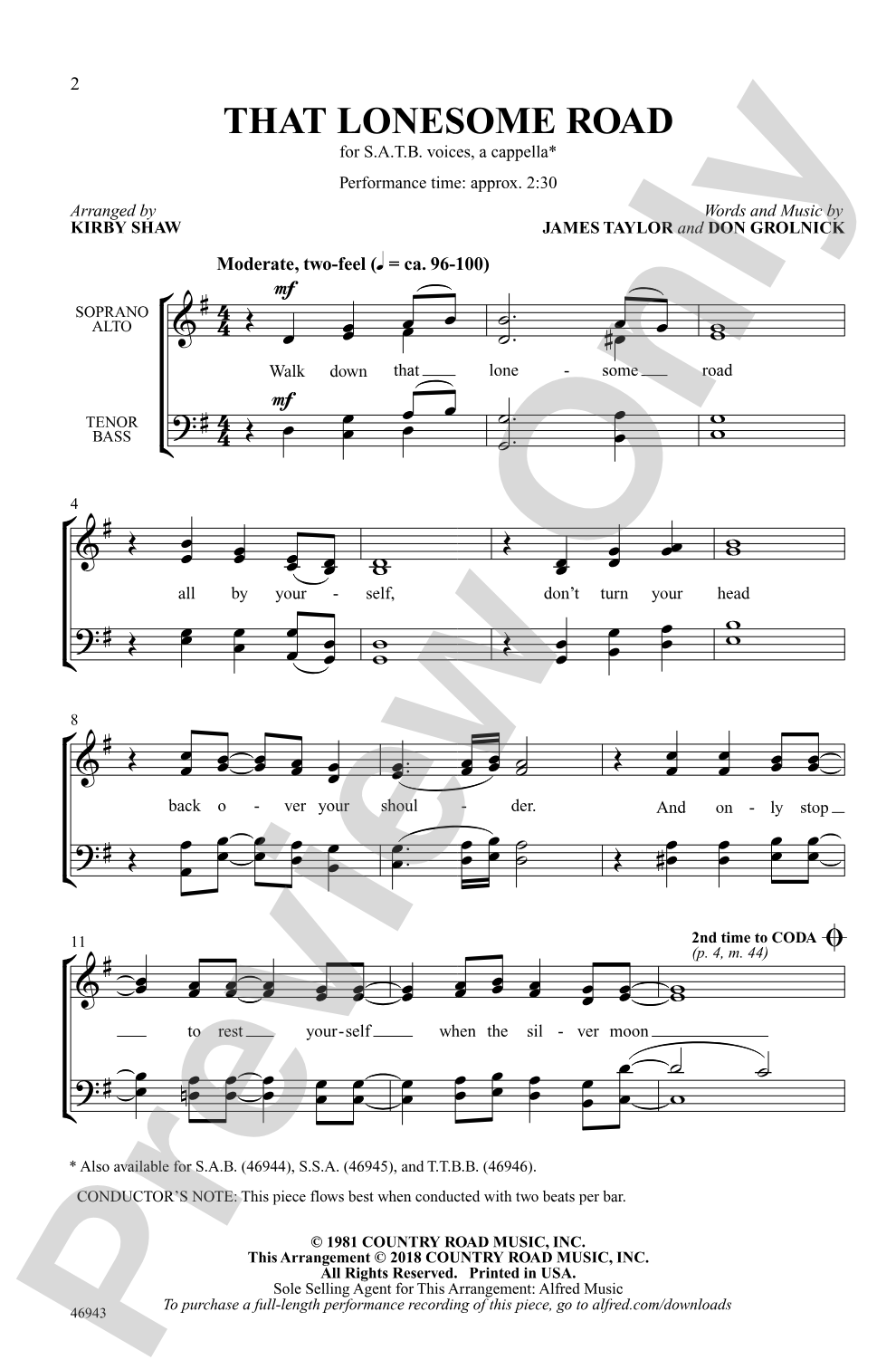

That Lonesome Road: SATB, a cappella Choral Octavo
Words and music by James Taylor and Don Grolnick / arr. Kirby Shaw
Item: 00-PO-0005800
$2.10
Minimum order quantity: 20 copies
One moment…
Related Items
That Lonesome Road: SAB, a cappella Choral Octavo |
$2.10
|
View | |
That Lonesome Road: SSA, a cappella Choral Octavo |
$2.10
|
View | |
That Lonesome Road: TTBB, a cappella Choral Octavo |
$2.10
|
View | |
That Lonesome Road: SATB, a cappella Choral Octavo |
$2.10
|
View | |
That Lonesome Road: SAB, a cappella Choral Octavo |
$2.10
|
View | |
That Lonesome Road: SSA, a cappella Choral Octavo |
$2.10
|
View | |
That Lonesome Road: TTBB, a cappella Choral Octavo |
$2.10
|
View |
Description
James Taylor's beautiful ballad gains new life in this simply stated a cappella setting by arranger Kirby Shaw. Sensible voice leading makes chords easy to tune, uncomplicated rhythms allow the text to speak. Awesome, accessible writing in every edition.


That Lonesome Road: SATB, a cappella Choral Octavo isn't in MakeMusic Cloud just yet...but it could be. Let us know you'd like to see it, and you'll help shape what comes next. In the meantime, start a free trial and dive into thousands of interactive titles your students can play along with today.
Request This Title
Tell us you want it.
Start Your Free Trial
Explore everything that's ready to play right now.
Sample Audio
1
Audio File
--:--
0:00
0:00
Sample Video
Additional Details
Series:
Alfred Pop Choral Series
Publisher:
Alfred Music
Page Count:
4
SKU:
00-PO-0005800
More about this title
About the Composer: James Taylor
James Taylor emerged as one of America's most distinctive singer-songwriters in the early 1970s, known for introspective lyrics, sophisticated harmonic sensibility, and fingerstyle guitar work that influenced generations of musicians. His catalog spans decades and genres, from intimate folk-influenced ballads to jazz-inflected compositions, making his music a rich resource for choral arrangers seeking material with both emotional depth and melodic integrity.
Why we love this
Kirby Shaw's arrangement respects the song's intimate character while making it genuinely singable for mixed voices. The straightforward voice leading and unhurried rhythm allow your singers to focus on lyrical expression rather than wrestling with complex counterpoint, yet the harmonies never feel thin or oversimplified.
What to expect
The piece unfolds with quiet contemplation, the kind of honest vulnerability that made Taylor's original so enduring. Without instrumental accompaniment, the voices become the entire emotional landscape, creating an intimate atmosphere that invites listeners to sit with the song's wistful, searching quality.
Who it's for
This arrangement suits choirs at the intermediate level and above who want accessible, emotionally resonant material that doesn't demand virtuosic technical demands. It's ideal for singers who appreciate classic songwriting and for directors building programs that include contemporary pop alongside traditional repertoire.
How to get the most out of it
- Balance the melody with the supporting voices; this is a song, not a showcase for inner-voice independence. The text should guide your phrasing as much as the harmonic structure.
- Take time to establish the unaccompanied sound in rehearsal. Without instrumental support, slight tuning imperfections become audible, so isolate problematic chords and sing them in context multiple times.
- Let the slower harmonic rhythm breathe. Avoid rushing through longer notes; the simplicity of the writing invites singers to shape phrases with intention rather than mechanical precision.
- Pay attention to vowel consistency across all four parts, especially on sustained notes. A cappella writing magnifies any drift in tone quality or vowel shape.
How to use it
Place this in a concert program where you want to shift the mood toward reflection or introspection; it pairs well with spirituals, folk arrangements, or other a cappella pieces that value storytelling over virtuosity. Consider programming it on the first half of a concert to establish connection with your audience before moving to more elaborate works.
Skills your students will build
- Tuning and balancing a cappella chords through careful listening
- Sustaining expressive phrasing without instrumental cues
- Blending vocal tone across all four voice parts
- Maintaining ensemble cohesion in slower tempos with simple rhythmic figures
- Interpreting lyrical content through vocal control and breath placement