
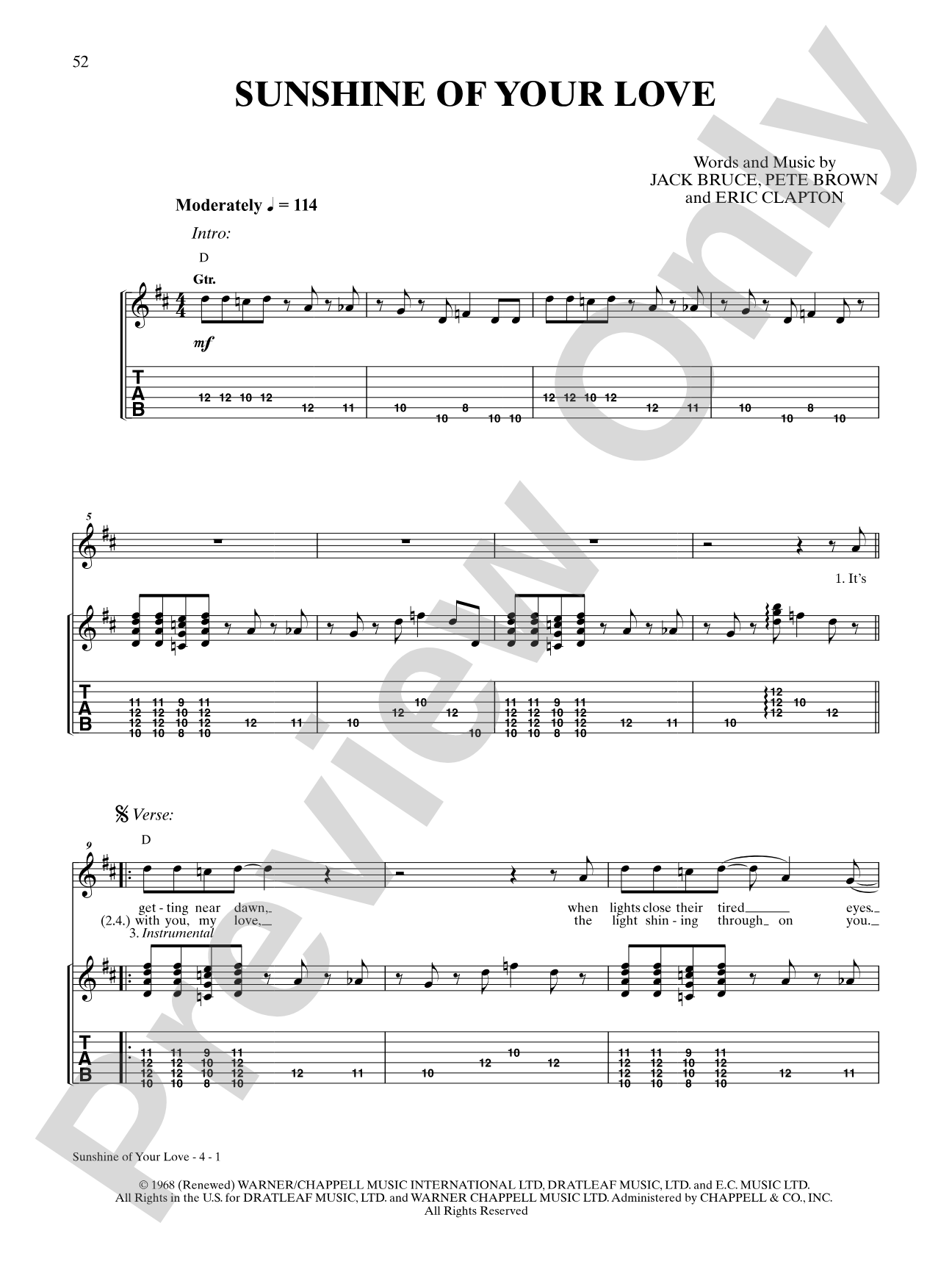

Sunshine of Your Love: Interm./Easy Guitar TAB
12 Great Songs of the '60s, '70s & '80s
Item: 00-PS-0011958
$4.99
One moment…
Related Items
Paint It, Black: Interm./Easy Guitar TAB |
$4.99
|
View | |
It's All Over Now: Interm./Easy Guitar TAB |
$4.99
|
View | |
Long Train Runnin': Interm./Easy Guitar TAB |
$4.99
|
View | |
The Night They Drove Old Dixie Down: Interm./Easy Guitar TAB |
$4.99
|
View | |
Stairway to Heaven: Interm./Easy Guitar TAB |
$5.99
|
View | |
After Midnight: Interm./Easy Guitar TAB |
$4.99
|
View | |
Maggie May: Interm./Easy Guitar TAB |
$4.99
|
View | |
Just for Fun: Classic Rock Guitar: Easy Guitar TAB Book |
$14.99
|
View |
Description
Classic Rock Guitar is designed for your total enjoyment. Each song's arrangement includes the guitar parts played on the original recording, simplified just enough to keep it fun and musically satisfying. Titles: After Midnight (Eric Clapton) * Go Your Own Way (Fleetwood Mac) * Hotel California (Eagles) * It's All Over Now (The Rolling Stones) * Jump (Van Halen) * Long Train Runnin' (The Doobie Brothers) * Maggie May (Rod Stewart) * The Night They Drove Old Dixie Down (The Band) * Paint It, Black (The Rolling Stones) * Stairway to Heaven (Led Zeppelin) * Sunshine of Your Love (Cream) * Truckin' (Grateful Dead).


Sunshine of Your Love: Interm./Easy Guitar TAB isn't in MakeMusic Cloud just yet...but it could be. Let us know you'd like to see it, and you'll help shape what comes next. In the meantime, start a free trial and dive into thousands of interactive titles your students can play along with today.
Request This Title
Tell us you want it.
Start Your Free Trial
Explore everything that's ready to play right now.
Sample Audio
No sample audio found.
Sample Video
No sample videos found.
Additional Details
Series:
Just for Fun
Publisher:
Alfred Music
Page Count:
68
SKU:
00-PS-0011958
More about this title
About the Composer: Eric Clapton
Eric Clapton emerged as one of rock music's most influential guitarists through his work with The Yardbirds, Cream, and Derek and the Dominos before launching a solo career that spanned decades. His blues-rooted approach to electric guitar and his role as co-composer on "Sunshine of Your Love" established him as a musician who could balance technical mastery with emotional directness, making his work enduringly appealing to guitar students across skill levels.
Clapton's compositions and interpretations have shaped how multiple generations of guitarists approach tone, phrasing, and the relationship between technique and feeling. His influence extends far beyond rock radio into music education, where his songs remain core repertoire for students learning to translate recorded guitar textures into playable arrangements.
Why we love this
This collection captures the genuine guitar work from iconic recordings without oversimplifying the musicality that made these songs last. Students encounter real riff patterns, recognizable chord voicings, and the harmonic choices that define each original, building an ear for how great guitarists solve musical problems.
What to expect
Plugging into the electric energy of 1970s and 1980s rock while discovering how much of the magic comes from smart voicing choices and rhythmic precision. Each song rewards close listening with small details that make the guitar part sit just right in the mix.
Who it's for
Intermediate and early-advanced guitarists who want to play recognizable material without struggling through overly complex arrangements. Classroom teachers can use these pieces for ensemble performance, and private instructors will find them ideal for students motivated by songs they already know.
How to get the most out of it
- Study the original recordings while learning each arrangement; you'll absorb the tone color and phrasing cues that tab alone cannot convey.
- Pay attention to the dynamics notated in the tab, especially on power chords and sustained notes where muting technique separates a polished performance from a raw one.
- Lock the rhythm by counting carefully through any tempo changes or rubato sections; classic rock records often have subtle timing variations that feel natural only when learned intentionally.
How to use it
Build a concert around a decade of classic rock, or weave individual pieces into a guitar recital that showcases different playing styles (fingerstyle, power chords, barre chords, rhythm work). These arrangements also work well as ensemble pieces when multiple guitarists divide the parts.
Skills your students will build
- Reading TAB fluently alongside standard notation
- Translating recorded guitar textures to fretboard technique
- Power chord voicings and muting control
- Phrase shaping and dynamic contrast in rock contexts
- Recognizing riff-based song structures