
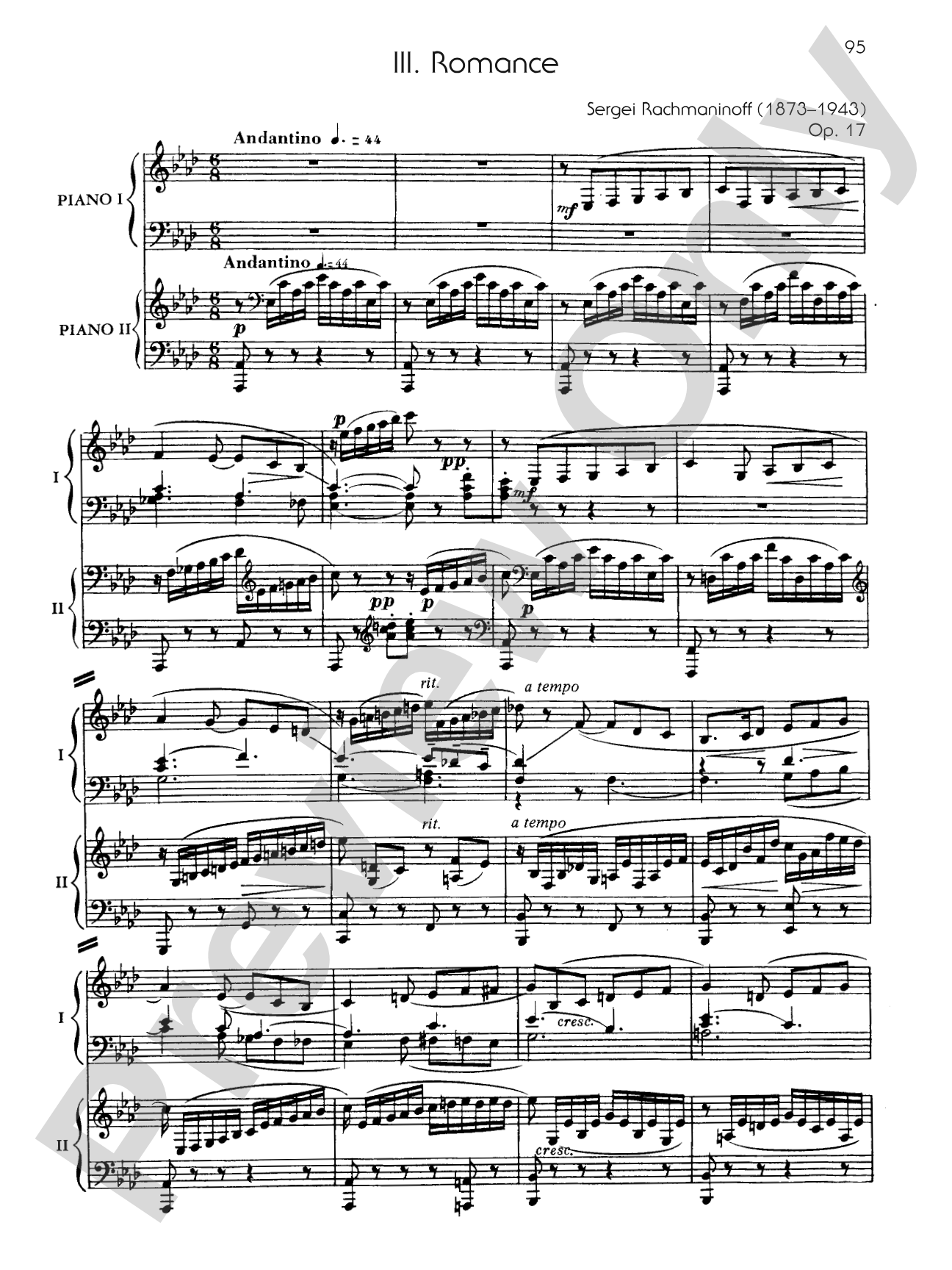
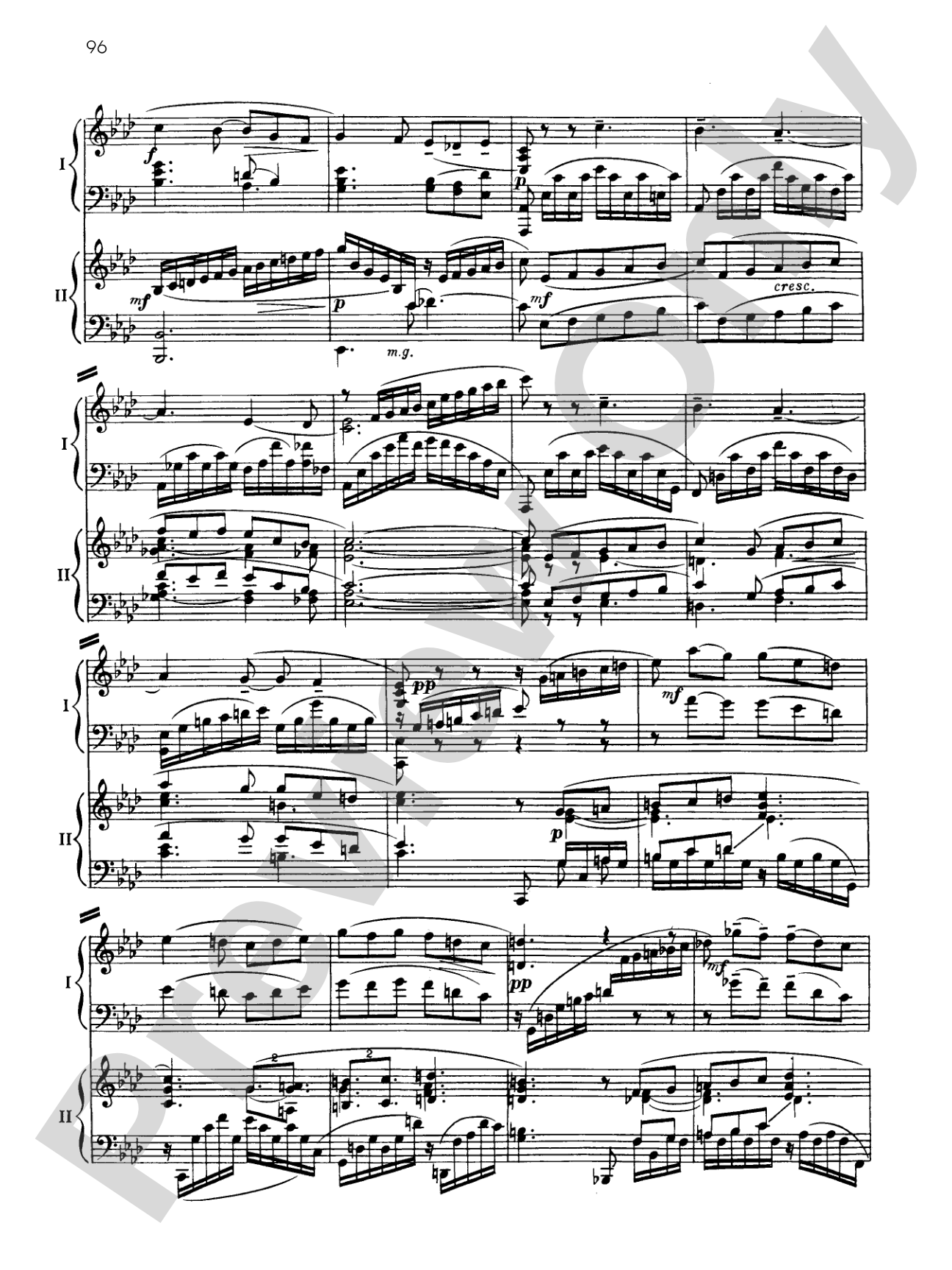
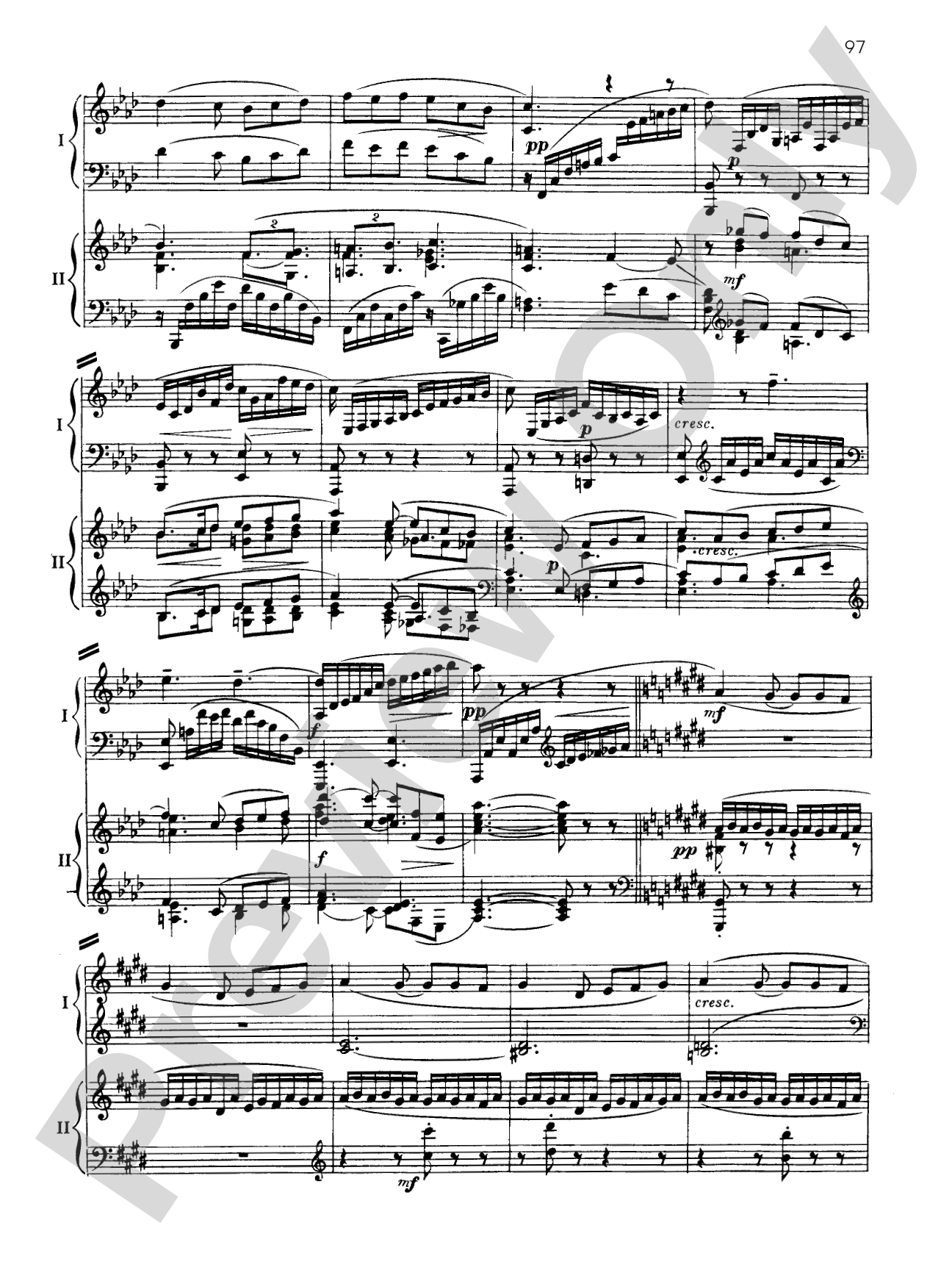

Suite No. 2, Opus 17 - III. Romance - Piano Duo (2 Pianos, 4 Hands): Piano Duo (2 Pianos, 4 Hands)
By Sergei Rachmaninoff
Level: Advanced
Item: 00-PS-0017274
$9.99
Pickup currently not available
Related Items
Fantaisie-tableaux (Suite No. 1), Opus 5 - I. Barcarolle - Piano Duo (2 Pianos, 4 Hands): Piano Duo (2 Pianos, 4 Hands) |
$9.99
|
View | |
Fantaisie-tableaux (Suite No. 1), Opus 5 - II. La nuit, l'amour - Piano Duo (2 Pianos, 4 Hands): Piano Duo (2 Pianos, 4 Hands) |
$9.99
|
View | |
Fantaisie-tableaux (Suite No. 1), Opus 5 - III. Les larmes - Piano Duo (2 Pianos, 4 Hands): Piano Duo (2 Pianos, 4 Hands) |
$9.99
|
View | |
Fantaisie-tableaux (Suite No. 1), Opus 5 - IV. Pâques - Piano Duo (2 Pianos, 4 Hands): Piano Duo (2 Pianos, 4 Hands) |
$5.99
|
View | |
Prelude in C-Sharp Minor - Piano Duo (2 Pianos, 4 Hands): Piano Duo (2 Pianos, 4 Hands) |
$5.99
|
View | |
Suite No. 2, Opus 17 - I. Introduction - Piano Duo (2 Pianos, 4 Hands): Piano Duo (2 Pianos, 4 Hands) |
$5.99
|
View | |
Suite No. 2, Opus 17 - II. Valse - Piano Duo (2 Pianos, 4 Hands): Piano Duo (2 Pianos, 4 Hands) |
$9.99
|
View | |
Suite No. 2, Opus 17 - IV. Tarantelle - Piano Duo (2 Pianos, 4 Hands): Piano Duo (2 Pianos, 4 Hands) |
$9.99
|
View | |
The Piano Works of Rachmaninoff, [0i*] Volume IX: Piano Duos (Two Pianos, Four Hands): Piano Duo (2 Pianos, 4 Hands) Book & Online Audio |
$16.99
|
View |
Description
This historic reference edition contains 9 pieces by Sergei Rachmaninoff for piano duo (Two Pianos, Four Hands), including an arrangement of Prelude in C-sharp Minor, Op. 3 No. 2 by the composer. Also included is a recording of Rachmaninoff's two suites by the famed piano duo Begoña Uriarte and Karl-Hermann Mrongovius. Contains: Fantaisie-tableaux (Suite No. 1), Op. 5 * Suite No. 2, Op. 17 * Prelude in C-sharp Minor, Op. 3, No. 2. A Federation Festivals 2024-2028 selection.


Suite No. 2, Opus 17 - III. Romance - Piano Duo (2 Pianos, 4 Hands): Piano Duo (2 Pianos, 4 Hands) isn't in MakeMusic Cloud just yet...but it could be. Let us know you'd like to see it, and you'll help shape what comes next. In the meantime, start a free trial and dive into thousands of interactive titles your students can play along with today.
Request This Title
Tell us you want it.
Start Your Free Trial
Explore everything that's ready to play right now.
Sample Audio
1
FantaisieTableauxPaques
--:--
2
Tarantelle
--:--
FantaisieTableauxPaques
0:00
0:00
Sample Video
No sample videos found.
Additional Details
Series:
Alfred's Classic Editions
Publisher:
Alfred Music
Page Count:
132
SKU:
00-PS-0017274
More about this title
About the Composer: Sergei Rachmaninoff
Sergei Rachmaninoff (1873-1943) stands as one of the most commanding voices in early twentieth-century music, bridging the late Romantic tradition with modernist sensibilities. A virtuoso pianist himself, Rachmaninoff composed with an intimate understanding of the keyboard's expressive potential, and his chamber works for piano duo reflect both technical sophistication and profound emotional depth.
Rachmaninoff's approach to ensemble writing for two pianos exploited the medium's unique sonic possibilities—the ability to blend two complete voices while maintaining textural clarity. His suites in this format remain cornerstone repertoire for advanced pianists seeking to explore large-scale forms that demand both interpretive maturity and collaborative discipline.
Why we love this
This collection captures Rachmaninoff at his most structurally ambitious for the two-piano medium, with Suite No. 2 showcasing his gift for long melodic lines and sophisticated harmonic language that never sacrifices emotional directness. The inclusion of the iconic Prelude in C-sharp Minor, arranged by the composer himself, gives pianists access to one of Rachmaninoff's most recognizable works in a collaborative setting. The accompanying recording by Uriarte and Mrongovius serves as an interpretive reference from pianists who understand the work's dramatic arc.
What to expect
Rachmaninoff's writing for two pianos evokes a sustained romantic languor interrupted by moments of darker introspection and dramatic surge. The Romance movement in particular breathes with the composer's characteristic long-lined melody, supported by rich harmonic color that the two-piano format amplifies into something nearly orchestral in scope.
Who it's for
Advanced pianists working in chamber partnerships who have moved beyond introductory two-piano literature and are ready for works that demand mature interpretation and collaborative listening. This collection suits advanced students preparing for university auditions, festival competitions, or serious chamber recital programming.
How to get the most out of it
- Balance the texture between pianos by thinking of one as the primary voice and the other as enrichment; this often shifts mid-phrase, so listen across the partnership rather than to your individual part alone.
- Take time establishing the two-piano sound in rehearsal before addressing the notes; the resonance of two instruments creates acoustic challenges that require intentional voicing choices.
- Use the recording as a study tool for pacing and pedal coordination, particularly in the Romance movement where sustained sonorities define the emotional arc.
- Drill the rhythmic alignment in passages where the pianos move in different note values; Rachmaninoff's figurations are forgiving only if both players occupy the same harmonic space with precision.
How to use it
Frame this as a centerpiece for an advanced chamber recital, pairing it with other twentieth-century two-piano works to show Rachmaninoff's place in the evolution of the medium. It also serves as a festival competition selection and prepares serious pianists for the kind of interpretive depth expected at university-level performance study.
Skills your students will build
- Balancing two independent melodic voices across two instruments
- Reading and coordinating complex rhythmic figures in ensemble context
- Sustaining long harmonic progressions through pedal coordination
- Interpreting romantic lyricism within modernist structural frameworks
- Ensemble communication and shared interpretive decision-making in partnership