
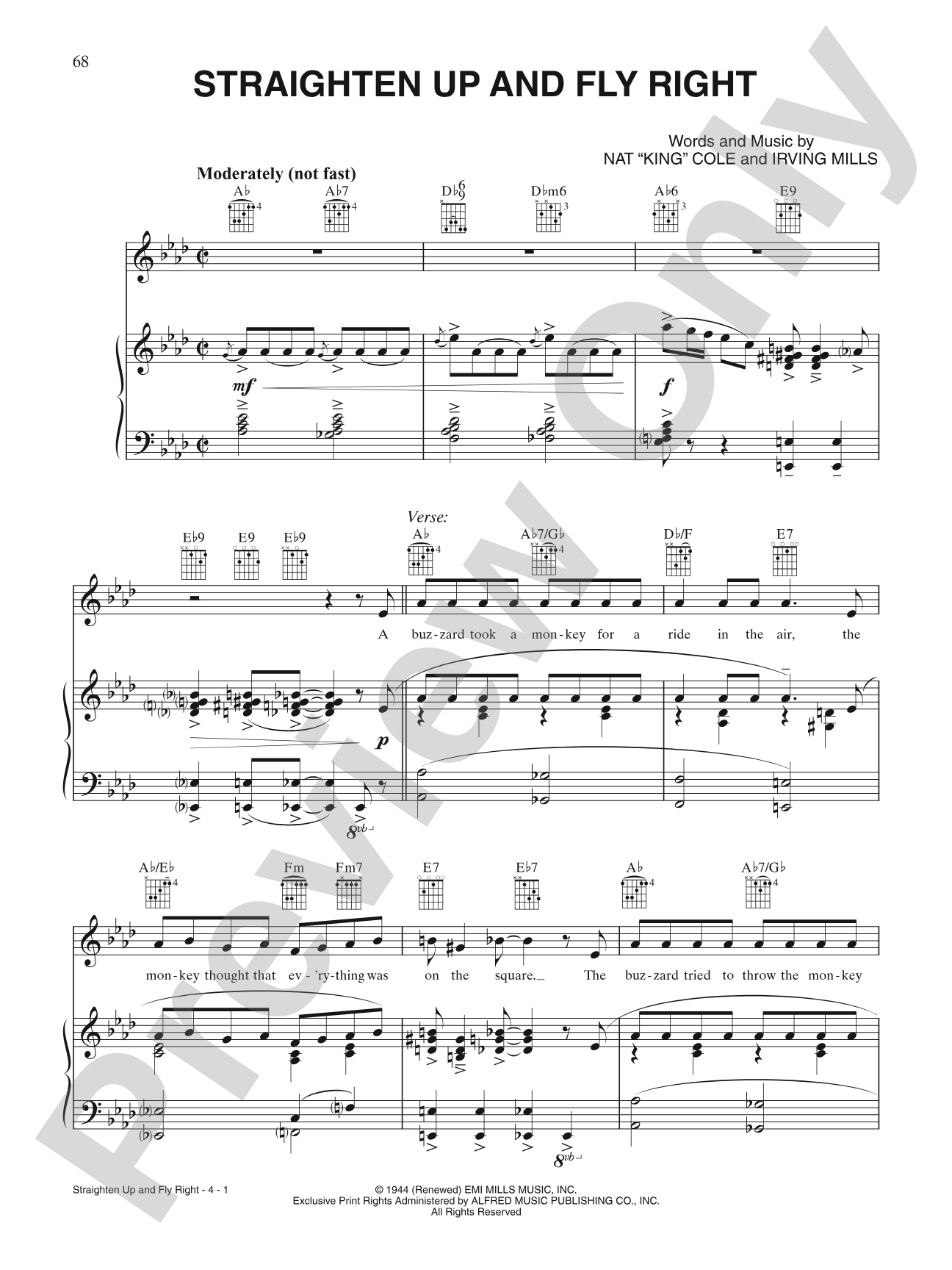

Straighten Up and Fly Right: Piano/Vocal/Chords
20 Great American Songbook and Jazz Favorites
Item: 00-PS-0015569
$4.99
One moment…
Related Items
Laura: Piano/Vocal/Chords |
$4.99
|
View | |
The Shadow of Your Smile: Piano/Vocal/Chords |
$4.99
|
View | |
I'm in the Mood for Love: Piano/Vocal/Chords |
$4.99
|
View | |
Moonlight Serenade: Piano/Vocal/Chords |
$4.99
|
View | |
Blue Moon: Piano/Vocal/Chords |
$4.99
|
View | |
I Put a Spell on You: Piano/Vocal/Chords |
$4.99
|
View | |
My Man: Piano/Vocal/Chords |
$4.99
|
View | |
Over the Rainbow: Piano/Vocal/Chords |
$4.99
|
View | |
Ain't Misbehavin': Piano/Vocal/Chords |
$4.99
|
View | |
Don't Sit Under the Apple Tree (With Anyone Else But Me): Piano/Vocal/Chords |
$4.99
|
View | |
Top-Requested Standards Sheet Music: Piano/Vocal/Guitar Book |
$14.99
|
View |
Description
The crowd-pleasing standards in this sheet music collection belong in every musician's repertoire. This songbook contains 20 piano/vocal arrangements of classic songs that are guaranteed to delight audiences of all ages. Complete lyrics and chord symbols are included. Titles: Ain't Misbehavin' * At Last * Blue Moon * Don't Get Around Much Anymore * Don't Sit Under the Apple Tree * I Put a Spell on You * I'm in the Mood for Love * Laura * Misty * Moonlight Serenade * My Man * Theme from New York, New York * Orange Colored Sky * Over the Rainbow * The Pink Panther * The Shadow of Your Smile * Straighten Up and Fly Right * Take Five * What a Wonderful World * Whatever Lola Wants.


Straighten Up and Fly Right: Piano/Vocal/Chords isn't in MakeMusic Cloud just yet...but it could be. Let us know you'd like to see it, and you'll help shape what comes next. In the meantime, start a free trial and dive into thousands of interactive titles your students can play along with today.
Request This Title
Tell us you want it.
Start Your Free Trial
Explore everything that's ready to play right now.
Sample Audio
No sample audio found.
Sample Video
No sample videos found.
Additional Details
Series:
Top-Requested Sheet Music
Publisher:
Alfred Music
Page Count:
80
SKU:
00-PS-0015569
More about this title
About the Composer: Nat "King" Cole
Nat "King" Cole was one of the most influential vocalists and pianists of the 20th century, a musician who shaped American popular music across multiple decades. His smooth baritone voice and sophisticated piano playing made him equally compelling as a soloist and bandleader. Cole's artistry extended far beyond performance; many of the songs in this collection reflect his instincts as an interpreter of the Great American Songbook, bringing elegance and emotional depth to material that continues to resonate with audiences today.
Beyond his recordings, Cole's influence on music education is profound. His approach to phrasing, dynamics, and harmonic sensibility provides a masterclass in interpreting standards. Musicians of all ages study his recordings to understand how to shape a melody, support a lyric, and move an audience without unnecessary flourish. For students learning to accompany singers or perform vocal standards, his interpretations remain a gold standard.
Why we love this
This collection pulls together the songs that actually work in real performance contexts. Rather than obscure deep cuts, every title here has proven staying power with audiences and sits comfortably under the fingers of pianists at multiple levels. The chord symbols and complete lyrics make it immediately useful for accompanists, vocalists in recital, or pianists building a working repertoire of standards.
What to expect
Opening this collection feels like stepping into an era when melody and harmony mattered above all else. Each song breathes with the confidence of music that has earned its place in the repertoire through decades of performance. The piano writing ranges from intimate and introspective to bright and swinging, capturing the full emotional spectrum of American popular music at its most sophisticated.
Who it's for
Pianists preparing for recitals, vocal accompanists building a working book, singers learning the Great American Songbook, and anyone looking to expand their repertoire with trusted, audience-friendly standards. Intermediate and advanced players will find the arrangements accessible and musically rewarding.
How to get the most out of it
- Keep the arrangements conversational rather than rigid. These songs live in the space between notation and interpretation, so allow rubato and phrasing flexibility while maintaining the harmonic framework.
- Pay attention to the relationship between the vocal line and piano accompaniment. Many of these arrangements were written when pianist and singer needed to communicate musically in real time, so listen actively and adjust your tempo and dynamics responsively.
- Invest time in the lyrics even if you're playing the accompaniment without a vocalist. Understanding the emotional arc of each song shapes how you voice the chords and approach the melody line in instrumental moments.
- Experiment with voicing the chords in different registers. These standards are flexible enough to sound sophisticated in high, close voicings or warm and full in more open ones, depending on your piano's character and the venue.
How to use it
Use this book to build a mixed recital program that appeals across generations. A single evening of three or four selections from this collection, paired with other genres, creates a sophisticated program. Many studios also assign individual titles as performance pieces for students ready to tackle standards with proper phrasing and interpretive maturity.
Skills your students will build
- Reading chord symbols and improvising or varying accompaniment patterns
- Balancing melodic support with independent piano voicing
- Phrasing and rubato in a jazz and popular music context
- Collaborating with vocalists and responding to real-time musical needs
- Interpreting the emotional content of a lyric through harmonic and dynamic choices