
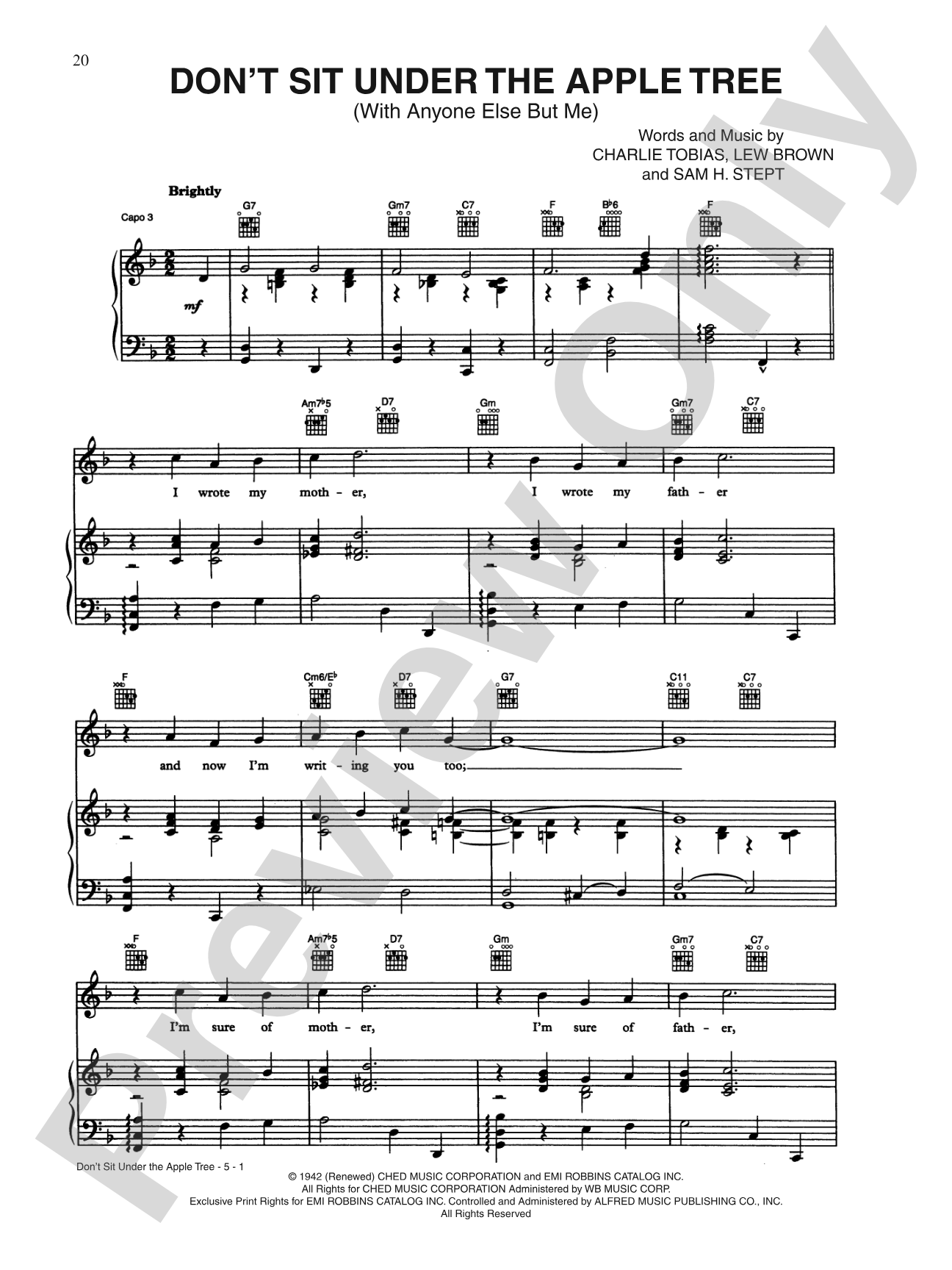

Don't Sit Under the Apple Tree (With Anyone Else But Me): Piano/Vocal/Chords
20 Great American Songbook and Jazz Favorites
Item: 00-PS-0015570
$4.99
One moment…
Related Items
Laura: Piano/Vocal/Chords |
$4.99
|
View | |
The Shadow of Your Smile: Piano/Vocal/Chords |
$4.99
|
View | |
I'm in the Mood for Love: Piano/Vocal/Chords |
$4.99
|
View | |
Moonlight Serenade: Piano/Vocal/Chords |
$4.99
|
View | |
Blue Moon: Piano/Vocal/Chords |
$4.99
|
View | |
I Put a Spell on You: Piano/Vocal/Chords |
$4.99
|
View | |
My Man: Piano/Vocal/Chords |
$4.99
|
View | |
Over the Rainbow: Piano/Vocal/Chords |
$4.99
|
View | |
Ain't Misbehavin': Piano/Vocal/Chords |
$4.99
|
View | |
Straighten Up and Fly Right: Piano/Vocal/Chords |
$4.99
|
View | |
Top-Requested Standards Sheet Music: Piano/Vocal/Guitar Book |
$14.99
|
View |
Description
The crowd-pleasing standards in this sheet music collection belong in every musician's repertoire. This songbook contains 20 piano/vocal arrangements of classic songs that are guaranteed to delight audiences of all ages. Complete lyrics and chord symbols are included. Titles: Ain't Misbehavin' * At Last * Blue Moon * Don't Get Around Much Anymore * Don't Sit Under the Apple Tree * I Put a Spell on You * I'm in the Mood for Love * Laura * Misty * Moonlight Serenade * My Man * Theme from New York, New York * Orange Colored Sky * Over the Rainbow * The Pink Panther * The Shadow of Your Smile * Straighten Up and Fly Right * Take Five * What a Wonderful World * Whatever Lola Wants.


Don't Sit Under the Apple Tree (With Anyone Else But Me): Piano/Vocal/Chords isn't in MakeMusic Cloud just yet...but it could be. Let us know you'd like to see it, and you'll help shape what comes next. In the meantime, start a free trial and dive into thousands of interactive titles your students can play along with today.
Request This Title
Tell us you want it.
Start Your Free Trial
Explore everything that's ready to play right now.
Sample Audio
No sample audio found.
Sample Video
No sample videos found.
Additional Details
Series:
Top-Requested Sheet Music
Publisher:
Alfred Music
Page Count:
80
SKU:
00-PS-0015570
More about this title
About the Composer: Charles Tobias
Charles Tobias (1898-1970) was a prolific songwriter and lyricist who helped define the Great American Songbook during the 1930s and 1940s. Working frequently with composers like Lew Brown and Sam H. Stept, Tobias crafted memorable melodies and witty lyrics that became standards performed by everyone from Ella Fitzgerald to Frank Sinatra. His ability to write singable, character-driven songs made him a trusted voice for theater, film, and radio during the golden age of American popular song.
For music educators, Tobias's catalog offers an accessible entry point into the standards repertoire. His songs balance harmonic sophistication with melodic clarity, making them ideal for singers and pianists building interpretive skills and stylistic awareness.
Why we love this
This collection hands you 20 of the most recognizable standards in accessible arrangements, complete with chord symbols for guitarists and full lyrics. You get authentic Great American Songbook material without needing to hunt through multiple sources or negotiate complex licenses for performance.
What to expect
These songs carry the elegance and ease of mid-century American entertainment. They swing with understated confidence, marry conversational lyrics to sophisticated harmonies, and invite performers to inhabit a world where melody, charm, and musicianship are inseparable.
Who it's for
Singers and pianists in jazz ensembles, show choirs, and vocal studios who want authentic standards arrangements with reliable chord notation for guitarists. This collection also serves accompanying pianists looking for repertoire that audiences love and that doesn't require extensive preparation.
How to get the most out of it
- Study the chord symbols as harmonic landmarks, not just accompaniment notation. They often reveal the song's harmonic movement and help you understand voice leading choices the arranger made.
- Balance the vocal line against the piano part by listening to how the accompaniment supports rather than competes with the melody. The standards in this folio reward collaborative listening between singer and accompanist.
- Use the full lyrics to shape phrasing and dynamics. These songs tell stories; let the text guide your interpretation of where to breathe, push, and pull back.
- For guitarists: treat the chord symbols as starting points for your own comping style. Jazz voicings, walking bass patterns, and rhythmic feels vary by era and arrangement, so experiment within the harmonic framework.
How to use it
Build a standards showcase concert around 4-5 of these titles, mixing uptempo numbers like "Take Five" and "Straighten Up and Fly Right" with slower ballads such as "Misty" and "Laura" for musical variety. You can also weave individual standards into a jazz or cabaret program, or use them as audition and juries repertoire for voice and piano students developing interpretive maturity.
Skills your students will build
- Reading chord symbols and understanding functional harmony in jazz and popular music contexts
- Interpreting and phrasing lyrics with attention to story, character, and emotional arc
- Balancing vocal line with piano/guitar accompaniment in ensemble settings
- Recognizing and performing stylistic conventions of swing-era and mid-century American song
- Collaborating between singer, pianist, and guitarist using lead sheet notation