
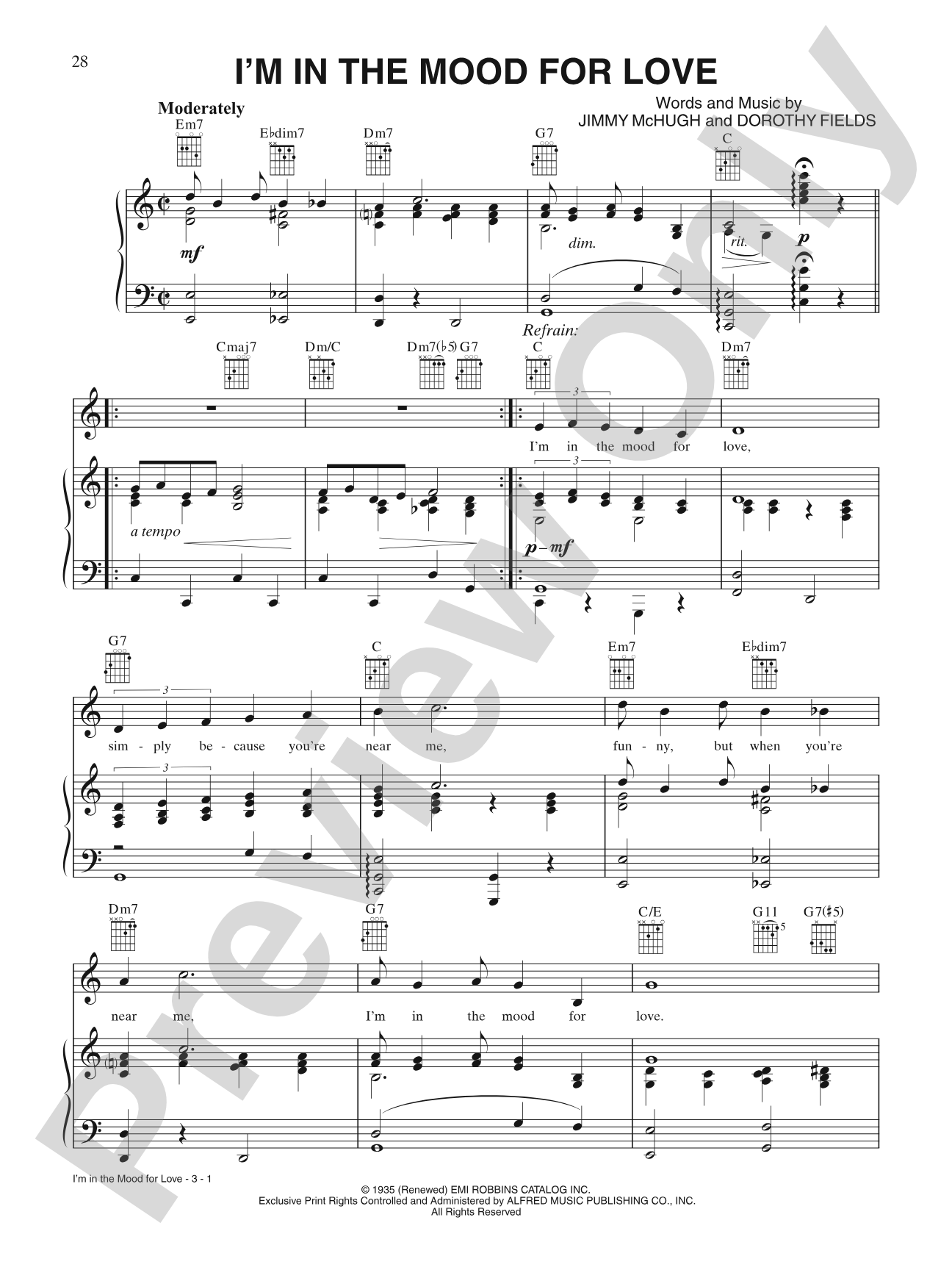

I'm in the Mood for Love: Piano/Vocal/Chords
20 Great American Songbook and Jazz Favorites
Item: 00-PS-0015562
$4.99
One moment…
Related Items
Laura: Piano/Vocal/Chords |
$4.99
|
View | |
The Shadow of Your Smile: Piano/Vocal/Chords |
$4.99
|
View | |
Moonlight Serenade: Piano/Vocal/Chords |
$4.99
|
View | |
Blue Moon: Piano/Vocal/Chords |
$4.99
|
View | |
I Put a Spell on You: Piano/Vocal/Chords |
$4.99
|
View | |
My Man: Piano/Vocal/Chords |
$4.99
|
View | |
Over the Rainbow: Piano/Vocal/Chords |
$4.99
|
View | |
Ain't Misbehavin': Piano/Vocal/Chords |
$4.99
|
View | |
Straighten Up and Fly Right: Piano/Vocal/Chords |
$4.99
|
View | |
Don't Sit Under the Apple Tree (With Anyone Else But Me): Piano/Vocal/Chords |
$4.99
|
View | |
Top-Requested Standards Sheet Music: Piano/Vocal/Guitar Book |
$14.99
|
View |
Description
The crowd-pleasing standards in this sheet music collection belong in every musician's repertoire. This songbook contains 20 piano/vocal arrangements of classic songs that are guaranteed to delight audiences of all ages. Complete lyrics and chord symbols are included. Titles: Ain't Misbehavin' * At Last * Blue Moon * Don't Get Around Much Anymore * Don't Sit Under the Apple Tree * I Put a Spell on You * I'm in the Mood for Love * Laura * Misty * Moonlight Serenade * My Man * Theme from New York, New York * Orange Colored Sky * Over the Rainbow * The Pink Panther * The Shadow of Your Smile * Straighten Up and Fly Right * Take Five * What a Wonderful World * Whatever Lola Wants.


I'm in the Mood for Love: Piano/Vocal/Chords isn't in MakeMusic Cloud just yet...but it could be. Let us know you'd like to see it, and you'll help shape what comes next. In the meantime, start a free trial and dive into thousands of interactive titles your students can play along with today.
Request This Title
Tell us you want it.
Start Your Free Trial
Explore everything that's ready to play right now.
Sample Audio
No sample audio found.
Sample Video
No sample videos found.
Additional Details
Series:
Top-Requested Sheet Music
Publisher:
Alfred Music
Page Count:
80
SKU:
00-PS-0015562
More about this title
About the Composer: Jimmy McHugh
Jimmy McHugh (1894-1969) composed some of the most enduring melodies in American popular music, creating standards that have remained in active performance for nearly a century. His gift for memorable, singable lines paired with sophisticated harmonic language made him a dominant force in Broadway and Hollywood during the 1920s through 1950s, collaborating with lyricists including Dorothy Fields and Irving Mills to produce songs that bridged jazz idioms, pop sensibility, and theatrical craft.
Why we love this
This collection assembles twenty of the most reliable crowd-pleasers in the Great American Songbook, each arranged accessibly for piano with full vocal melody and chord symbols. You get versatile material that works equally well as a recital program, a practice resource for developing singers and pianists, or a foundation for jazz interpretation and improvisation. The breadth here spans multiple styles within the standards repertoire, so you're not locked into a single mood or approach.
What to expect
Stepping into a room where the best of midcentury American songcraft lives. These melodies linger; the harmonies sophisticated but never cold; the emotional range spanning wistful nostalgia, playful charm, torch-song intimacy, and unbridled joy. You're working with material that has proven its staying power across generations of musicians and audiences.
Who it's for
Singers at the intermediate level and beyond who want reliable material for recitals, auditions, or performance classes; pianists seeking to deepen their understanding of American song standards and jazz harmony; and accompanists building a core repertoire of songs that work across multiple performance contexts and vocalist preferences.
How to get the most out of it
- Treat the chord symbols as a blueprint for accompaniment style rather than strict instruction; jazz voicings will feel more authentic than block triads, and the recordings of these songs reward listening before finalizing your arrangement choices.
- Balance vocal line transparency with harmonic interest in the piano part; these songs are built on melody first, so resist the urge to fill every space with accompaniment figures.
- Lyric clarity matters enormously with material this familiar; audiences hear these words through decades of recorded versions, so commit to articulate diction and intentional phrasing rather than rushing through familiar passages.
- Explore the range of tempos these songs can sustain; pieces like 'Misty' and 'The Shadow of Your Smile' reward slower treatment that lets harmonic movement breathe, while 'Straighten Up and Fly Right' and 'Take Five' demand rhythmic precision and groove.
How to use it
Build a full recital around songs from this collection, mixing tempos and emotional textures for shape and variety. Pair these standards with contemporary art songs or classical repertoire to show how American songbook mastery enhances broader musical literacy. Use individual selections as teaching tools for jazz harmony, phrasing, and interpretation study, where students can learn from abundant recorded reference versions.
Skills your students will build
- Reading and interpreting chord symbols in jazz and popular music contexts
- Balancing vocal line projection with piano accompaniment texture
- Understanding harmonic language of the Great American Songbook (ii-V-I progressions, secondary dominants, chromatic voice leading)
- Developing interpretive choices informed by style-specific conventions and recorded tradition
- Sight-reading across treble and bass clefs while maintaining rhythmic ensemble coordination