
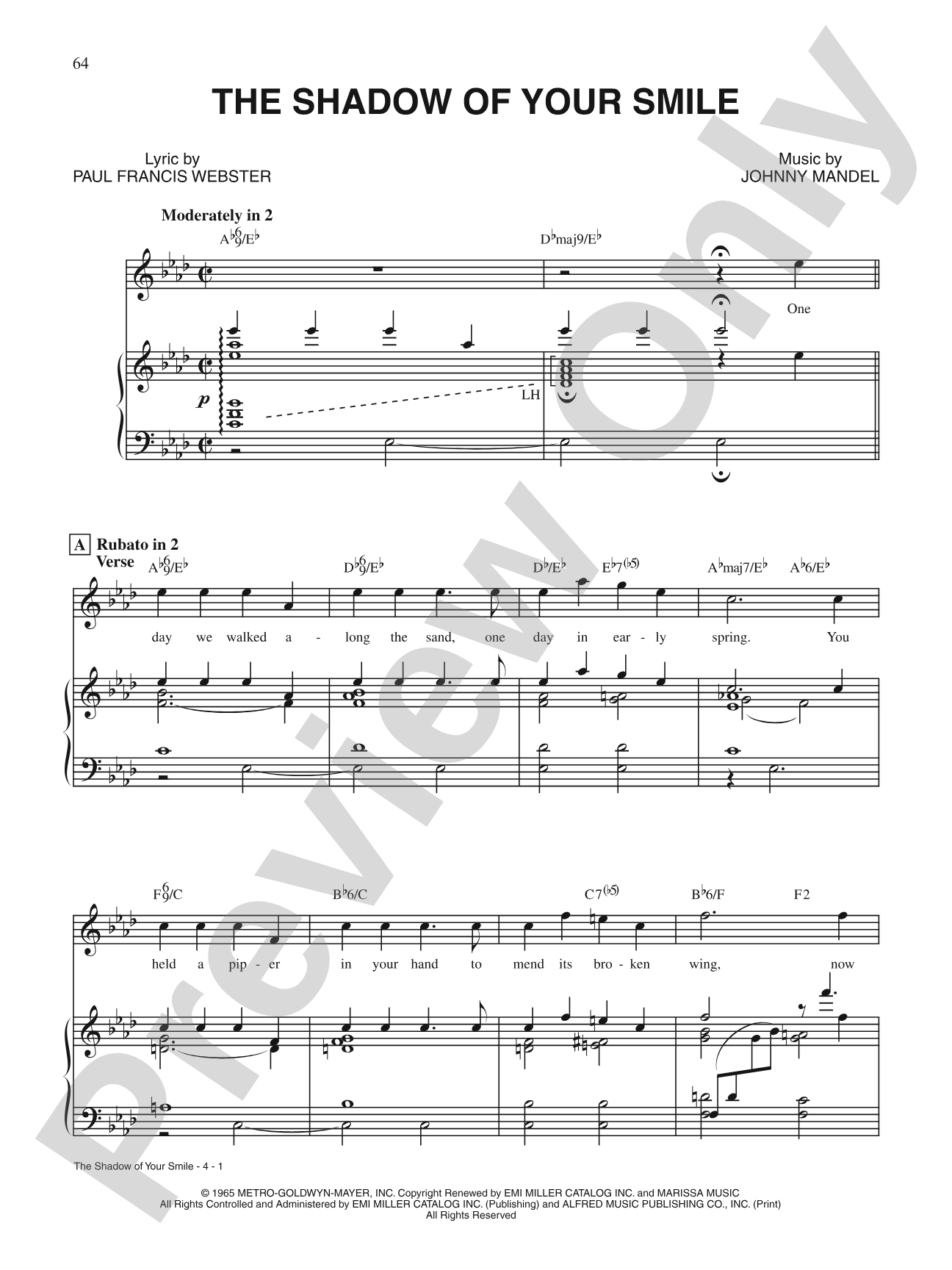

The Shadow of Your Smile: Piano/Vocal/Chords
20 Great American Songbook and Jazz Favorites
Item: 00-PS-0015561
$4.99
One moment…
Related Items
Laura: Piano/Vocal/Chords |
$4.99
|
View | |
I'm in the Mood for Love: Piano/Vocal/Chords |
$4.99
|
View | |
Moonlight Serenade: Piano/Vocal/Chords |
$4.99
|
View | |
Blue Moon: Piano/Vocal/Chords |
$4.99
|
View | |
I Put a Spell on You: Piano/Vocal/Chords |
$4.99
|
View | |
My Man: Piano/Vocal/Chords |
$4.99
|
View | |
Over the Rainbow: Piano/Vocal/Chords |
$4.99
|
View | |
Ain't Misbehavin': Piano/Vocal/Chords |
$4.99
|
View | |
Straighten Up and Fly Right: Piano/Vocal/Chords |
$4.99
|
View | |
Don't Sit Under the Apple Tree (With Anyone Else But Me): Piano/Vocal/Chords |
$4.99
|
View | |
Top-Requested Standards Sheet Music: Piano/Vocal/Guitar Book |
$14.99
|
View |
Description
The crowd-pleasing standards in this sheet music collection belong in every musician's repertoire. This songbook contains 20 piano/vocal arrangements of classic songs that are guaranteed to delight audiences of all ages. Complete lyrics and chord symbols are included. Titles: Ain't Misbehavin' * At Last * Blue Moon * Don't Get Around Much Anymore * Don't Sit Under the Apple Tree * I Put a Spell on You * I'm in the Mood for Love * Laura * Misty * Moonlight Serenade * My Man * Theme from New York, New York * Orange Colored Sky * Over the Rainbow * The Pink Panther * The Shadow of Your Smile * Straighten Up and Fly Right * Take Five * What a Wonderful World * Whatever Lola Wants.


The Shadow of Your Smile: Piano/Vocal/Chords isn't in MakeMusic Cloud just yet...but it could be. Let us know you'd like to see it, and you'll help shape what comes next. In the meantime, start a free trial and dive into thousands of interactive titles your students can play along with today.
Request This Title
Tell us you want it.
Start Your Free Trial
Explore everything that's ready to play right now.
Sample Audio
No sample audio found.
Sample Video
No sample videos found.
Additional Details
Series:
Top-Requested Sheet Music
Publisher:
Alfred Music
Page Count:
80
SKU:
00-PS-0015561
More about this title
About the Composer: Johnny Mandel
Johnny Mandel (1925-2024) shaped the sound of American popular music across seven decades as a composer, arranger, and instrumentalist. His gift for melody and harmonic sophistication earned him four Grammy Awards and an Academy Award nomination for "The Shadow of Your Smile," a tune that exemplifies his elegant approach to songwriting.
Mandel's work spans film scores, television themes, and jazz standards that remain staples in vocal and instrumental repertoire. His arrangements and compositions reveal a deep understanding of what singers and musicians need: singable lines, logical chord progressions, and emotional directness that never sacrifices craft.
Why we love this
This collection gathers 20 standards that audiences recognize instantly, removing the guesswork from programming decisions. The arrangements strike an ideal balance between accessibility for singers and pianists and enough harmonic sophistication to keep advanced musicians engaged. Whether you're building a jazz-standards recital, preparing audition material, or looking for sing-along repertoire that works in mixed ensembles, these versions deliver reliability and style.
What to expect
These arrangements breathe with the ease and confidence of songs that have earned their place in American culture. Whether you land on "Over the Rainbow," "Misty," or "Take Five," you find yourself in territory where melody feels inevitable and harmony speaks without strain. The writing consistently prioritizes emotional clarity and vocal singability, creating performances that feel personal even when the song is heard for the hundredth time.
Who it's for
Vocalists and piano/guitar accompanists preparing recitals, audition books, or church and event performances will find immediate value in this curated set. Musicians working in jazz ensembles or jazz-inflected worship settings can trust these arrangements to read cleanly and sound polished. Community theater musicians, wedding musicians, and anyone building a standards repertoire should keep this collection close at hand.
How to get the most out of it
- Pay close attention to the chord symbols, which often suggest reharmonization beyond basic triads. This notation guides accompanists toward the intended jazz vocabulary and helps guitarists understand voicing options.
- Tempo is everything in these standards. Establish a clear pulse in rehearsal before layering the melody, since many of these songs sit in a narrow range and rely on rhythmic pocket to stay interesting.
- Coordinate with your accompanist on interpretation of swing feels versus straight eighths. Several arrangements (especially the uptempo numbers) hinge on this distinction, so agreement between vocalist and pianist prevents rhythmic disconnect.
- Use the complete lyrics provided to inform phrasing and breath placement. These songs tell stories, and attention to the text shapes how the melody lands with audiences.
How to use it
Program these standards as palate cleansers between heavier classical or contemporary material, or anchor an entire recital around a thematic selection from the collection. Vocal studios can assign individual songs as recital audition choices, since the variety in tempo, style, and mood ensures every student finds something suited to their voice and interpretation. Use the uptempo numbers ("Straighten Up and Fly Right," "Take Five") to energize community performances and mixed-voice events.
Skills your students will build
- Interpreting jazz chord symbols and recognizing altered and extended harmonies
- Balancing lyrical phrasing with rhythmic accuracy in swing and jazz contexts
- Coordinating vocal and instrumental parts across different harmonic interpretations
- Understanding the relationship between standards arrangements across voice types and instrumental combinations
- Managing tempo and dynamic contrast within the American Songbook idiom