
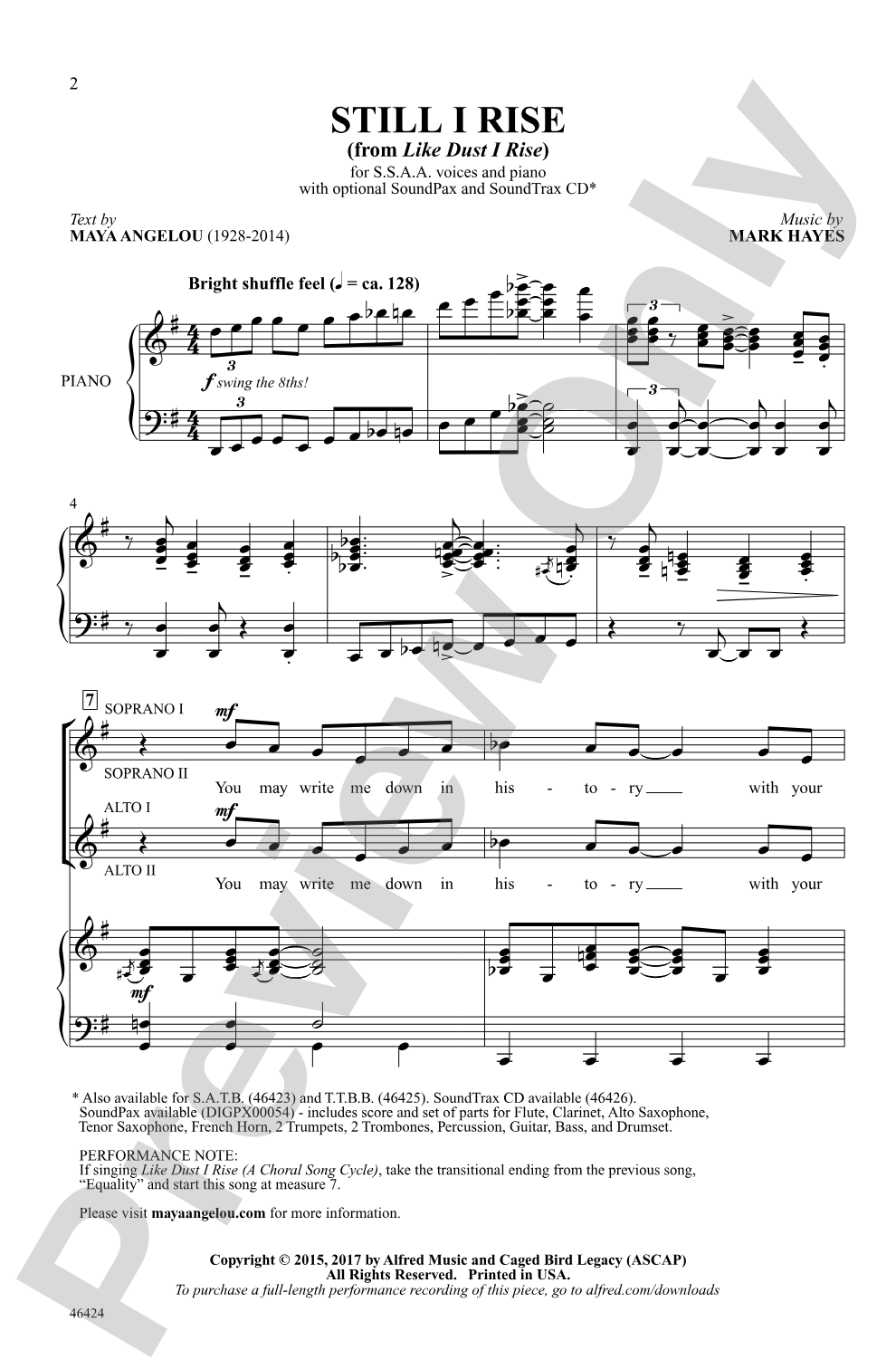
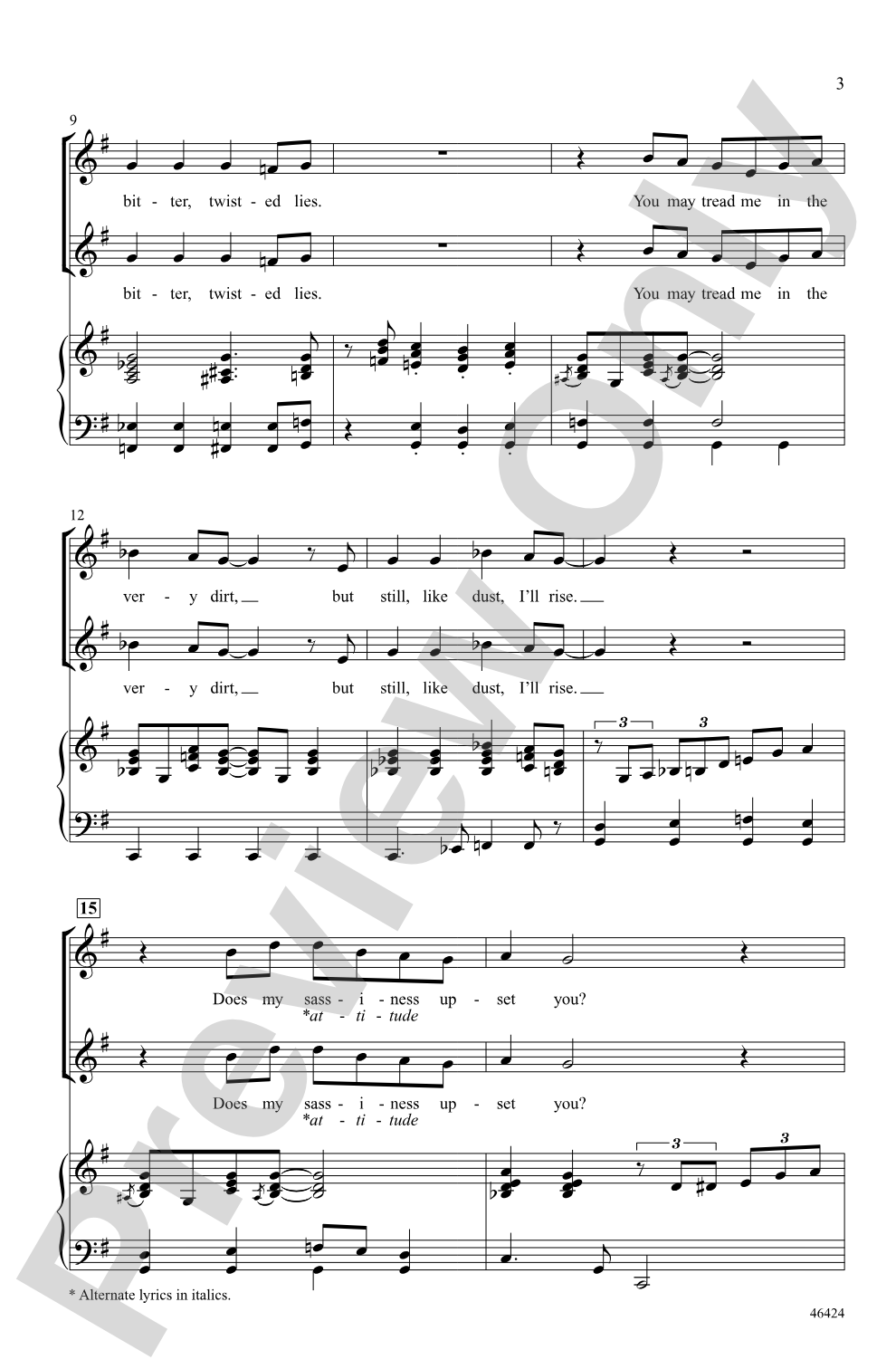
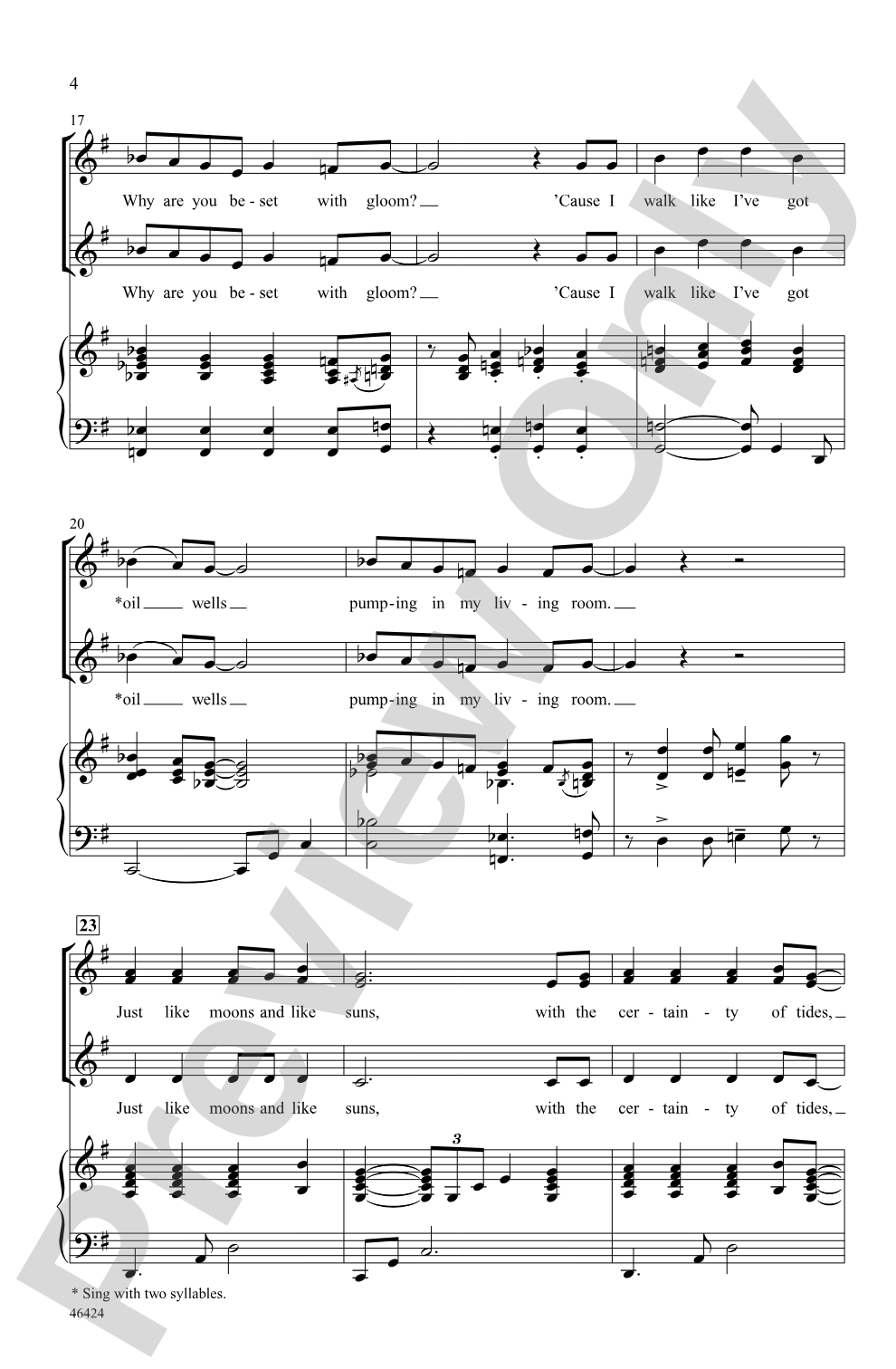

Still I Rise: SSAA Choral Octavo
From Like Dust I Rise (A Choral Song Cycle)
Text by Maya Angelou, music by Mark Hayes
Item: 00-PO-0005660
$2.00
Minimum order quantity: 20 copies
Pickup currently not available
Related Items
Still I Rise: SoundTrax Digital Audio Download |
$29.99
|
View | |
Still I Rise: SATB Choral Octavo |
$2.00
|
View | |
Still I Rise: TTBB Choral Octavo |
$2.00
|
View | |
Still I Rise: Choral SoundPax |
$50.00
|
View | |
Still I Rise: SATB Choral Octavo |
$2.00
|
View | |
Still I Rise: SSAA Choral Octavo |
$2.00
|
View | |
Still I Rise: TTBB Choral Octavo |
$2.00
|
View | |
Still I Rise: Choral Octavo SoundTrax CD |
$29.99
|
View | |
Still I Rise: Choral SoundPax |
$50.00
|
View |
Description
Maya Angelou's most popular poem about triumph over adversity comes brilliantly to life in this vivid setting by Mark Hayes. The bright shuffle tempo and bluesy piano riffs perfectly embody Angelou's strength, courage, and determination to rise above. One of the most uplifting choral selections of our time! This is the final movement from the song cycle Like Dust I Rise.


Still I Rise: SSAA Choral Octavo isn't in MakeMusic Cloud just yet...but it could be. Let us know you'd like to see it, and you'll help shape what comes next. In the meantime, start a free trial and dive into thousands of interactive titles your students can play along with today.
Request This Title
Tell us you want it.
Start Your Free Trial
Explore everything that's ready to play right now.
Sample Audio
1
Audio File
--:--
2
SATB Recording
--:--
Audio File
0:00
0:00
Sample Video
Additional Details
Series:
Alfred Choral Designs
Publisher:
Alfred Music
Page Count:
16
SKU:
00-PO-0005660
More about this title
About the Composer: Mark Hayes
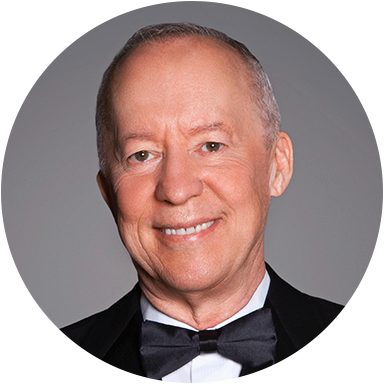
Mark Hayes has composed, arranged, and conducted over 1,750 published works across classical, sacred, and popular styles. A summa cum laude graduate in Piano Performance from Baylor University, he has guest conducted at Lincoln Center, the National Cathedral, and Carnegie Hall, and received the 2010 Award for Exemplary Leadership in Christian Music from Baylor University Center for Christian Music Studies.
Beyond the concert hall, Hayes has shaped musical theater and film, orchestrating the musical Madame Buttermilk and composing the score for Civil War Voices, which won six awards at the Midtown International Theatre Festival. His primary devotion remains the piano, with over 100 piano books in publication spanning gospel, classical, jazz, and Broadway. He conducted the world premiere of his Requiem at Lincoln Center in 2013 and later presented it at the Vatican's Festival Pro Musica E Arte Sacra in Rome.
Why we love this
Hayes captures the defiant, unshakeable spirit of Angelou's verse without sentimentality. The shuffle rhythm and bluesy accompaniment patterns ground the piece in contemporary musical language while the SSAA voicing remains accessible to most high school and college choirs, making this both musically sophisticated and genuinely singable.
What to expect
Bright and propulsive, with the kind of rhythmic drive that makes singers sit forward in their chairs. The blues-inflected harmony and shuffle tempo create an atmosphere of quiet strength and determination, transforming Angelou's words into a musical statement that feels both celebratory and purposeful.
Who it's for
High school and college treble choirs seeking repertoire that speaks to resilience and social meaning. This setting works equally well for concert choirs with strong vocal blend and for educational settings where students benefit from engaging with text of genuine literary and historical weight.
How to get the most out of it
- Lean into the shuffle groove as a rhythmic anchor rather than a decorative element. This piece demands a sense of swing and forward motion that lifts it above straightforward block chords.
- Shape phrases to follow the poem's logic and emotional arc rather than musical phrase marks alone. Angelou's text demands intentional weight and deliberate pacing.
- Balance the piano accompaniment so it remains rhythmically present without overshadowing the choir. The bluesy riffs should dialogue with the voices, not dominate them.
- Encourage uniformity of vowel shape among the SAA sections so the three-voice texture reads as unified even when the parts move independently.
How to use it
Position this as a second-half opener or program finale where its momentum and uplifting message can reset the emotional tenor of a concert. It pairs well with other contemporary works on themes of equity and justice, or stands alone as a centerpiece statement piece for a concert devoted to American voices and literature.
Skills your students will build
- Maintaining steady shuffle rhythm and syncopation across ensemble
- Singing independent lines while supporting overall harmonic blend
- Text interpretation and emotional communication in contemporary settings
- Balancing rhythm section accompaniment with choral sound
- Ensemble awareness across three independent voice parts