
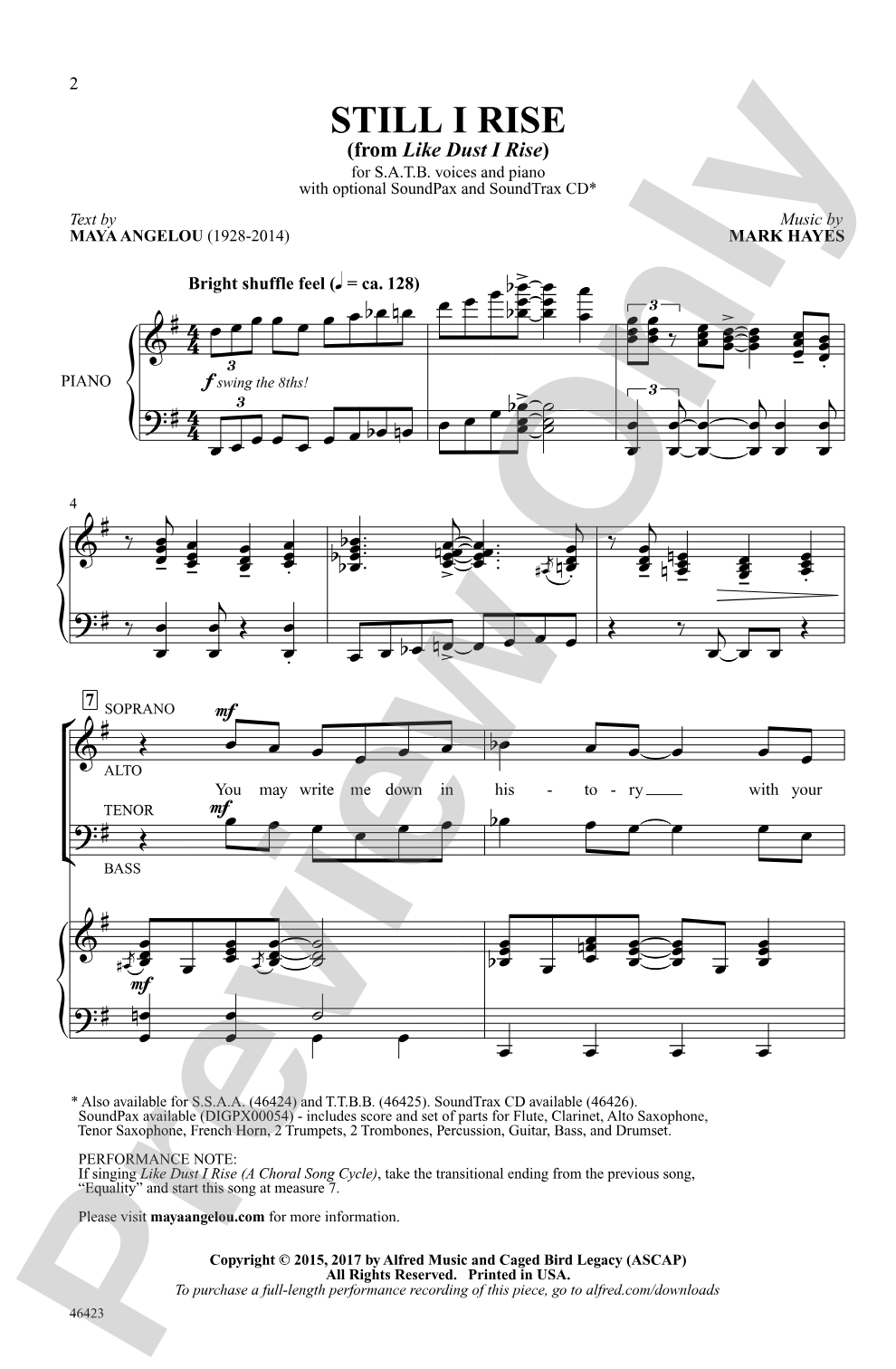
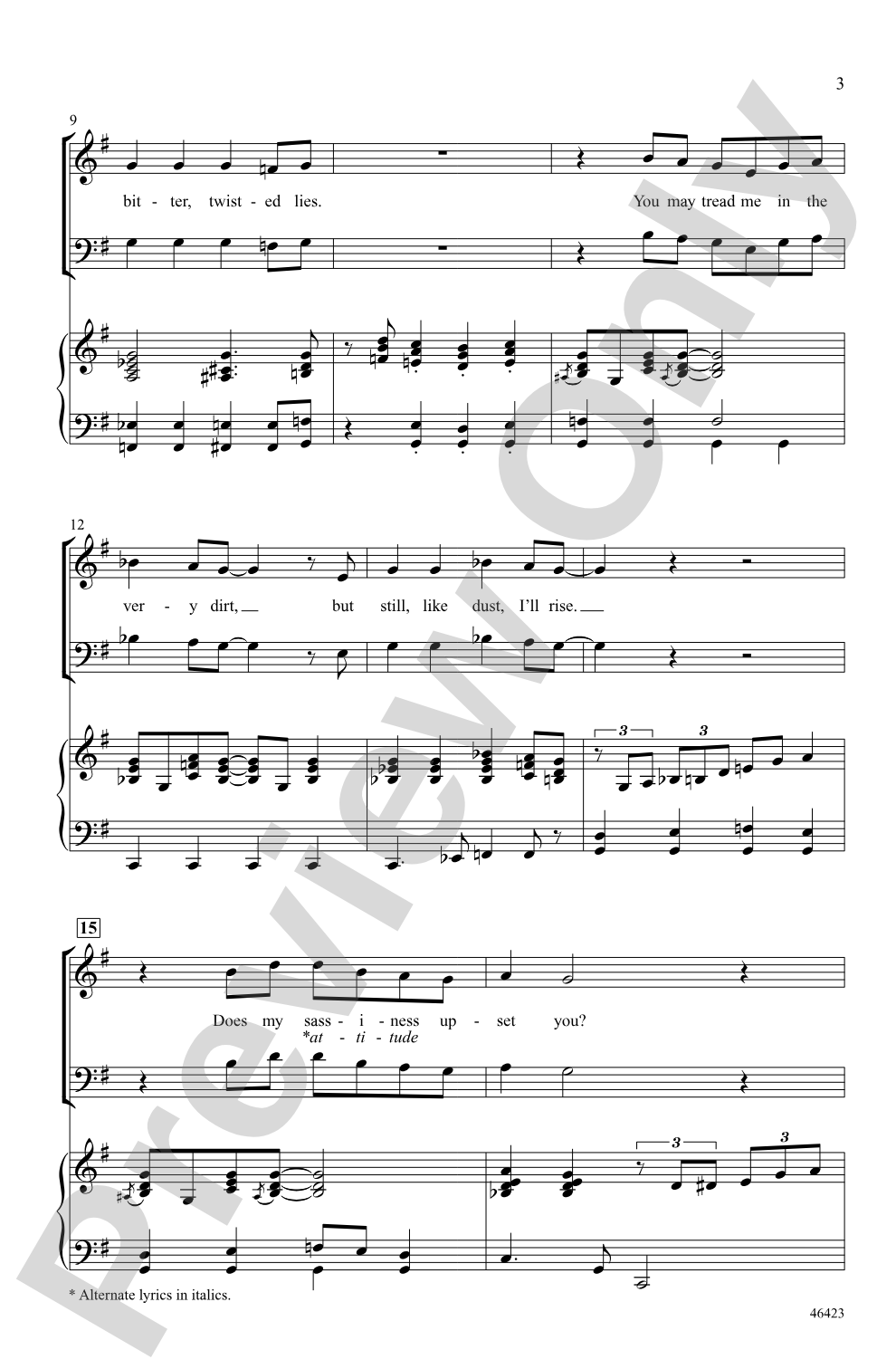
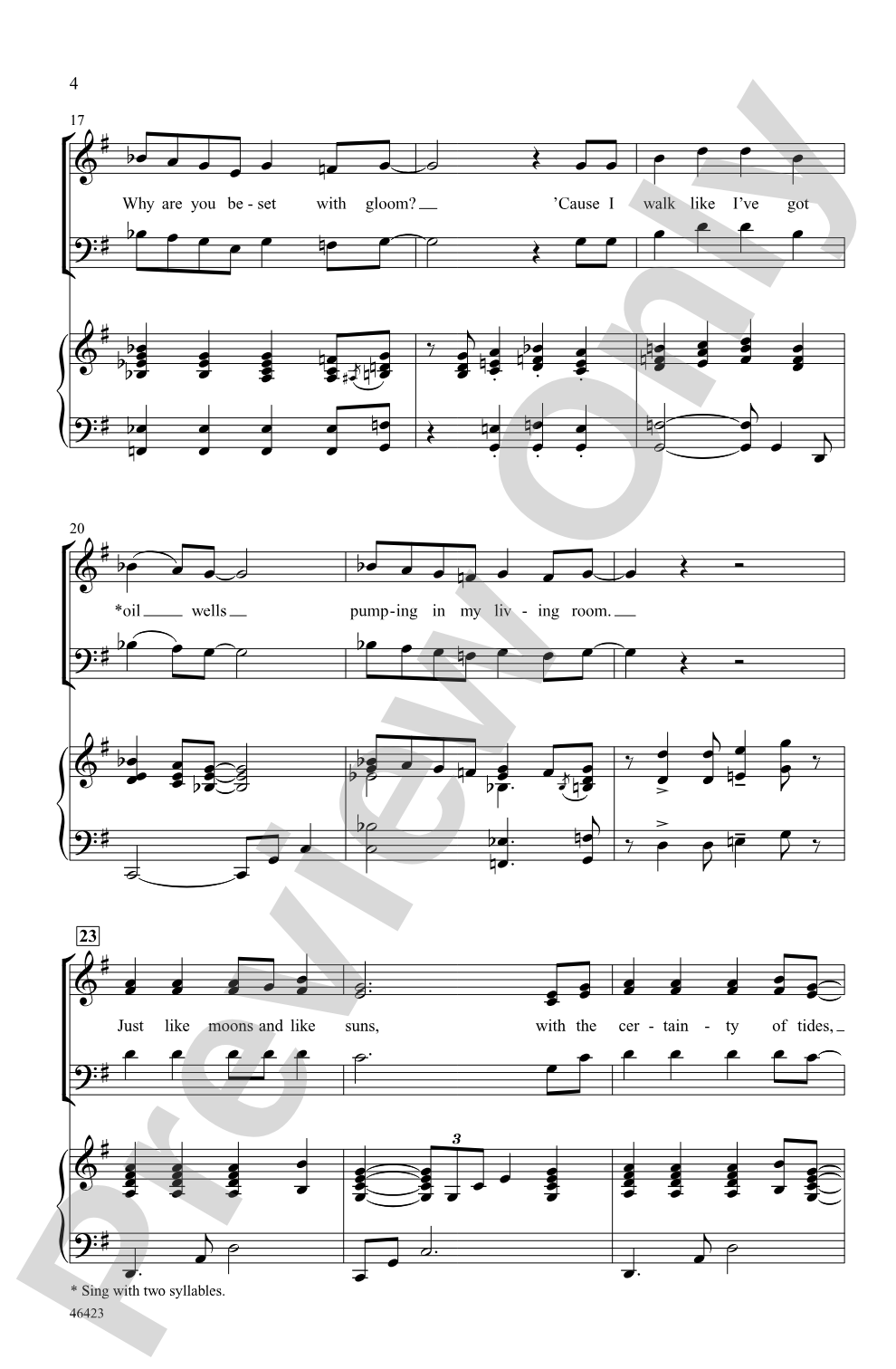

Still I Rise: SATB Choral Octavo
From Like Dust I Rise (A Choral Song Cycle)
Text by Maya Angelou, music by Mark Hayes
Item: 00-PO-0005659
$2.00
Minimum order quantity: 20 copies
Pickup currently not available
Related Items
Still I Rise: SoundTrax Digital Audio Download |
$29.99
|
View | |
Still I Rise: SSAA Choral Octavo |
$2.00
|
View | |
Still I Rise: TTBB Choral Octavo |
$2.00
|
View | |
Still I Rise: Choral SoundPax |
$50.00
|
View | |
Still I Rise: SATB Choral Octavo |
$2.00
|
View | |
Still I Rise: SSAA Choral Octavo |
$2.00
|
View | |
Still I Rise: TTBB Choral Octavo |
$2.00
|
View | |
Still I Rise: Choral Octavo SoundTrax CD |
$29.99
|
View | |
Still I Rise: Choral SoundPax |
$50.00
|
View |
Description
Maya Angelou's most popular poem about triumph over adversity comes brilliantly to life in this vivid setting by Mark Hayes. The bright shuffle tempo and bluesy piano riffs perfectly embody Angelou's strength, courage, and determination to rise above. One of the most uplifting choral selections of our time! This is the final movement from the song cycle Like Dust I Rise.


Still I Rise: SATB Choral Octavo isn't in MakeMusic Cloud just yet...but it could be. Let us know you'd like to see it, and you'll help shape what comes next. In the meantime, start a free trial and dive into thousands of interactive titles your students can play along with today.
Request This Title
Tell us you want it.
Start Your Free Trial
Explore everything that's ready to play right now.
Sample Audio
1
Audio File
--:--
2
SATB Recording
--:--
Audio File
0:00
0:00
Sample Video
Additional Details
Series:
Alfred Choral Designs
Publisher:
Alfred Music
Page Count:
16
SKU:
00-PO-0005659
More about this title
About the Composer: Mark Hayes
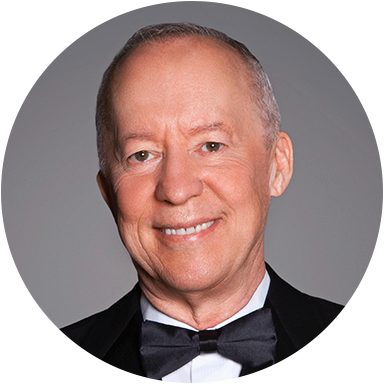
Mark Hayes has established himself as a prolific composer with over 1,750 published works spanning sacred and secular genres. His training began at Baylor University, where he earned a Bachelor of Music degree summa cum laude in Piano Performance in 1975, and his career has taken him to some of the world's most prestigious venues: he has guest conducted at Lincoln Center, the National Cathedral, and Carnegie Hall, and premiered his Requiem at both Lincoln Center in 2013 and St. Ignatius Basilica in Rome in 2014 as part of a Vatican-sponsored festival.
Beyond the concert hall, Hayes has worked extensively in musical theater, orchestrating the musical Madame Buttermilk and arranging scores for theatrical productions that have earned major festival awards. His deepest passion remains piano writing; he has published over 100 piano books that range across gospel, classical, jazz, and Broadway idioms. In recognition of his sustained contributions to Christian music education, Baylor University awarded him the Award for Exemplary Leadership in Christian Music in 2010.
Why we love this
Hayes captures the essence of Angelou's message not through oversimplification but through sophisticated musical language: the shuffle rhythm and bluesy piano writing create immediate energy while the SATB voicing allows each section its moment to claim agency. The setting honors the text's power without prettifying it, making this an ideal choice for choirs that want to program socially conscious literature with musical depth and accessibility.
What to expect
Bright, propulsive energy meets quiet defiance. The shuffle tempo drives forward with optimism, while the blues-inflected harmonies add soulfulness and depth; together they create a soundscape that feels both celebratory and grounded in real human struggle. Angelou's words about rising above gain musical weight through Hayes's refusal to make them sentimental.
Who it's for
This octavo serves choirs at intermediate to advanced levels who are prepared to engage with meaningful text and rhythmic vitality. It works well for ensembles seeking contemporary settings of literary work and for programs that celebrate resilience, social justice, and human dignity.
How to get the most out of it
- Lock the rhythm section (piano and any rhythm instruments) to the shuffle pulse early in rehearsal; this rhythmic foundation will anchor the full ensemble's sense of forward motion.
- Balance the piano riffs so they support rather than overpower the voices; Hayes's bluesy writing should complement, not compete with, the choir's articulation of the text.
- Shape phrases around Angelou's syntax rather than strictly at bar lines; let the poetry's natural breathing inform where voices find moments of release and renewal.
- Use the recorded accompaniment to establish the shuffle feel in early rehearsals, then gradually move toward a cappella or reduced accompaniment moments if your ensemble is ready to own the rhythm collectively.
How to use it
Position this as a centerpiece for a concert exploring themes of courage and transformation, where it can sit alongside both classical and contemporary works that examine human resilience. It also functions powerfully as a finale, leaving audiences with an affirming and energized close to an evening of music.
Skills your students will build
- Maintaining shuffle rhythm and swing feel in a choral context
- Balancing rhythmic independence across voice parts
- Connecting poetic text to musical gesture and phrasing
- Blending blues-influenced harmonic language with traditional SATB voicing