
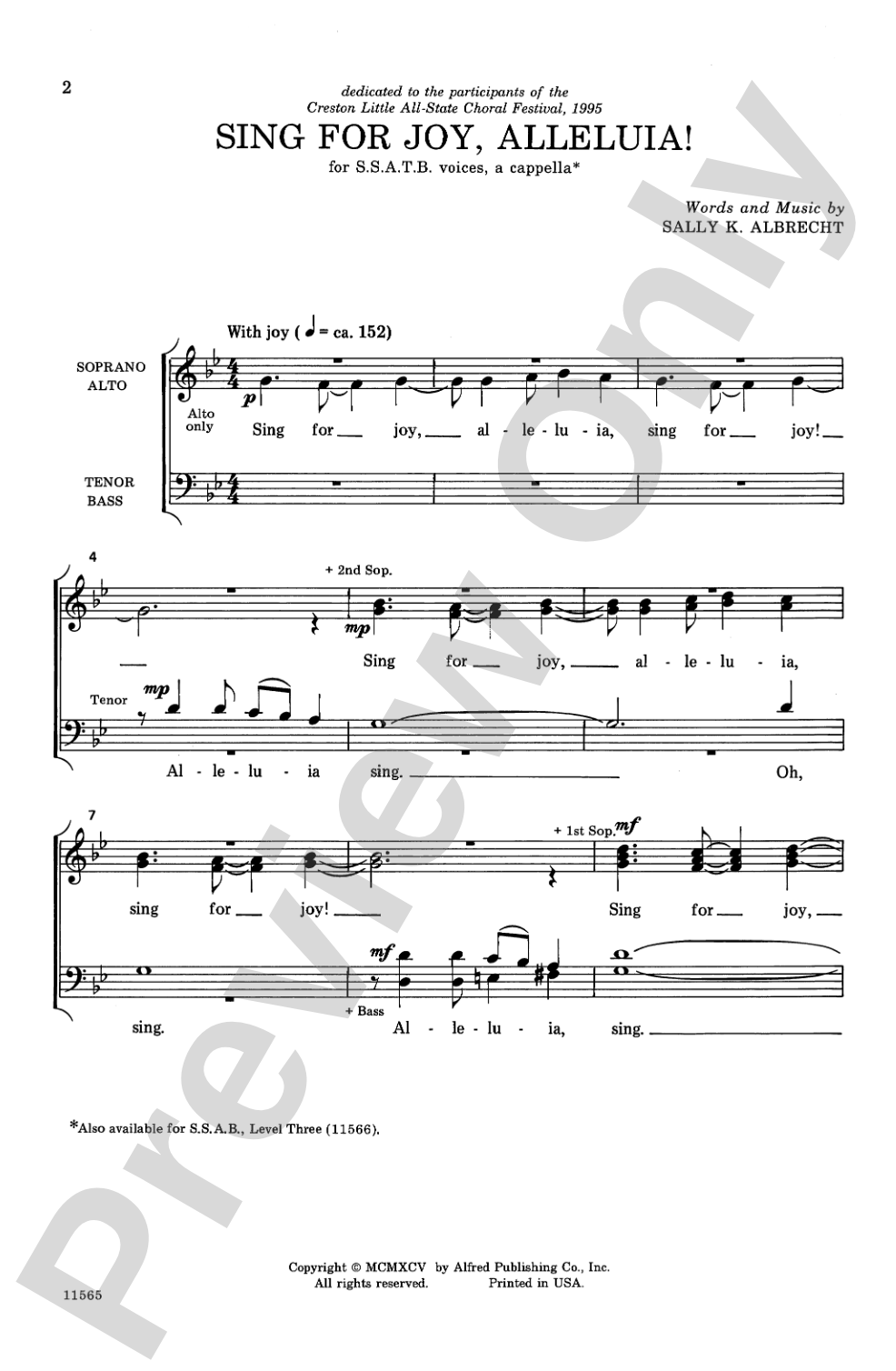

Sing for Joy, Alleluia!: SSATB, a cappella Choral Octavo
Music by Sally K. Albrecht
Item: 00-PO-0002844
$2.25
Minimum order quantity: 20 copies
Pickup currently not available
Description
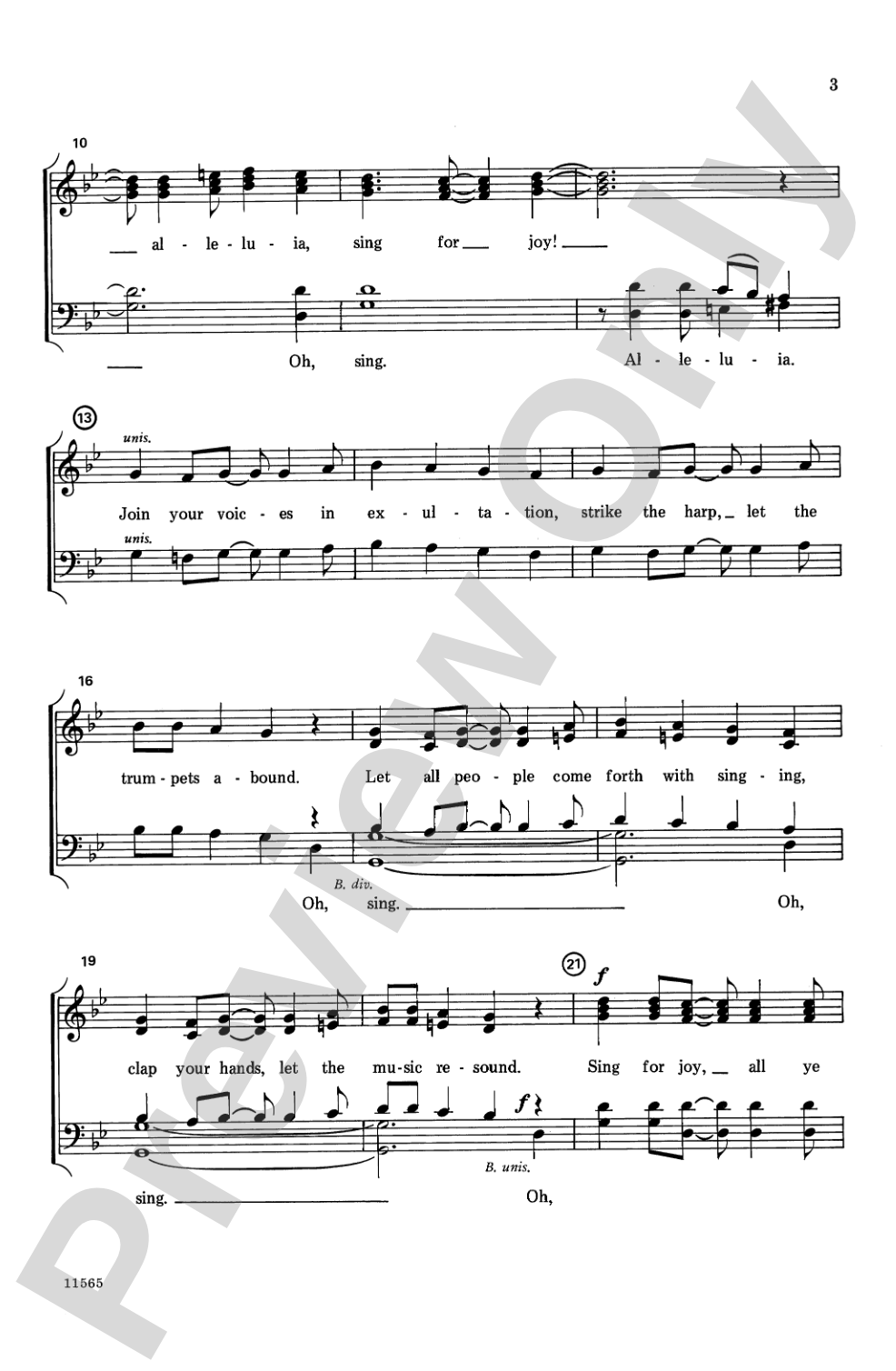
This full-sounding choral work with a driving, rhythmic intensity may be performed a cappella or with the piano doubling the voices. ABA form makes for quick learning. Secular text is perfect for school chorals . . . and a great festival work, too. Note: The SSAB edition is excellent for choirs with few men.


Sing for Joy, Alleluia!: SSATB, a cappella Choral Octavo isn't in MakeMusic Cloud just yet...but it could be. Let us know you'd like to see it, and you'll help shape what comes next. In the meantime, start a free trial and dive into thousands of interactive titles your students can play along with today.
Request This Title
Tell us you want it.
Start Your Free Trial
Explore everything that's ready to play right now.
Sample Audio
No sample audio found.
Sample Video
No sample videos found.
Additional Details
Series:
Alfred Archive Edition: Alfred Choral Designs
Publisher:
Alfred Music
Page Count:
8
SKU:
00-PO-0002844
More about this title
About the Composer: Sally K. Albrecht

Sally K. Albrecht has shaped choral music education for over thirty years, first as Director of School Choral, Vocal, and Elementary Publications at Alfred Music, and through her prolific output of more than 600 published choral works. Her compositions have been performed at major venues including Lincoln Center, Carnegie Hall, and The Kennedy Center, where she has frequently conducted honor choirs and led festival clinics across the country. An ASCAP award winner since 1987, she brings both compositional craft and deep pedagogical understanding to everything she writes.
Albrecht holds degrees from Rollins College (B.A. in Music and Theater, 1976), the University of Miami (M.A. in Drama, 1977, and M.M. in Accompanying, 1979), and has taught at Oakland University, Jersey City State College, and Meredith College. She is particularly known for her innovative integration of movement into choral performance, a hallmark of her teaching and composition philosophy. In 2021, she received the Distinguished Alumna Award from both the University of Miami Frost School of Music and Rollins College.
Why we love this
Albrecht crafts a piece that sounds mature and energetic without demanding advanced vocal technique or complex harmonic language. The ABA form ensures your ensemble locks the music quickly, and that driving rhythmic momentum carries rehearsals forward. Directors consistently choose her work when they need something that sings fully in five parts yet remains accessible enough for mixed-ability school choirs.
What to expect
Rhythmically propulsive and joyful, this piece channels celebratory energy through its driving pulse and full five-part texture. The text and musical character combine to create an uplifting, accessible work that feels modern without sacrificing accessibility or warmth.
Who it's for
School and community choirs looking for contemporary sacred music that sits comfortably in a secular concert context. This octavo works equally well for choirs with full SATB sections or those adapting to available voice parts, since the scoring supports flexible casting while maintaining a full harmonic sound.
How to get the most out of it
- Establish a steady pulse from the opening and maintain consistent rhythmic energy throughout; the piece's power comes from precision and drive, not from slowing down to accommodate parts.
- If performing with piano doubling, ensure the accompaniment supports without overwhelming; the voices should remain the primary focus.
- Shape the middle section (B section) with a slight dynamic contrast to highlight the form and give singers a chance to refresh before the return.
- Balance the SSATB voicing by listening for the two soprano parts independently during rehearsal; clear separation between soprano 1 and soprano 2 lines keeps the texture from muddying.
How to use it
Program this as an opener or a closing number in concerts where you want immediate musical impact and audience engagement. Its secular text and celebratory character make it ideal for spring festivals, holiday programs, or community choral events where you're mixing sacred and secular repertoire.
Skills your students will build
- Maintaining rhythmic precision in ensemble while managing five independent voice parts
- Balancing independent soprano lines within a divisi texture
- Reading and performing ABA form with intentional structural awareness
- Singing full, resonant vowels in rapid-fire rhythmic passages