
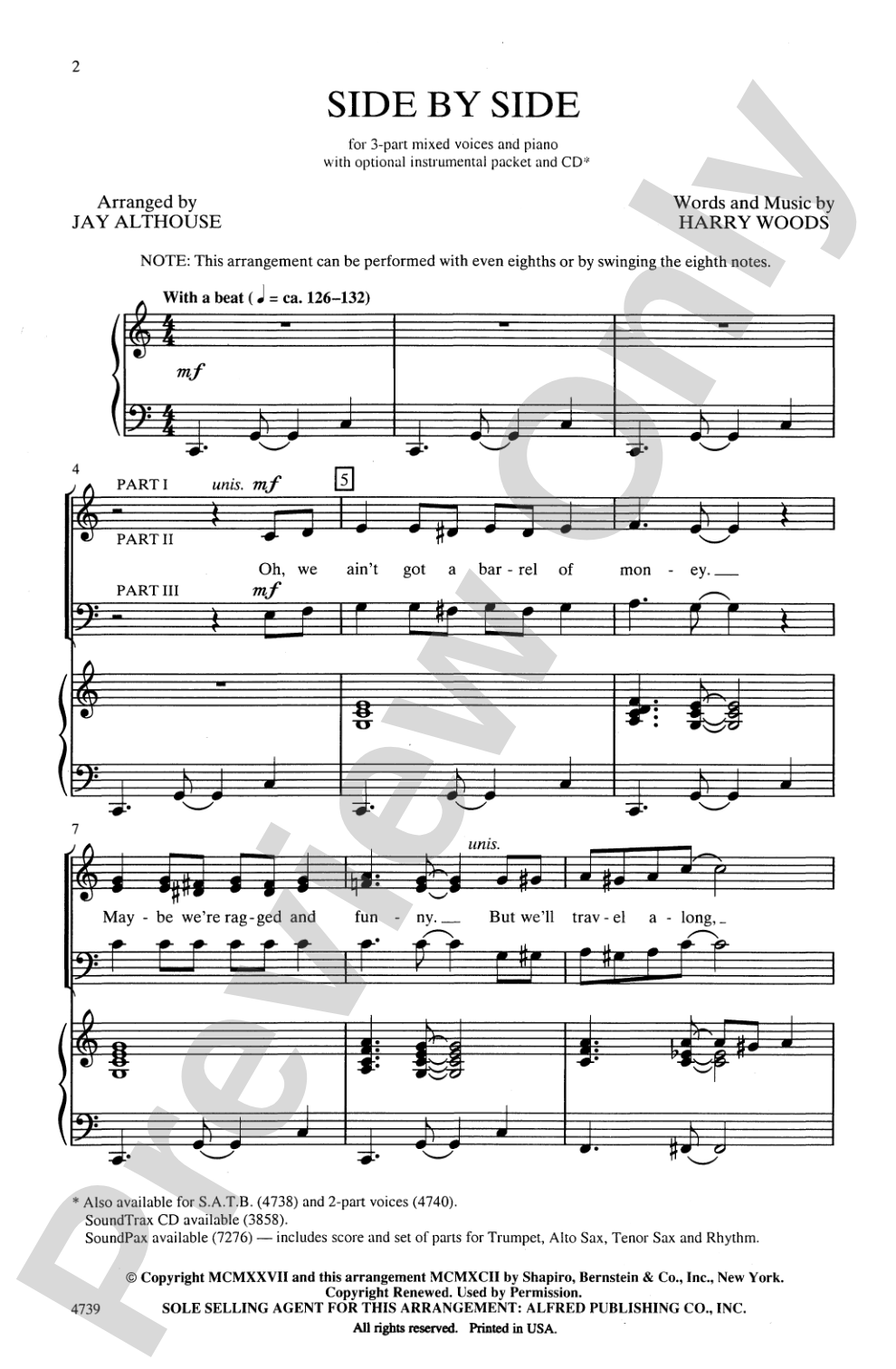
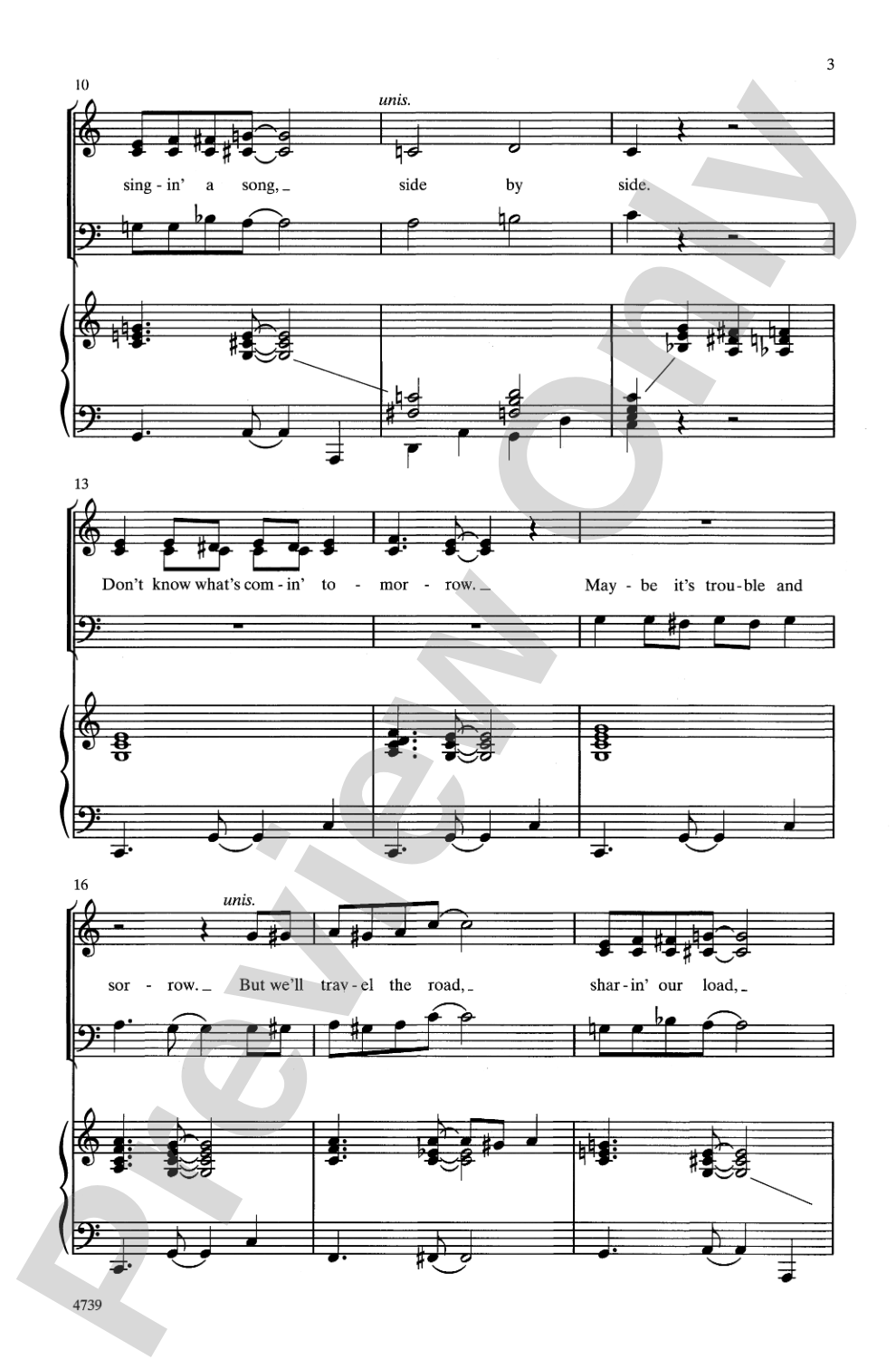

Side by Side: 3-Part Mixed Choral Octavo
Arr. Jay Althouse
Item: 00-PO-0004445
$2.25
Minimum order quantity: 20 copies
Pickup currently not available
Related Items
Side by Side: SATB Choral Octavo |
$2.25
|
View | |
Side by Side: 2-Part Choral Octavo |
$2.25
|
View | |
Side by Side: Choral SoundPax |
$15.00
|
View | |
Side by Side: SATB Choral Octavo |
$2.25
|
View | |
Side by Side: 3-Part Mixed Choral Octavo |
$2.25
|
View | |
Side by Side: 2-Part Choral Octavo |
$2.25
|
View | |
Side by Side: Choral Octavo SoundTrax CD |
$27.99
|
View | |
Side by Side: Choral SoundPax |
$15.00
|
View |
Description
A unique arrangement of one of the all-time great friendship songs . . . unique because it can be performed with a swing beat OR with even eighth notes. The straightforward treatment means it's easy-to-learn in just a few rehearsals so it's perfect for the beginning . . . or the end . . . of the school year. A good choice for movement.


Side by Side: 3-Part Mixed Choral Octavo isn't in MakeMusic Cloud just yet...but it could be. Let us know you'd like to see it, and you'll help shape what comes next. In the meantime, start a free trial and dive into thousands of interactive titles your students can play along with today.
Request This Title
Tell us you want it.
Start Your Free Trial
Explore everything that's ready to play right now.
Sample Audio
1
Audio File
--:--
0:00
0:00
Sample Video
No sample videos found.
Additional Details
Series:
Alfred Archive Edition: Alfred Choral Designs
Publisher:
Alfred Music
Page Count:
8
SKU:
00-PO-0004445
More about this title
About the Arranger: Jay Althouse

Jay Althouse holds degrees in Music Education and Music from Indiana University of Pennsylvania, where he was later honored with the Distinguished Alumni award. His eight-year tenure as a rights and licenses administrator for a major educational music publisher gave him deep insight into what choirs need and how music reaches classrooms. He served on the Executive Board of the Music Publishers Association of America during this period.
As a composer, Althouse has over 800 choral works in print across all levels, performed widely throughout English-speaking countries. He is an ASCAP writer member and a consistent recipient of the ASCAP Special Award. Beyond composing, he has co-written children's musicals with Sally K. Albrecht, compiled respected vocal solo collections, co-authored the best-selling The Complete Choral Warm-up Book and Accent on Composers, and created classroom resources including Ready to Read Music and One-Page Composer Bios. He co-wrote I Hear America Singing, performed by the San Francisco Girls and Boys Choirs at President Barack Obama's 2009 Inauguration. Althouse resides in Wake Forest, North Carolina, and serves on the National Advisory Board of the Folk Art Society of America.
Why we love this
Althouse gives directors real flexibility here by offering two distinct rhythmic interpretations of the same arrangement. You can shape this to match your ensemble's strength and your concert vision without reworking the part-writing. The straightforward voice leading means even a newer choir learns the parts quickly, freeing rehearsal time for musical refinement rather than note-bashing.
What to expect
Warm and inclusive, this arrangement captures the essence of a classic anthem of togetherness. Whether you lean into swing feel or keep the eighth notes flowing evenly, the three-part writing sits comfortably in all voices, creating a sound that feels accessible and celebratory rather than demanding.
Who it's for
Beginning choirs and experienced ensembles alike benefit from this arrangement. It works for groups that need confidence-building material before a major concert, groups wanting a short learning project late in the year, or any choir seeking an uplifting piece that celebrates friendship and connection.
How to get the most out of it
- Decide your rhythmic approach before the first rehearsal and commit to it. The swing versus straight-eighth choice affects articulation, phrasing, and the overall character, so announce the version clearly and let singers know what to expect.
- Build the three-part texture gradually during rehearsals. Start with the melody line, add the second part, then layer in the bass. This scaffolding approach works especially well when teaching quickly before a performance deadline.
- Use the recorded accompaniment to anchor intonation during early rehearsals. Let singers hear the harmonic context and their place in it, then gradually reduce reliance on the track as confidence grows.
- Integrate staging or movement early rather than as an afterthought. The piece's friendly message invites physical expression, and rehearsing the vocal line alongside gestures or positioning creates stronger performer engagement.
How to use it
Program this as a concert opener to set a positive, welcoming tone, or close with it to send the audience out feeling connected. It pairs well in a set devoted to peace, brotherhood, or celebration themes, and its brief length makes it ideal for assembly performances, community events, or transitional moments in a larger choral concert.
Skills your students will build
- Flexibility in rhythmic interpretation (swing versus straight eighth-note feel)
- Three-part voice balance and intonation in mixed voicing
- Quick part-learning and memorization
- Integration of movement or staging with vocal performance