
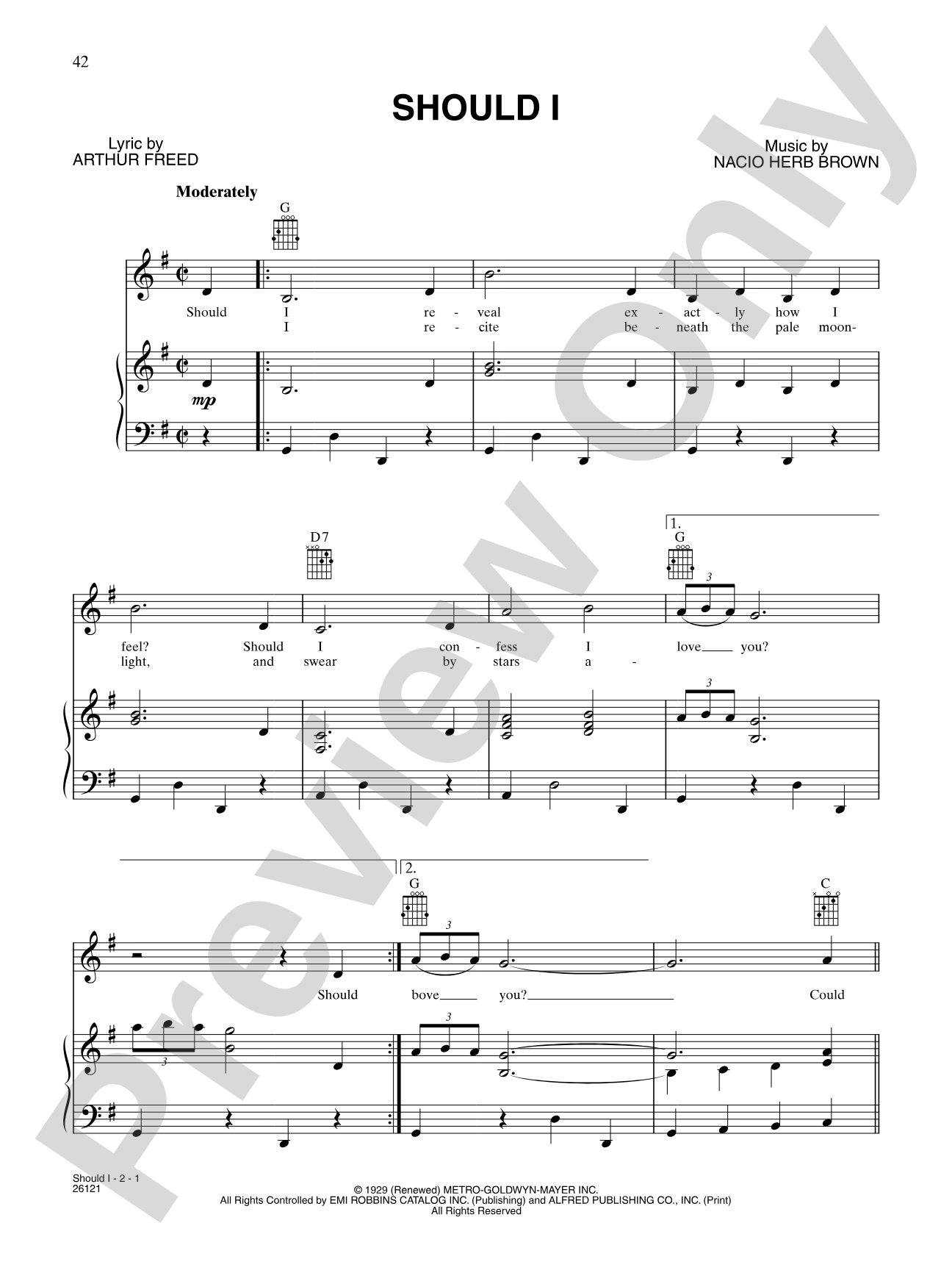

Should I? (from "Singin' in the Rain"): Piano/Vocal/Chords
Item: 00-PSP-000152
$4.99
One moment…
Related Items
All I Do Is Dream Of You (from "Singin' in the Rain"): Piano/Vocal/Chords |
$4.99
|
View | |
Broadway Melody (from "Singin' in the Rain"): Piano/Vocal/Chords |
$4.99
|
View | |
Broadway Rhythm (from "Singin' in the Rain"): Piano/Vocal/Chords |
$4.99
|
View | |
Good Morning (from "Singin' in the Rain"): Piano/Vocal/Chords |
$4.99
|
View | |
I've Got A Feelin' You're Foolin' (from "Singin' in the Rain"): Piano/Vocal/Chords |
$4.99
|
View | |
Make 'em Laugh (from "Singin' in the Rain"): Piano/Vocal/Chords |
$4.99
|
View | |
Moses (from "Singin' in the Rain"): Piano/Vocal/Chords |
$4.99
|
View | |
Temptation (from "Singin' in the Rain"): Piano/Vocal/Chords |
$4.99
|
View | |
Would You (from "Singin' in the Rain"): Piano/Vocal/Chords |
$4.99
|
View | |
You Are My Lucky Star (from "Singin' in the Rain"): Piano/Vocal/Chords |
$4.99
|
View | |
You Were Meant For Me (from "Singin' in the Rain"): Piano/Vocal/Chords |
$4.99
|
View | |
Singin' in the Rain: Deluxe 50th Anniversary Edition: Piano/Vocal/Chords Book |
$14.99
|
View |
Description
Alfred is pleased to release Singin' in the Rain: Deluxe 50th Anniversary Edition.
Singin' in the Rain, starring classic film stars Gene Kelly, Donald O'Conner, and Debbie Reynolds, is considered one of the best musicals ever made. This book features music from the movie, providing the lyrics along with piano and chord arrangements for all the songs included.
Titles: All I Do Is Dream of You * Broadway Melody * Broadway Rhythm * Fit As a Fiddle (And Ready for Love) * Good Morning * I've Got a Feeling Your Foolin' * Make 'Em Laugh * Moses * Should I * Singin' in the Rain * Temptation * The Wedding of the Painted Doll * Would You? * You Are My Lucky Star * You Were Meant for Me.


Singin' in the Rain, starring classic film stars Gene Kelly, Donald O'Conner, and Debbie Reynolds, is considered one of the best musicals ever made. This book features music from the movie, providing the lyrics along with piano and chord arrangements for all the songs included.
Titles: All I Do Is Dream of You * Broadway Melody * Broadway Rhythm * Fit As a Fiddle (And Ready for Love) * Good Morning * I've Got a Feeling Your Foolin' * Make 'Em Laugh * Moses * Should I * Singin' in the Rain * Temptation * The Wedding of the Painted Doll * Would You? * You Are My Lucky Star * You Were Meant for Me.
Should I? (from "Singin' in the Rain"): Piano/Vocal/Chords isn't in MakeMusic Cloud just yet...but it could be. Let us know you'd like to see it, and you'll help shape what comes next. In the meantime, start a free trial and dive into thousands of interactive titles your students can play along with today.
Request This Title
Tell us you want it.
Start Your Free Trial
Explore everything that's ready to play right now.
Sample Audio
No sample audio found.
Sample Video
No sample videos found.
Additional Details
Publisher:
Alfred Music
Page Count:
68
SKU:
00-PSP-000152
More about this title
About the Composer: Arthur Freed
Arthur Freed (1894-1973) was one of Hollywood's most prolific and influential lyricists, shaping the golden age of movie musicals during the 1930s through 1950s. Working alongside composers like Nacio Herb Brown, he created some of the most enduring songs in American musical theatre, crafting lyrics that served the narrative while remaining singable and memorable for audiences. His work established a template for musical theatre songwriting that prioritized clarity, emotional directness, and theatrical impact.
Why we love this
This selection from the 50th Anniversary Edition captures one of cinema's most beloved scores in an accessible piano/vocal format. The arrangement gives singers and pianists a chance to inhabit songs already shaped by Hollywood brilliance, with chord symbols that invite improvisation and reharmonization. It's a rewarding pairing for voice students who benefit from material with genuine dramatic context and melodies that sit naturally in the voice.
What to expect
Stepping into the world of 1950s Hollywood glamour and unbridled joy. These songs carry an optimism and theatrical directness that feels refreshing; the melodies are generous and vocally satisfying, while the harmonic language sits squarely in the tradition of American song craft without requiring pianists to navigate extreme technical demands.
Who it's for
Pianists accompanying singers, voice students building a musical theatre repertoire, and performers preparing audition or recital material drawn from classic film. This works equally well for serious music students and community theatre participants who want professional-quality arrangements without oversimplification.
How to get the most out of it
- Notice the rhythmic swing of the accompaniment patterns; let them breathe rather than rushing the tempo. The beauty of these songs lives in space and relaxation.
- Treat the lyrics as conversational. These are songs designed to sound like characters thinking aloud, not belt-heavy production numbers.
- Use the chord symbols as a starting point for exploring your own comping style on piano. The printed arrangement provides a guide, not a mandate.
- Check the recording from the film to hear how the melody sits in the original context; this often clarifies phrasing choices that notation alone won't show.
How to use it
Program individual songs from this collection in a musical theatre showcase, a cabaret-style recital, or a concert celebrating American songbook standards. The page count and variety of moods make it possible to build an entire concert from this single source, or to select one or two pieces that fit alongside classical art song or contemporary musical theatre selections.
Skills your students will build
- Interpreting melody within a narrative context
- Reading and voicing chord symbols on piano
- Singing with clarity and conversational phrasing in a popular music idiom
- Understanding harmonic conventions of mid-century American musical theatre
- Coordinating piano accompaniment with vocal line in standard lead-sheet notation